
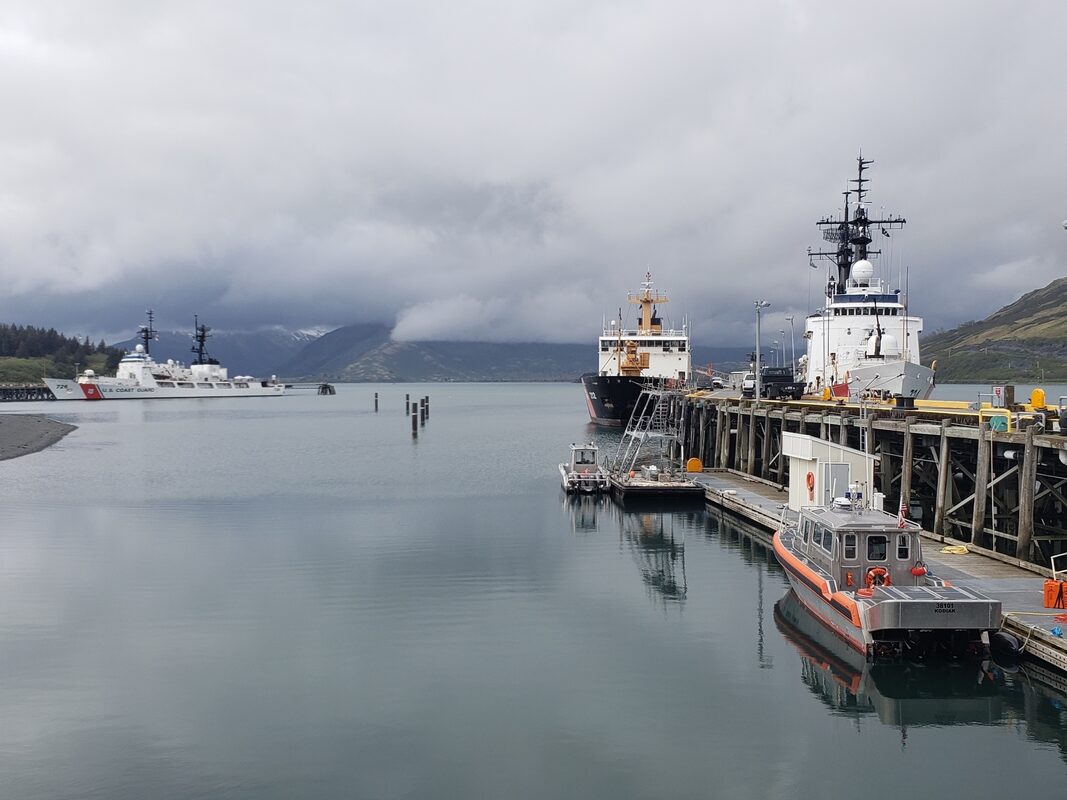
Coast Guard cutters stationed in Alaska are getting a rebuilt waterfront that can keep pace with the service's growing footprint in the Arctic. The Coast Guard announced Sept. 23 that it awarded a $315 million contract on Sept. 11 to Tutor Perini Corp. to design and build a new fuel pier and major cutter mooring at Base Kodiak. The pier is designed to take fuel deliveries by tank barge, standard for the region, and to berth up to two major cutters at a time, according to gCaptain and The Maritime Executive, which both reported on the award.
What the $315 Million Buys at Base Kodiak
The contract covers more than a new dock. The Coast Guard says the project includes waterfront grading and ground stabilization, a new fueling utility building, cutter shore-tie connections, and water, sewage and IT infrastructure. The scope also includes unexploded-ordnance removal at the work site, a cost that construction on former military waterfront sites often carries but that rarely shows up in a project's headline description. The Coast Guard expects the work to be complete by fall 2030, a four-year build timeline that reflects both the scale of the waterfront work and the logistical challenge of running a major construction project in southern Alaska.
The upgrade is arriving alongside a broader shift in what the Coast Guard expects Kodiak to do. The service said in June it will homeport its first two Arctic Security Cutters there, with a third planned for Seward once supporting infrastructure is ready; the first Arctic Security Cutter is due for delivery in 2028. That buildout is proceeding while the Coast Guard's existing icebreaker fleet is stretched thin: the medium icebreaker Healy has been sidelined in Seattle since a July engineering casualty forced the service to cancel its planned 2026 high-latitude summer mission, leaving the newer cutter Storis to cover more of the gap. A modern fuel pier and mooring at Kodiak is part of the infrastructure the incoming Arctic Security Cutters will need once they arrive.
The four-year build window also says something about the site itself. Kodiak is not a base the Coast Guard can shut down while construction crews work; cutters still have to fuel, moor and rotate through the installation throughout the project. Sequencing waterfront grading, a new fueling building and shore-tie work around live operations, on top of the unexploded-ordnance sweep, is part of why the fall 2030 completion date sits so far out from the September 2026 award date.
How the Coast Guard Is Paying for a Four-Year Rebuild
The award blends three separate funding streams rather than drawing on a single appropriation: the 2022 Infrastructure Investment and Jobs Act, FY2023 Major Acquisition Systems Infrastructure funds, and FY2025 budget reconciliation funding, according to gCaptain and The Maritime Executive. The reconciliation piece traces back to the One Big Beautiful Bill Act, which set aside $4.4 billion for rebuilding Coast Guard shoreside facilities nationwide, including $300 million earmarked specifically for a new icebreaker homeport in Alaska, The Maritime Executive reported. That OBBBA funding pool for the Coast Guard is due to expire in late 2029 — a deadline that helps explain why the service is moving on Kodiak's waterfront now rather than waiting for a single infrastructure appropriation to cover the full $315 million.
Why the Coast Guard Is Tying the Pier to Arctic Strategy
Coast Guard Commandant Adm. Kevin Lunday framed the Kodiak project as part of the service's broader Arctic posture rather than a routine facilities upgrade. "This contract represents a major investment in the infrastructure that supports Coast Guard crews and families in Alaska," Lunday said. "Modernizing Base Kodiak's waterfront delivers the capabilities we need to be ready and carry out the missions to secure our northern border and maritime approaches in the Arctic."
Alaska's congressional delegation, which says it helped secure funding for the project, framed the award in similar terms. "The historic build-up of the Coast Guard in Alaska and Kodiak continues today with $315 million coming for shoreside infrastructure projects in this great Coast Guard community," Sen. Dan Sullivan said, according to Your Alaska Link. Sen. Lisa Murkowski added that the new fuel pier "will also allow for the berthing of two Arctic Security Cutters" and "bolsters Base Kodiak's capability to carry out Coast Guard missions in the Arctic."
That language reflects a shift underway across the Coast Guard's Alaska posture. The service is trying to expand its Arctic presence at the same time its icebreaker fleet is thin and its newest cutters are still years from delivery, so shore infrastructure that can support longer, more frequent cutter deployments out of Kodiak becomes one of the few levers the Coast Guard can pull in the meantime. A fuel pier that can't keep pace with cutter operations becomes a limiting factor on how often and how far north the Coast Guard can actually operate, regardless of how many ships it has in its fleet.
What It Means for Contractors
The award adds a major, multiyear Arctic infrastructure job to Tutor Perini's federal backlog, and it isn't the company's first at Kodiak this year: in May, the Coast Guard awarded Tutor Perini two additional task orders worth a combined $143.4 million for 30 family housing units and a new child development center at the same base, gCaptain reported. Between the two awards, Tutor Perini has picked up close to $460 million in Coast Guard work at Kodiak in 2026 alone. For other contractors, the structure of the funding is instructive: the Coast Guard is stitching together IIJA, acquisition-account and reconciliation dollars rather than waiting on a single line item, and it's doing so against a $4.4 billion OBBBA shoreside-facilities pool that expires in 2029. Firms chasing Coast Guard shore-infrastructure work in Alaska should expect more blended-funding awards on a similar timeline as the service works through a shore-facilities backlog that stretches well beyond Kodiak.
