
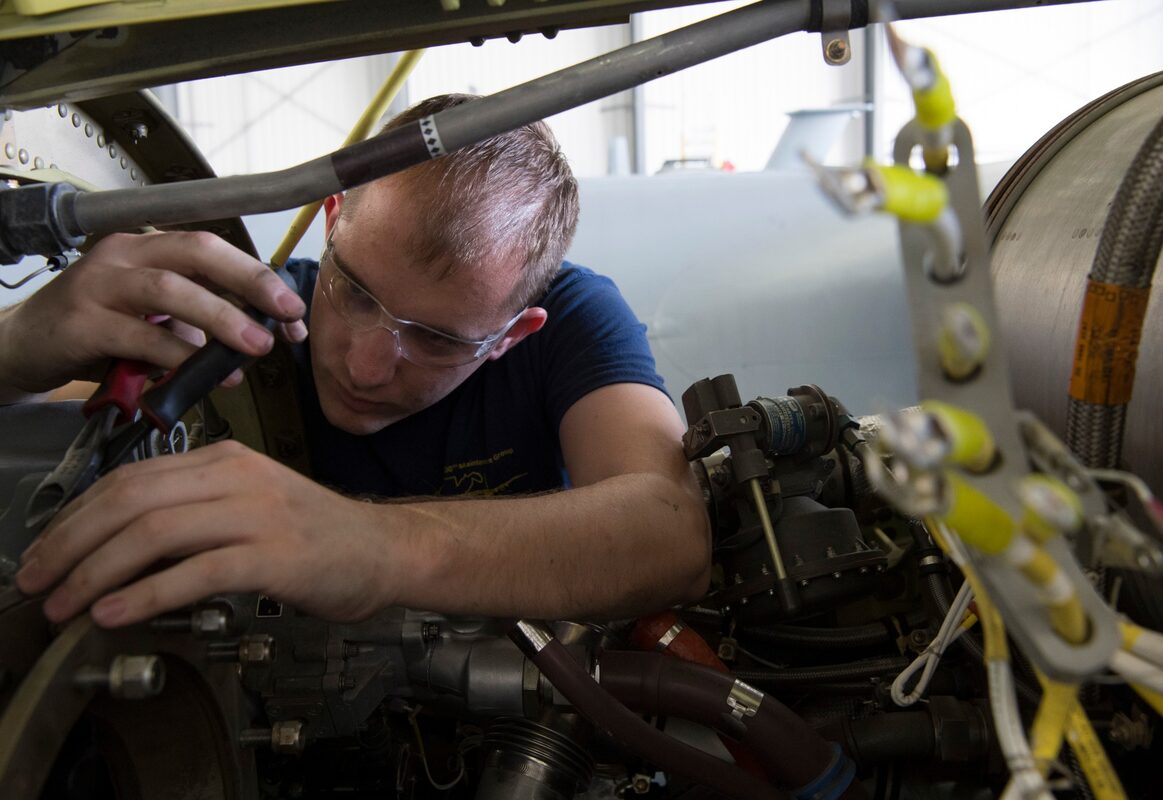
The Air Force has spread a single sustainment award across three engine shops, handing Segers Aero Corp., Standard Aero (San Antonio) Inc., and Turbopower LLC a shared indefinite-delivery/indefinite-quantity contract with a ceiling of $343,201,556 to repair and overhaul parts for the T56 engine that powers the C-130. The Department of War disclosed the deal in its contracts announcement for July 23, 2026, listing the Air Force Sustainment Center at Tinker Air Force Base, Oklahoma, as the awarding activity and a performance period stretching to July 22, 2036.
Background
The Rolls-Royce (formerly Allison) T56 turboprop is one of the longest-serving military engines in the world. It entered service in the 1950s and still turns the four propellers on the C-130 Hercules, the tactical airlifter that anchors airlift, aeromedical evacuation, and special-mission fleets across dozens of air forces. Because the airframe and its engine have stayed in production and in service for so long, the sustainment tail behind them is enormous: worn compressor and turbine sections, gearboxes, and hot-section hardware come off the line constantly and must be inspected, repaired, or overhauled to airworthiness standards before returning to a wing.
That work sits with the Air Force Sustainment Center, the Air Force Materiel Command organization at Tinker AFB that manages depot maintenance and the supply chain for aging weapon systems. Rather than run every T56 component repair in-house, the center buys "non-commercial" part repair and overhaul from qualified vendors under long-running IDIQ vehicles. The new award replaces expiring capacity with a decade-long ceiling and, notably, splits the requirement among three firms instead of concentrating it in one, preserving competition at the task-order level and hedging against any single shop's backlog or capacity limits.
The three awardees are established propulsion repair specialists. Segers Aero Corp. operates from Fairhope, Alabama; Standard Aero (San Antonio) Inc. works out of San Antonio, Texas; and Turbopower LLC is based in Opa-locka, Florida. The contract also names Winnipeg, Canada, among the performance locations, reflecting the cross-border footprint of the engine's overhaul base. Spreading a ten-year requirement across shops in three states and one allied country gives the sustainment center depth: if one facility slips on schedule, capacity or a design change, the others can absorb the workload without a stop-work on the fleet.
Key Details
The vehicle is a firm-fixed-price, indefinite-delivery/indefinite-quantity service contract with a combined ceiling of $343,201,556. The scope is the repair and overhaul of non-commercial aircraft parts for the T56 engine used on C-130 aircraft. The Air Force acquired it competitively and received three offers, meaning each named firm will draw work through individual delivery or task orders issued over the life of the deal.
Work runs through July 22, 2036, a full ten-year horizon, and will be performed at the three U.S. sites plus Winnipeg, Canada. The awarding and contracting activity is the Air Force Sustainment Center at Tinker AFB, Oklahoma.
The most striking element is the foreign customer base. The requirement supports foreign military sales to 29 partner nations, a list that spans nearly every region where the C-130 flies: Argentina, Austria, Brazil, Chile, Colombia, Ecuador, Egypt, France, Greece, Indonesia, Israel, Japan, Jordan, Korea, Malaysia, Mexico, the Netherlands, Pakistan, the Philippines, Poland, Portugal, Romania, Saudi Arabia, Singapore, South Africa, Taiwan, Thailand, Tunisia, and Türkiye. Under FMS, the U.S. government contracts for the repairs and the partner governments reimburse the cost, so the ceiling covers both U.S. Air Force depot demand and a large slice of allied Hercules sustainment routed through the same vendors.
The Pentagon listing assigns each shop its own contract number — Segers Aero under FA8121-26-D-B001, Standard Aero (San Antonio) under FA8121-26-D-B002, and Turbopower under FA8121-26-D-B003 — and describes the effort as the "T56 joint follow-on contract," the successor to the prior sustainment vehicle. Only $1,500 in fiscal 2026 working capital funds, $500 per awardee, was obligated at the time of award, with the balance of the ceiling to be committed on individual delivery and task orders as repairs are ordered.
What It Means for Contractors
The structure of this award is the lesson. The Air Force did not pick a single prime; it qualified three engine shops onto one ceiling and will make them compete order by order. For sustainment vendors, that is the increasingly common shape of depot-adjacent work: winning a seat on the vehicle is the entry ticket, but revenue depends on staying price-competitive and keeping turnaround times low across a ten-year run. A slot on a shared IDIQ is a pipeline, not a guarantee.
The heavy FMS content is the second signal. With nearly 30 partner nations feeding parts into the same three shops, demand is diversified well beyond U.S. budget cycles, and a firm positioned in legacy turboprop overhaul gains exposure to a global installed base that shows no sign of retiring soon. C-130 variants remain in production and in front-line service worldwide, which means the T56 repair tail is a durable, recurring line of business rather than a program with a fixed sunset. An FMS-heavy vehicle also carries administrative weight worth pricing in, because partner-nation reimbursement, case management, and export controls add process on top of the repair itself.
For smaller firms, the takeaway is that specialized repair capability still wins federal work on its own merits. All three awardees are focused propulsion overhaul houses rather than large integrators, and the competitive, three-offer outcome shows the Air Force actively wants multiple qualified sources for hard-to-source legacy parts. Companies with certified repair processes for aging engine hardware, and the throughput to service both U.S. and allied fleets, are the ones the sustainment enterprise is buying. The cross-border performance footprint, with Winnipeg named alongside the U.S. sites, also shows that qualified capacity in an allied country can sit inside a U.S. depot vehicle when the engine's overhaul base is genuinely international.
Finally, the ten-year period of performance is worth weighing against near-term proposals. A 2036 completion date locks in a stable demand signal, and vendors deciding where to invest in tooling, certifications, and workforce for legacy propulsion can treat this vehicle as evidence that the T56 and the C-130 will keep flying, and keep needing parts, well into the next decade.
