
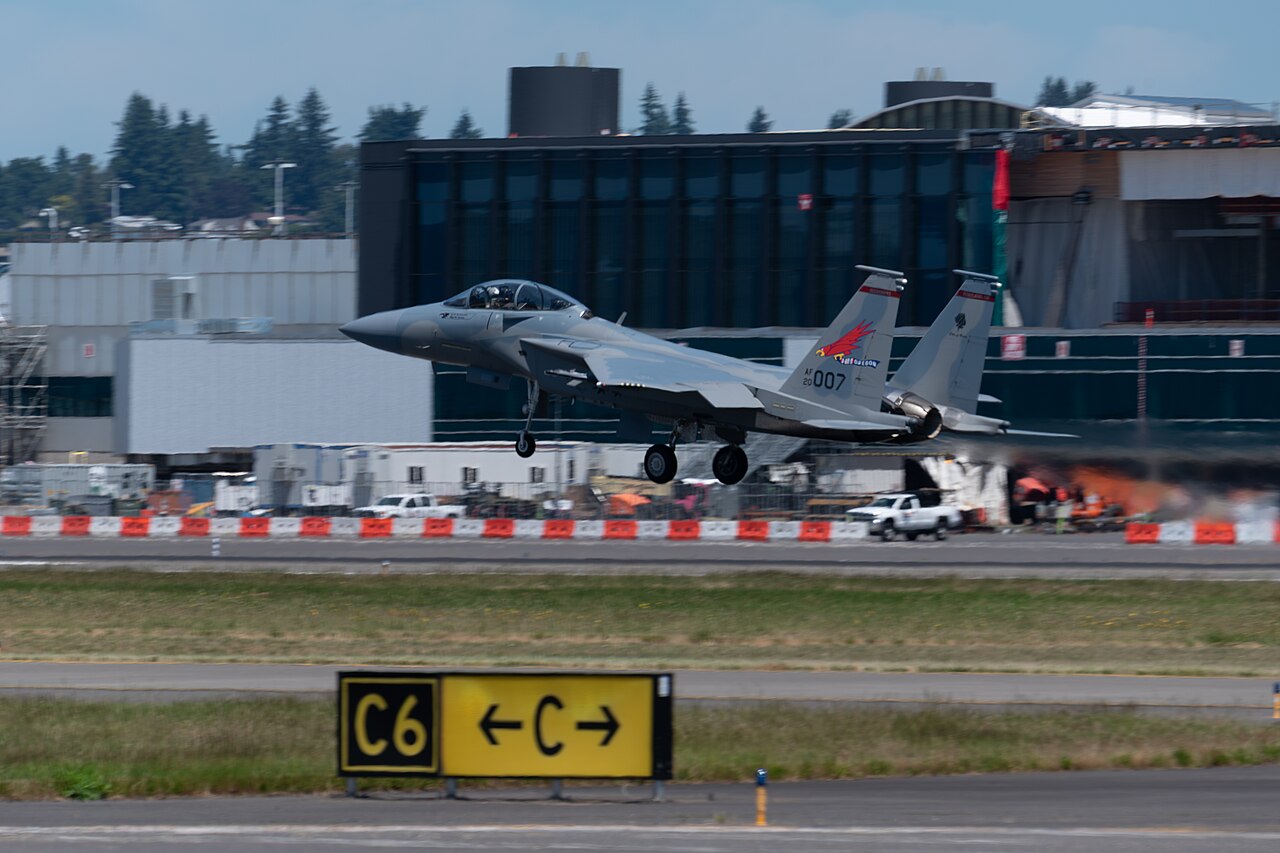
The Air Force has locked in another 22 F-15EX Eagle II fighters for Boeing's St. Louis line, and it did so ahead of the fiscal-year deadline on money that would otherwise have been cut. Defense News reported that the service tapped Boeing for a $2.38 billion Lot 7 contract, using funds from the congressionally provided reconciliation package to keep procurement moving before the fiscal year deadline.
Defense News published its report on Sept. 30, 2026, the last day of the fiscal year. The Air Force did not put a price on the deal in its own release. Boeing disclosed the $2.38 billion figure in a separate company release, according to Defense News. ExecutiveGov, which covered the award on Oct. 1, likewise reported Boeing's valuation of the award at $2.38 billion for 22 aircraft.
Why Did the Air Force Have to Close the F-15EX Deal by Sept. 30?
The deadline came from the money itself. According to Defense News, the Lot 7 funding came from the 2026 budget and a subsequent reconciliation package, titled One Big Beautiful Bill, that required the funds to be spent before the fiscal year ended Sept. 30 or face cuts to the amount allotted.
That made the end of September a hard stop rather than a target. Reconciliation dollars that went unobligated would have shrunk the pool available to the program. ExecutiveGov's account says the same thing from a different angle: the award was completed before the fiscal year-end deadline using reconciliation funds to sustain production.
For a program that builds in annual lots, a missed obligation window can ripple into the production schedule, which is why the service's emphasis on continuity in its release is more than boilerplate.
What Does $2.38 Billion Buy in Lot 7?
The contract covers 22 F-15EX Eagle II aircraft. Defense News reports that the award is under Lot 7, which accounts for current programmatic realities, meaning it includes the effects of the 2025 production disruptions and inflation across the defense industrial base. ExecutiveGov reports that negotiators kept the full 22-aircraft lot without exceeding the program budget, despite those pressures.
The two accounts together describe a negotiation in which cost growth was absorbed without cutting the aircraft count. The sources do not break the $2.38 billion into airframe, engine, mission-system or support elements, and neither source states a per-aircraft price, so this article does not calculate one.
Brig. Gen. Timothy Helfrich, portfolio acquisition executive for the Fighters and Advanced Aircraft Directorate, framed the outcome around constrained resources. "Lot 7 reflects a disciplined approach to executing available resources while balancing the realities affecting defense production," Helfrich said in the Air Force release, as quoted by Defense News.
He continued: "The team remained focused on affordability, production continuity and delivering the aircraft needed to modernize the U.S. Air Force's fighter fleet for the threats we face today and into the future."
How Lot 7 Takes the F-15EX Program to 120 Aircraft
With this award, Boeing is now under contract with the Air Force for Lots 1 through 7, bringing the total number of aircraft to be manufactured to 120, per Defense News. The F-15EX is built on the F-15 design and is meant to replace the aging F-15C and F-15D aircraft. Defense News describes it as a multirole heavy fighter with advanced avionics, large-area displays, digital backbone architecture and increased survivability capabilities.
Production is the other half of the story. ExecutiveGov reports that, according to Boeing, the company recently delivered the first F-15EX-22 Lot 3 aircraft, plans to hand over the remaining Lot 3 jets through 2026, and is working with the Air Force to raise output to two aircraft per month. The delivery shows the line is working through earlier lots while the service books later ones. A two-per-month rate would matter for Lot 7 in particular: a 22-aircraft lot is roughly a year of output at that pace (about 11 months), so any slip below it pushes deliveries further out.
The sources do not say when Lot 7 aircraft will deliver, and the Air Force release as relayed by Defense News does not give a schedule. Readers should treat any delivery timeline as unconfirmed until the service or Boeing publishes one.
The Acquisition-Transformation Angle
The Air Force is using the award to make a policy point. According to Defense News, the release says the agreement showcases the Pentagon's acquisition transformation principles by allowing for the integration of an F-15 negotiation team to boost delivery. ExecutiveGov adds that the integrated team received authority to move quickly, escalating issues that needed senior leadership decisions while remaining accountable for cost, schedule and quantity.
The release stops short of describing how the team was structured or what specific steps it shortened. Defense News does not report any change to contract type or terms, and neither source says whether the award is fixed price. The claim is the Air Force's own characterization, and the public record so far supports only the outcome: a full-lot award, closed before the fiscal-year deadline, at a price Boeing rather than the service chose to announce.
That last detail is worth noting for anyone tracking pricing. The Air Force's own release did not carry the dollar figure, so the number reached the public through the contractor. Companies and analysts who follow award values should check the company release and the formal contract notice rather than relying on the service statement alone.
What It Means for Contractors
For Boeing's supply base, a seventh lot means continued demand through the St. Louis line and the engines, avionics and structures that feed it. With 120 aircraft now on contract across seven lots, suppliers have a multi-year view of volume, though the sources do not describe subcontract awards or any change in vendor requirements.
The deadline mechanics carry a broader lesson for any company with work funded by reconciliation dollars. Those funds came with an obligation date, and the Air Force met it by closing the deal before the fiscal year ended. Contractors that depend on similarly time-limited money should expect negotiations to compress toward the deadline and should have pricing, certifications and subcontractor commitments ready well before it.
Inflation and the 2025 production disruption are now written into the Lot 7 price. Primes and subcontractors negotiating future lots can expect the government to ask how those same pressures show up in their quotes, and the Air Force has signaled that it will treat affordability and continuity as the test of a good deal.
Finally, the stated production goal of two aircraft per month puts pressure on second- and third-tier suppliers. If Boeing reaches that rate, parts flow has to rise with it. Companies on the F-15EX supply chain should confirm their own capacity against that target, since the sources report the goal but not a date for reaching it.
