
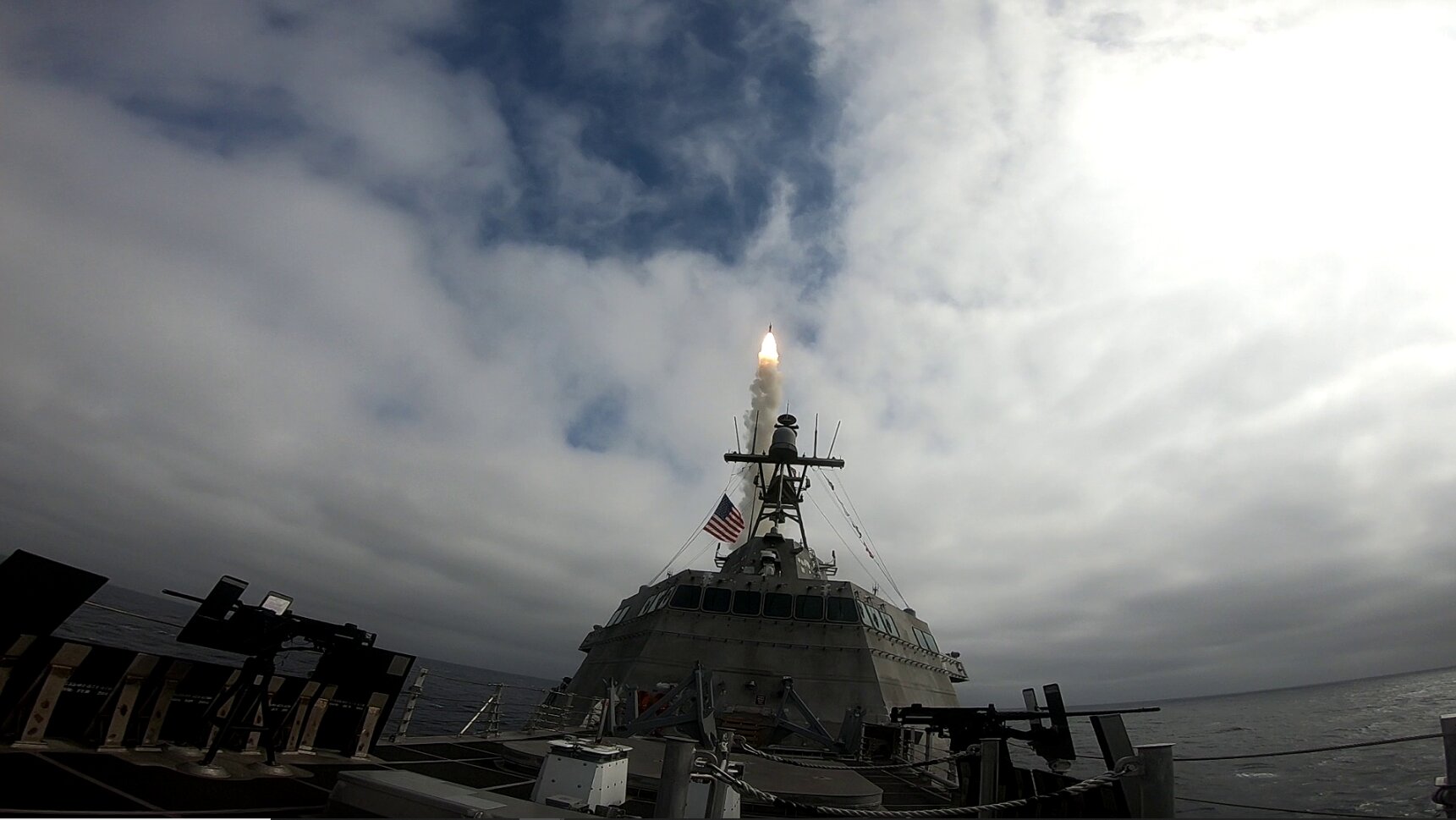
The Navy has committed to buying Standard Missile-6 interceptors from Raytheon at multiyear scale, a deal that gives suppliers up and down the Navy's missile chain a long production runway. Defense News, citing Reuters, reported that RTX's Raytheon unit won a multiyear contract worth up to $24.4 billion to produce SM-6 interceptors, which the Navy announced on Thursday, Oct. 1, 2026.
The contract runs five years and includes two additional option years. The Navy says it is meant to provide a steady, reliable supply of a missile that performs both strike and missile-defense missions. The harder question is whether the money behind the ceiling will show up on the schedule the Navy wants.
What Does the $24.4B SM-6 Contract Actually Buy?
The headline figure is a ceiling, not a delivery order. The award is for "up to" $24.4 billion, and the public record does not say how many missiles the Navy will take or when. Baird Maritime reported that quantities and delivery schedules for the October contract remain unspecified.
The structure is firmer than the quantities. According to Baird Maritime, the agreement has a five-year firm term plus two additional option years. If the Navy exercises both options, the arrangement stretches to seven years. That gives Raytheon and its sub-tier suppliers a planning horizon that annual contracting does not.
The missile itself explains the priority. Defence-industry.eu, relaying Navy and Raytheon statements, described the SM-6 as a weapon used for air defense, surface strikes and ballistic missile defense. One round fills three roles, so each missile spent on one mission is unavailable for another.
Baird Maritime also placed the award in the context of five framework agreements RTX announced with the Department of War in February 2026. Those frameworks set an annual SM-6 production target of more than 500 missiles. Baird did not say the new contract commits to that rate, and neither did the other sources. Treat 500 per year as the stated production goal from the earlier frameworks, not as a contractual delivery requirement in this award.
Why the Navy Is Burning Through Interceptors
Demand is not hypothetical. Baird Maritime reported that US Navy surface combatants fired 80 SM-6 missiles between October 2023 and January 2025 while countering attacks on shipping by Yemen's Iran-backed Houthi group. Vice Admiral Brendan McLane, then head of Naval Surface Forces, gave that figure to a Surface Navy Association conference in January 2025, according to Baird.
Naval leaders framed the award around quantity. "Maritime strength demands weapons at speed and scale," said Acting Secretary of the Navy Hung Cao, according to defence-industry.eu.
Adm. Daryl Caudle, the Chief of Naval Operations, made the same point more directly. "Combat credibility depends on having enough weapons, produced at the speed and scale the fleet requires," Caudle said, as reported by Baird Maritime. Defence-industry.eu prints the same sentence with "Fleet" capitalized.
Van Hendrey, Portfolio Acquisition Executive for Munitions, tied the award to acquisition method. "This award demonstrates what is possible when the Department leverages innovative acquisition approaches to deliver capability at the speed of relevance," Hendrey said, per defence-industry.eu. The quoted statement does not spell out which approaches he meant.
Raytheon President Phil Jasper put the company's position in one line. "SM-6's multi-mission capability is vital to our customer, and Raytheon is intensely focused on meeting the demand," Jasper said, according to defence-industry.eu.
Third Big Munitions Deal in Three Months, and Unfunded
Defense News, citing Reuters, places the SM-6 award in a run of large munitions agreements. It follows a $20.7 billion provisional multiyear deal for Raytheon's AMRAAM air-to-air missile in late September and a $58.6 billion Patriot interceptor deal for Lockheed Martin in July. Three awards of this size in about three months show the Pentagon trying to replenish depleted munitions stockpiles through large production commitments. Reuters describes the agreements as designed to entice contractors to move faster while surging production.
There is a catch. Defense News reports that industry executives have warned Congress has not yet appropriated funding for these deals. Contractors may therefore be unable to invest at scale in components and facilities until lawmakers act.
That warning matters because a multiyear ceiling does not pay for a new rocket-motor line or a seeker-assembly expansion. A supplier deciding whether to buy machine tools or add a shift looks for obligated dollars or a firm order, not a headline value. Until appropriations catch up, the contract signals intent more than it releases cash. The sources do not say when Congress will act or how the Navy plans to bridge the gap.
The sources also leave several mechanics unaddressed: the contract type, the pricing structure, how much of the $24.4 billion is obligated at award, and which Raytheon facilities and suppliers will carry the work. None of the three articles reports those details, and this story does not guess at them. The primary Navy release was not available to this newsroom, so the quotes above come from the outlets that relayed it.
What It Means for Contractors
For subcontractors and component makers, the useful reading is a demand signal with a funding condition attached. A five-year firm term plus two option years supports long-lead purchasing conversations with Raytheon, the prime. It does not by itself authorize spending, and primes will be cautious about passing risk down to suppliers while appropriations are unsettled.
Suppliers should expect three things to matter in the coming months:
- Funding timing. Defense News reports that executives warned contractors may be unable to invest at scale until Congress acts. Suppliers that can commit capital early, or that hold long-lead material, may be better placed once money flows.
- Quantity clarity. With quantities and delivery schedules unspecified, the earlier more-than-500-per-year production target is the only published rate reference. Suppliers should ask their Raytheon contacts whether that target is driving flow-down schedules.
- Competition for shared inputs. The AMRAAM and SM-6 awards both go to Raytheon, while the Patriot deal went to Lockheed Martin. Whether these programs compete for the same motors, seekers, electronics and test capacity is a question the sources do not answer, but it is the one second- and third-tier suppliers should be asking.
Firms outside the Raytheon supply chain have fewer direct openings here. The award goes to a single prime for a single missile, and the sources describe no competitive follow-on or second-source plan. Companies that want a role will likely need to approach Raytheon about subcontracts or second-source qualification, not wait for a Navy solicitation.
For program watchers, the signals to track are a definitized delivery schedule, the first obligation announcement, and any appropriations language that covers multiyear munitions. Each would convert a ceiling into a production plan.
Sources
- US Navy awards RTX's Raytheon $24.4B for SM-6 missiles amid stockpile concerns (Defense News / Reuters, Oct. 1, 2026)
- U.S. Navy awards Raytheon SM-6 contract worth up to $24.4 billion (defence-industry.eu, relaying Navy and Raytheon statements)
- US Navy awards $24b multi-year contract for expanded SM-6 missile production (Baird Maritime)
