
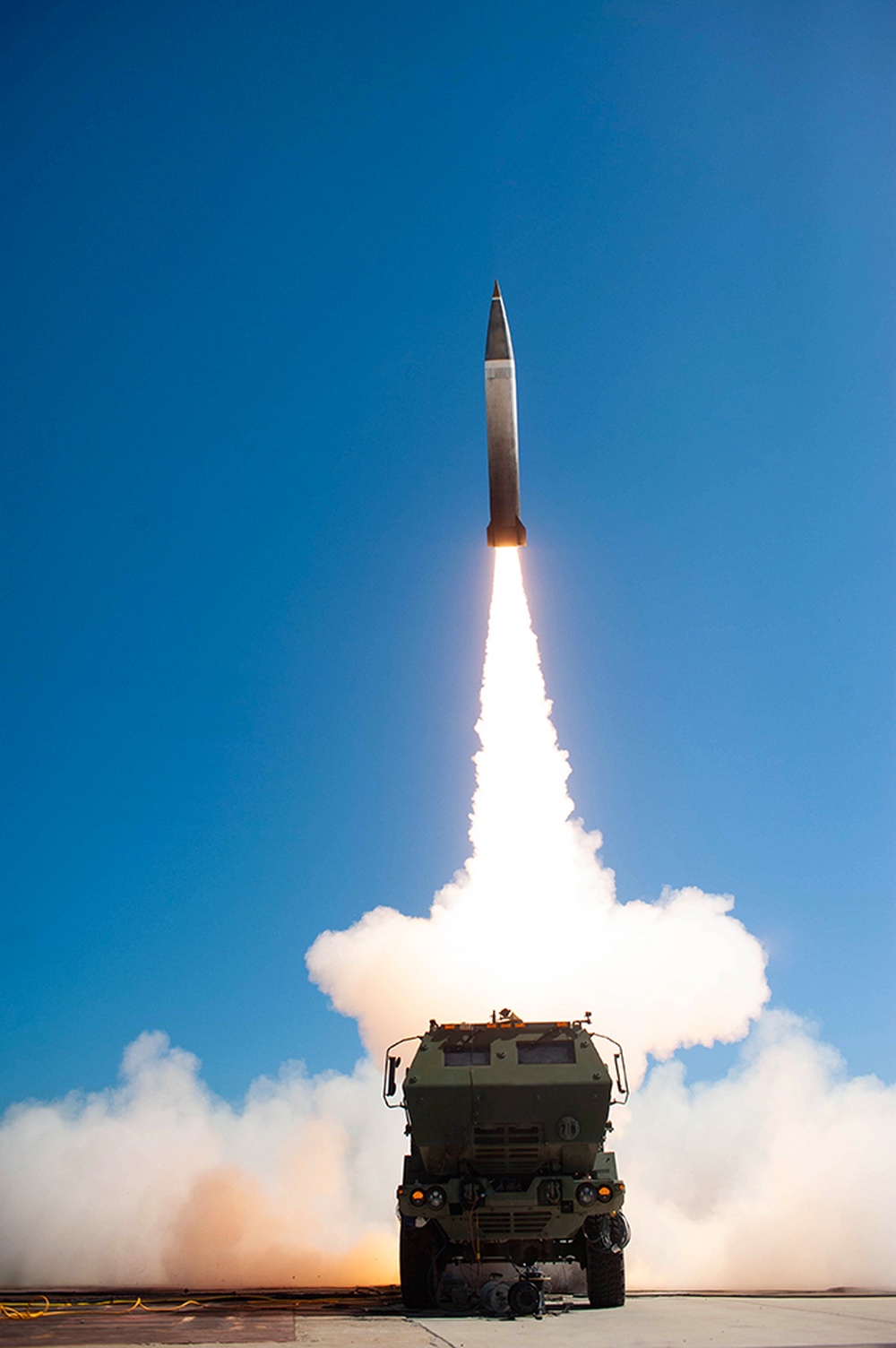
The U.S. Army just bought a missile that can chase down a moving warship. The Department of War's daily contracts announcement confirms Army Contracting Command at Redstone Arsenal, Alabama, awarded Lockheed Martin a $1,211,234,988 contract on September 14, 2026, for early production of the Precision Strike Missile Increment 2. Lockheed was the only company solicited and the only one that bid, and the Army expects work under the contract to run through September 13, 2031.
The award turns PrSM Increment 2 from a test program into a fielded weapon. Unlike the baseline PrSM already in Army inventories, Increment 2 carries a multi-mode seeker that lets it find and strike moving maritime targets and relocating land threats — a sea-denial capability the Army has never fielded on a ground-launched missile at this range.
What the Multi-Mode Seeker Changes About PrSM
The original PrSM, which entered service to replace the Army Tactical Missile System, hits fixed coordinates. Increment 2 adds a seeker that updates in flight, letting the missile track a target that has moved since launch — most notably a ship underway. Lockheed Martin's Dave Griser, vice president of the company's precision fires program, said the contract "marks an important step in delivering PrSM Increment 2 to the warfighter," according to DefenseScoop's reporting on the award.
The Army first proved the seeker in February 2026, when a PrSM Increment 2 round flew 350 kilometers from a HIMARS launcher and met its test objectives. That test validated the missile's ability to find and engage a moving target rather than just hit a preset grid coordinate — the core capability the Army is now buying at scale.
PrSM Increment 2 already exceeds 500 kilometers in range. Separately, Lockheed is developing a further increment — tested earlier this summer of 2026 — that flew beyond 1,000 kilometers, a data point on how far the company is pushing ground-launched fires beyond Increment 2's own envelope. Longer-range PrSM variants point toward land-based Army fires eventually reaching targets that previously required naval or air assets, a shift the service has been pursuing since it began developing PrSM as a longer-range, ground-launched alternative to older tactical missiles.
Why the Army Is Racing to Rebuild PrSM Stockpiles
The contract lands against a backdrop of depleted munitions. The Center for Strategic and International Studies estimated in April that the military had burned through between 44% and 77% of its pre-war PrSM stockpile during the ongoing conflict with Iran — a consumption rate that led the administration to strike a framework deal in March 2026 aiming to quadruple PrSM production capacity, then invoke the Defense Production Act in June 2026 to accelerate munitions manufacturing further.
The DoD announcement itself lays out the award in blunt contracting language: "Lockheed Martin Corp., Grand Prairie, Texas, was awarded a $1,211,234,988… indefinite-delivery/indefinite-quantity contract for the Precision Strike Missile Increment 2 Early Operational Capability," with an estimated completion date of September 13, 2031. That sole-source structure — one bid solicited, one received — reflects both PrSM's status as a program of record with no competing production line and the urgency of closing the stockpile gap quickly rather than running a fresh competition.
The stockpile numbers explain why the Army moved this fast. Losing nearly half to more than three-quarters of a munitions class in an active conflict is the kind of consumption rate that normally takes years to plan around, not months. Invoking the Defense Production Act is a rare step reserved for exactly this scenario — a wartime shortfall the existing industrial base cannot close on its own timeline — and pairing it with a framework deal to quadruple output shows the administration treating PrSM replenishment as a production-line problem, not just a contracting problem.
Breaking Defense's coverage of the award confirmed the same sole-source detail, reporting that "Lockheed's bid was the only one solicited and the only one received." The outlet also described the new seeker as capable of "hitting maritime targets on the move." That combination — no competitor teed up and an urgent capability gap — is becoming a recurring pattern across Army long-range fires contracts this year, as the service prioritizes speed to the field over competitive procurement timelines.
Grand Prairie Becomes the Center of Gravity for Army Long-Range Fires
All PrSM Increment 2 production under this contract will happen at Lockheed's Grand Prairie, Texas, facility. The five-year performance period signals the Army expects sustained, not one-time, output from that plant as delivery orders come in under the contract. That plant, which already builds baseline PrSM rounds, now takes on an additional, more complex variant with the seeker hardware and integration work that distinguishes Increment 2 from the baseline round.
The five-year window to 2031 gives the Army room to place additional delivery orders under this same indefinite-delivery/indefinite-quantity contract vehicle as production ramps, rather than negotiating a fresh agreement for every batch. PrSM Increment 2's contract title — "Early Operational Capability" — signals the Army is treating this specific award as the bridge between testing and full-rate production rather than the end state.
What It Means for Contractors
Lockheed's sole-source position on this contract is not guaranteed to extend to every delivery order placed under it as production ramps toward full rate. Competitors and subcontractors working seeker, guidance, or propulsion technology for ground-launched precision fires should watch how the Army structures future orders, since a program moving from early operational capability into full-rate production is exactly the point where the Army sometimes opens a second source or dual-award structure to protect the supply chain — particularly with a Defense Production Act invocation already on the books signaling the Pentagon's concern about single-vendor risk on this munition.
Suppliers feeding into Grand Prairie should expect sustained, multi-year demand through 2031 at minimum, and companies building maritime-target seekers, multi-mode guidance electronics, or extended-range propulsion for tactical missiles have a concrete data point for where Army fires modernization dollars are landing. The stockpile drawdown that triggered this award is not unique to PrSM; contractors across the long-range fires portfolio should anticipate similar urgency-driven, sole-source production awards in adjacent programs as the service works through wartime consumption rates.
