
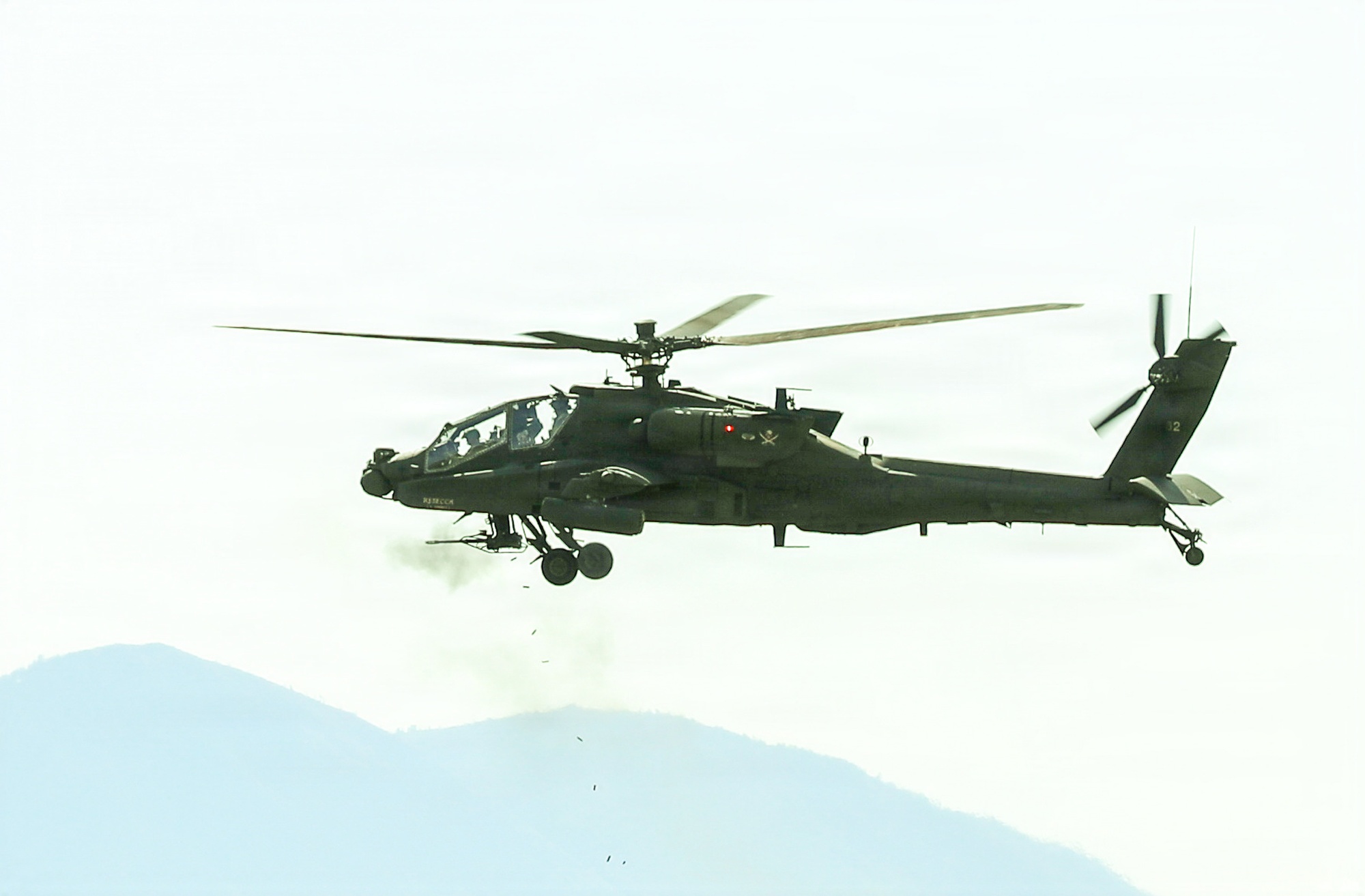
The Army has awarded Lockheed Martin Corp. a $502,381,686 hybrid contract to keep the targeting and night-vision sensors on the AH-64 Apache fleet running, covering post-production support for the Modernized Target Acquisition Designation Sight/Pilot Night Vision Sight system across every Apache operator worldwide tied to a U.S. international agreement.
Background
The Modernized Target Acquisition Designation Sight/Pilot Night Vision Sight, known in the field as M-TADS/PNVS or by its nickname "Arrowhead," is the sensor suite mounted on the nose of the AH-64 Apache that lets pilots and gunners find, identify and engage targets in daylight, at night and in degraded visual conditions. Lockheed Martin has built and supported the system for decades, and the Army routinely funds sustainment work through hybrid contract vehicles that combine cost-reimbursement and fixed-price line items so individual task orders can be tailored to specific repair, upgrade or logistics needs as they arise.
Because M-TADS/PNVS is fielded not just on U.S. Army Apaches but on aircraft flown by allied and partner nations that acquired the AH-64 through foreign military sales or other international agreements, post-production support contracts like this one typically fund parts, repairs, technical assistance and engineering changes across that entire global user base rather than a single customer's fleet.
Lockheed Martin performs the work through its Orlando, Florida-based missiles and fire control business, the same unit that originally developed and produced the Arrowhead sensor suite. "Post-production support" is standard Army terminology for the sustainment phase that follows a program's initial manufacturing run: once the Army has bought the number of sensor units it needs, follow-on contracts shift from production to keeping fielded units repaired, calibrated and technically current for the rest of their service life. Apache remains the Army's primary attack helicopter, and the aircraft's ability to acquire and engage targets at night or through smoke, dust and other obscurants depends directly on the M-TADS/PNVS system staying operational across the fleet.
Key Details
Army Contracting Command at Redstone Arsenal, Alabama, made the award under contract number W58RGZ-26-D-0052. The Department of War's July 8, 2026 contracts announcement lists the deal as a hybrid arrangement combining cost-no-fee, cost-plus-fixed-fee and firm-fixed-price elements, structured so different categories of sustainment work can be priced under the mechanism that fits them best.
The Army solicited a single bid and received one, making this a sole-source award rather than a competed procurement — consistent with how the government typically handles long-running sustainment of a proprietary sensor system where Lockheed Martin holds the technical data package and manufacturing know-how. The hybrid pricing structure lets the Army pay Lockheed Martin's actual allowable costs on line items where the scope of work is not yet fully defined, add a fixed fee on cost-plus-fixed-fee task orders to reward performance, and lock in firm fixed prices once the work — such as a known repair or overhaul procedure — is well enough understood to price with confidence.
The contract runs through an estimated completion date of July 5, 2031, giving both the Army and Lockheed Martin a five-year sustainment window. Work locations and funding will be determined with each individual task order rather than obligated in a lump sum at award, meaning the $502.4 million figure represents a ceiling value under which specific orders will be issued and funded incrementally as requirements are identified.
The award appeared in the Department of War's daily contracts list on July 8, 2026, and was independently reported the same week by Investing.com, which confirmed the dollar figure and scope, and by Aerotech News & Review's contract briefs roundup.
What It Means for Contractors
For Lockheed Martin, the award extends a sustainment relationship on a sensor system that has no ready substitute in the near term — the Army is not shopping for a new targeting sight, it is paying to keep the current one flying reliably on an aircraft that remains in front-line service. That gives the prime a predictable, multi-year revenue stream through mid-2031, even though the headline ceiling will be realized gradually through individual task orders rather than all at once.
The sole-source structure is worth noting for smaller firms and second-tier suppliers: this is not a program where a new entrant can bid for the prime role, because the government solicited exactly one offer. Opportunities for outside companies will instead show up downstream, as Lockheed Martin issues subcontracts for repair depot work, calibration equipment, spare components or field service support tied to individual task orders. Firms that already hold a place in the Apache sensor supply chain, or that support night-vision and electro-optical sustainment more broadly, are the ones positioned to see work flow from this vehicle.
Because funding and work locations are set order by order rather than all at once, contractors watching this vehicle will need to track individual task-order announcements rather than treating the July award as a single funding event. That incremental structure is typical of large sustainment IDIQ-style vehicles and gives the Army flexibility to shift funding toward whichever Apache fleet — U.S. Army or an allied operator — has the most urgent sensor repair or upgrade need in a given year, without having to compete a new contract each time.
The global scope of the contract also signals where task orders are likely to originate. Because the award explicitly covers AH-64 operators "fielded worldwide" under international agreements, allied air arms flying the Apache — a group that has grown as more countries adopt the aircraft — will draw on this same vehicle for their sensor support rather than negotiating separate bilateral sustainment deals. Contractors that provide logistics, training or in-country maintenance support tied to foreign military sales cases involving the Apache should expect coordination requirements to flow through this contract's task-order structure over the next five years.
More broadly, the award is a reminder that a large share of defense contracting dollars goes not to new platforms or headline-grabbing capability upgrades but to keeping existing, proven systems combat-ready. The Apache's targeting sight has been in service long enough that its sustainment pipeline is now measured in contract ceilings approaching half a billion dollars for a single five-year support window, and that pattern is likely to repeat as the Army works through similar recompetes or extensions for other legacy sensor and avionics systems across its rotary-wing fleet.
