
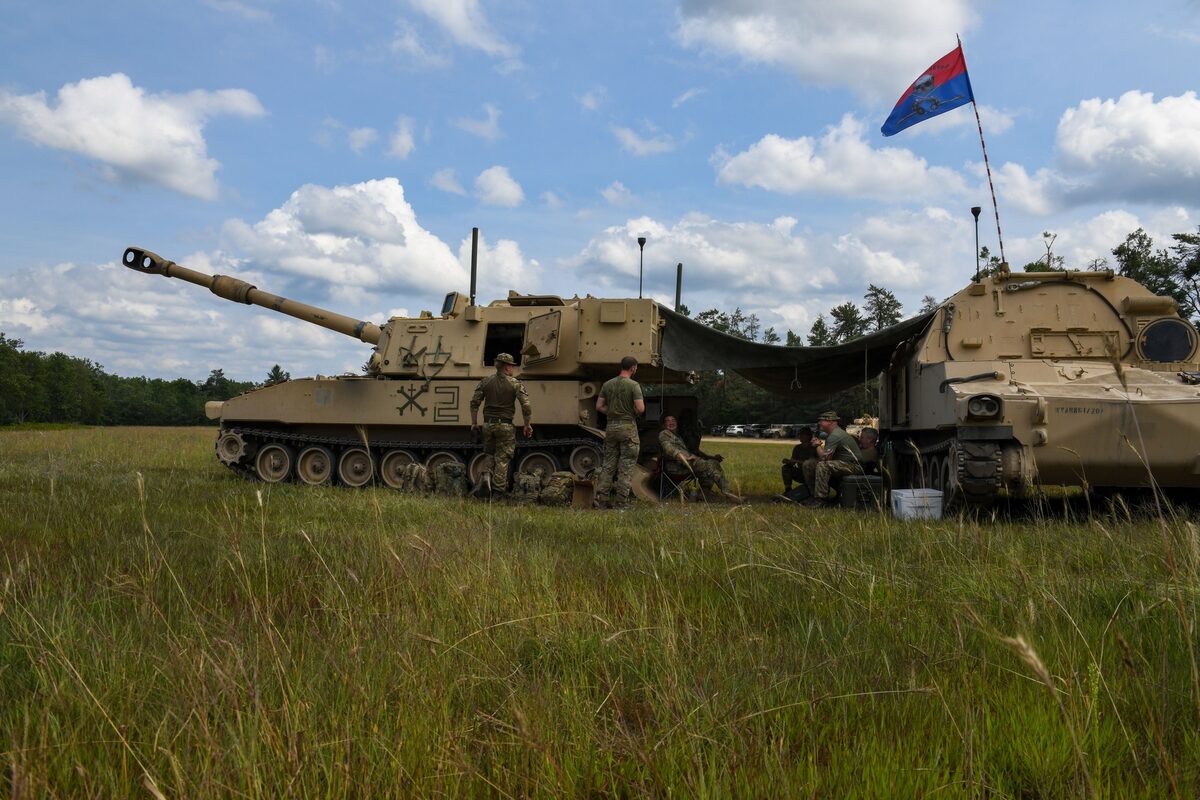
Artillery crews firing 105mm and 155mm rounds from M119, M777 and M109A6 Paladin howitzers will keep drawing their point-detonating fuzes from the same Bristol, Pennsylvania production line for at least five more years, after the Department of War awarded Action Manufacturing Co. a $712,480,000 firm-fixed-price indefinite-delivery/indefinite-quantity contract on August 31, 2026. The ceiling runs through August 31, 2031, and covers manufacture, inspection, testing, packaging and delivery of the M739A1 fuze, the standard point-detonating and delay fuze fitted to artillery rounds fired by three of the Army's core towed and self-propelled howitzer systems.
The war.gov contract notice puts the scope in plain terms: Action Manufacturing was awarded the deal "to manufacture, inspect, test, package and deliver M739A1 point detonating/delay fuzes." The notice does not itemize a delivery schedule up front. Work locations and funding will instead be set order by order under the IDIQ structure, a common approach for munitions components where the Army wants contracting flexibility to match production against changing ammunition demand over a multi-year window.
What the M739A1 Fuze Actually Does
The M739A1 is not a headline weapon system, but it is a part every one of the Army's cannon artillery units depends on. It threads into the nose of a 105mm or 155mm projectile and controls how the round detonates: on contact for point-detonating effect against exposed targets, or with a brief mechanical delay so the round penetrates before exploding, useful against bunkers, buildings or dug-in positions. Army Recognition's account of the award puts it plainly: "The M739A1 provides point-detonating and delay functions for artillery rounds fired by systems including the M119, M777 and M109A6 Paladin." That spread covers the M119 lightweight towed howitzer, the M777 lightweight towed howitzer and the tracked, self-propelled M109A6 Paladin — the Army's current towed and self-propelled cannon artillery. A fuze failure or supply gap on the M739A1 line does not ground an aircraft or sideline a ship; it quietly limits how much artillery ammunition units can actually fire, which is why sustaining the production base for it draws the same contracting rigor as a bigger-ticket program.
Why the Award Went to the Incumbent Without Competition
The contract notice does not frame this as a new capability standing up. Action Manufacturing is already identified in Army documentation as an M739A1 production partner, according to Army Recognition, and the war.gov notice confirms the solicitation drew only one bid. In practical terms, the Army was not choosing among competing suppliers for a five-year, $712.5 million ceiling; it was renewing an established domestic source for a fuze design already in the inventory. A single-bid outcome is not unusual in fuze and other legacy munitions manufacturing, where the tooling, explosive-handling certifications and quality-assurance infrastructure needed to produce a specific fuze design to military specification represent a real barrier to new entrants. Rather than opening a new production line elsewhere, the Army is paying to keep an existing line at Bristol running rather than risk a gap in fuze supply while a new source stood up its own certifications.
That logic fits a broader pattern in munitions procurement: sustained demand for 155mm ammunition has put pressure on production chains across the industrial base, and fuzes are as exposed to that pressure as any other component. As Army Recognition frames it, maintaining domestic production of a widely compatible artillery fuze reduces the risk that a relatively small but indispensable component becomes a bottleneck if ammunition demand rises sharply. The M739A1 award does not add new capacity in that sense — it is explicitly about sustaining an existing, single-source line — but it reflects the same underlying concern that has the Army locking down five years of supply from its only qualified source rather than competing a program that had no alternative bidder waiting.
What the Five-Year Ceiling Buys the Army
Structuring the award as an IDIQ with a $712.5 million ceiling rather than a single firm order gives the Army room to place delivery orders against demand as it materializes through 2031, without having to run a fresh competition or renegotiate a base contract each time ammunition requirements shift. The war.gov notice frames it as a firm-fixed-price vehicle, meaning individual delivery orders will carry set prices once issued, but the notice does not specify funding obligated at time of award or an initial delivery order value for the M739A1 deal — unlike other contracts in the same August 31 notice, such as a Tern AI Inc. award that listed $11,263,793 in fiscal 2026 funds obligated at time of award. That omission suggests the Army has not yet placed a first order of meaningful size against the ceiling, or at least has not disclosed one, leaving the $712.5 million as a five-year planning ceiling rather than a near-term spending commitment.
What It Means for Contractors
For companies that hold sole-source or single-bid positions on legacy munitions components, this award is a template worth watching. The Army did not run a competitive shootout for a fuze it has bought from one qualified vendor for years; it extended that vendor's production window by five years and structured the deal as an IDIQ so it can keep buying without re-competing every order. Contractors in comparable positions — the only qualified producer of a specific fuze, primer, warhead component or explosive fill — should expect the Army to favor continuity awards like this one over forcing new entrants through a lengthy qualification process, particularly while demand across the munitions industrial base stays elevated. For firms hoping to break into fuze or munitions-component manufacturing, the more relevant signal is the qualification barrier itself: a single-bid outcome on a $712.5 million ceiling contract means the Army had no second qualified source to compare against, and closing that gap takes years of investment in explosive-handling certification and specification-matched tooling, not a competitive proposal alone. Firms already holding legacy munitions IDIQs should also note the five-year, no-option structure — the Army is choosing long, single-award windows over annual renewals for at least some of these lines, which shifts planning and workforce decisions for the incumbent onto a longer horizon than shorter contract vehicles allow.
