
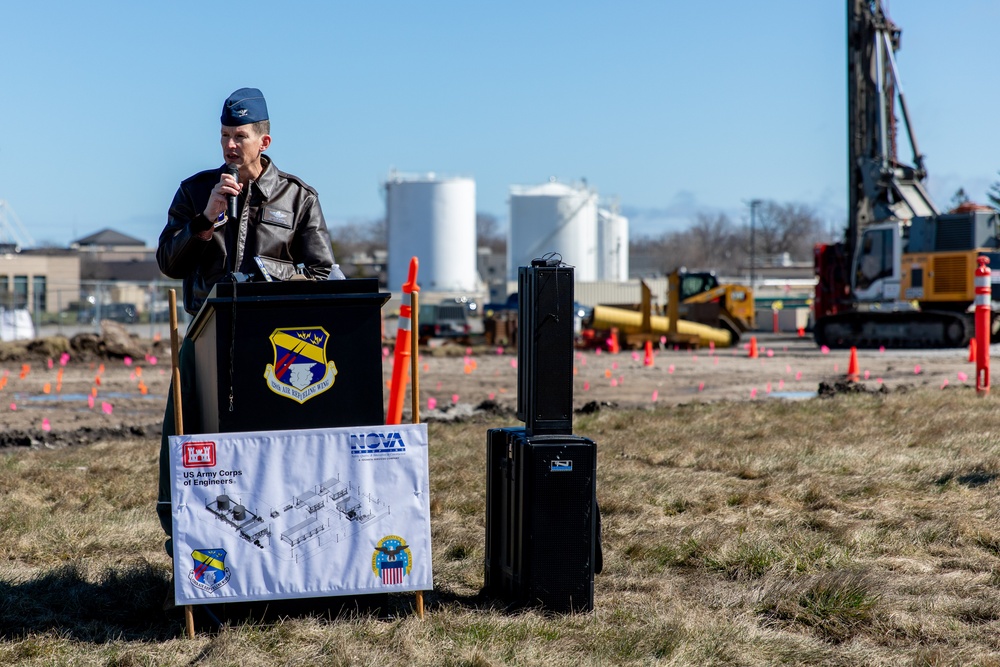
The Army awarded a $699,000,000 multiple-award task-order construction contract on Aug. 6, 2026, to Bering Weston JV LLC and six other companies for design-build and design-bid-build construction supporting the Petroleum, Oil, and Lubricants Mandatory Center of Expertise, closing out a procurement that spent the past several weeks under a bid protest at the Government Accountability Office.
Background
The POL Mandatory Center of Expertise sits inside the U.S. Army Corps of Engineers and centralizes technical authority over the design and construction of fuel storage, distribution, and handling facilities across the military. Projects that fall under POL-MCX oversight tend to be complex and safety-critical: tank farms, pipelines, hydrant fueling systems, and other petroleum infrastructure that has to meet both military and environmental-protection standards. Because that expertise is concentrated in one office, the Corps regularly bundles the resulting construction work into multiple-award contracts so it can issue task orders to a pre-vetted pool of builders rather than running a full source-selection for every job.
This particular contract went through a two-phase small-business competition, and it did not reach an award without a fight. Two-phase design-build competitions are structured deliberately: phase one narrows a broad field of interested firms down to a shortlist based largely on qualifications and past performance, and only the shortlisted firms are invited to submit full technical and price proposals in phase two. That structure is meant to save both the government and industry the cost of preparing detailed proposals from offerors who were never realistically competitive, but it also means the phase-one and phase-two cuts carry outsized weight in determining who ultimately wins.
Pacific Ohana Laulima LLC, a competitor eliminated at phase two, filed a protest challenging that elimination. GAO denied the protest on Wednesday, July 15, 2026, according to Bloomberg Law's reporting on the case. The GAO's finding was narrow but decisive: the Army Corps had reasonably concluded that Pacific Ohana had not demonstrated relevant past-performance examples sufficient to advance to the second phase of the competition. With the protest resolved in the government's favor, the Corps was free to proceed to award.
Key Details
The contract carries a $699 million ceiling and was structured as a small-business set-aside. Seven companies share the award, led by Bering Weston JV LLC. That joint venture pairs Weston Solutions, a 100% employee-owned environmental and infrastructure services firm with a 65-year history, with Bering Straits Global Innovations LLC, a subsidiary of Bering Straits Native Corporation, an Alaska Native Corporation. The pairing is organized as an SBA-certified 8(a) mentor-protégé joint venture, a structure the Small Business Administration uses to let an experienced "mentor" firm team with a smaller, disadvantaged "protégé" so the pair can pursue set-aside work the protégé might not win alone while building the protégé's capacity over time.
The war.gov contract notice for Aug. 6 names all seven awardees: Bering Weston JV LLC of Anchorage, Alaska; Bristol Engineering Services Company LLC of Anchorage, Alaska; Dawson Federal Inc. of Honolulu, Hawaii; Goshawk LLC of San Antonio, Texas; Jack Wayte CMS JV of Alamogordo, New Mexico; Reliable Contracting Group LLC of Louisville, Kentucky; and SES Energy Services LLC of Knoxville, Tennessee — all marked as small businesses in the notice, though it does not break out individual dollar shares of the ceiling among them. As a multiple-award task-order contract, the $699 million figure represents the shared ceiling across all seven awardees rather than a guaranteed sum to any single firm; actual dollars will flow only as the Corps issues individual task orders. The notice states that 21 bids were received for the competition, and that work locations and funding will be determined with each order, which is standard for vehicles of this kind — the base award establishes the pool of eligible performers and the competitive rules for future orders, not a fixed project list.
The protest history adds useful context to how the Corps ran this competition. Pacific Ohana Laulima's challenge centered on the agency's phase-two evaluation, where it argued it should not have been cut before the final round. GAO's review upheld the agency's judgment that the firm's proposal lacked the relevant past-performance record needed to compete credibly for POL facility construction — a technical, safety-adjacent niche where the Corps evidently weighted demonstrated experience heavily in narrowing the field.
What It Means for Contractors
The award confirms that POL-MCX construction work is moving forward now that the GAO protest is resolved, and it gives the seven winning firms — Bering Weston JV chief among them — standing to compete for task orders as they're released. For firms that didn't make the award pool, the practical opportunity now shifts to subcontracting relationships with the seven primes, since none of them are likely to self-perform every order across every location the Corps eventually taps.
The mentor-protégé structure behind Bering Weston JV is worth watching as a template. This win is a meaningful data point for firms considering a similar 8(a) mentor-protégé joint venture as an entry strategy into specialized infrastructure work like petroleum facilities: an Alaska Native Corporation subsidiary paired with an established mentor firm competed against 20 other bidders in a two-phase small-business competition and came out leading a $699 million ceiling. Firms weighing whether to form a comparable pairing should note that this was a competed, 21-bid award rather than a sole-source arrangement — the mentor-protégé structure appears to have helped assemble a past-performance record credible enough to survive phase one and phase two, not a shortcut around competition itself.
The GAO outcome also carries a lesson that extends well beyond this one procurement: agencies running phase-based, past-performance-heavy evaluations have real latitude to eliminate offerors who can't document directly relevant experience, and GAO will generally defer to that judgment when the record supports it. Firms pursuing MCX or similarly technical construction work should treat past-performance narratives — not just pricing or capacity — as a first-order proposal risk, particularly in phase-one and phase-two cuts where a thin record can end a bid before price is ever discussed.
Finally, because this is a task-order vehicle rather than a single project award, the real competitive action for the seven winners — and the real opportunity for their subcontractors and suppliers — starts now, as the Corps begins issuing individual design-build and design-bid-build orders against the ceiling. Firms with petroleum, oil, and lubricants facility experience should watch for those task-order solicitations, which will carry their own location-specific requirements and evaluation criteria even though the base competition is closed. That steady drumbeat of task-order releases, rather than the base award itself, is where most of the $699 million will ultimately be won and lost.
