
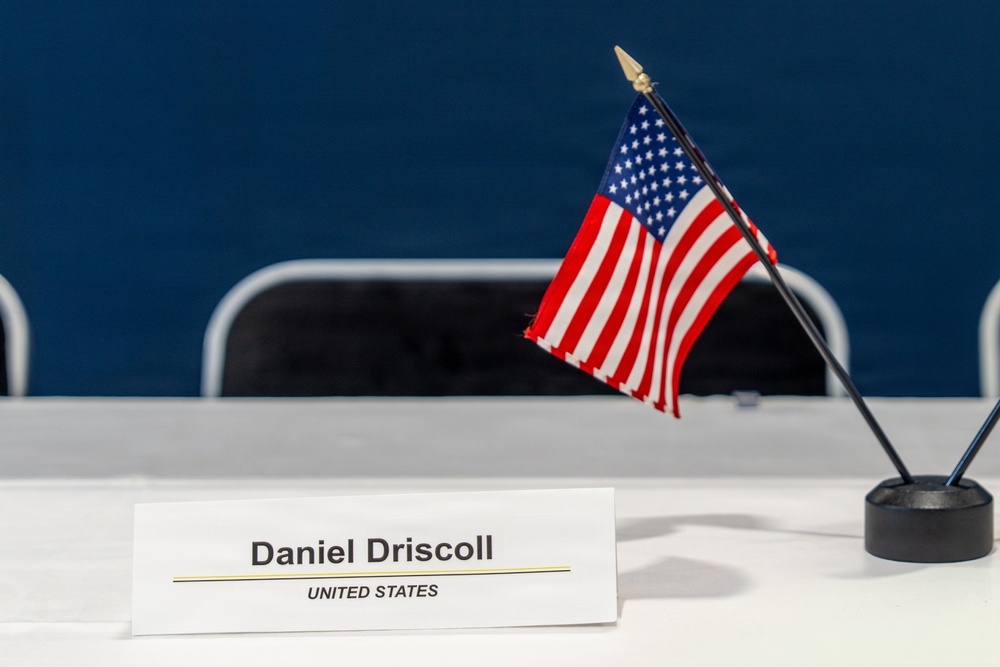
Army Secretary Dan Driscoll signed a joint statement of intent on June 16, 2026, at the Eurosatory defense exhibition in Paris, expanding the Army's unmanned aerial system (UAS) and Counter-UAS (C-UAS) Marketplaces to nine NATO allies. Sweden, Denmark, Norway, France, Poland, the United Kingdom, the Netherlands, Italy, and Lithuania joined the program. The Army's stated goal is to reach 25 allied and partner nations by the end of summer 2026.
Background
The UAS and Counter-UAS Marketplaces emerged from a recognition that allied nations were independently procuring drone and counter-drone systems with incompatible data standards, limiting interoperability on the battlefield. Joint Interagency Task Force 401 (JIATF-401) manages the Counter-UAS Marketplace, which aggregates allied demand, establishes common data standards, and provides member nations access to a vetted catalog of counter-drone capabilities spanning interceptors, radars, electro-optical and infrared sensors, and electronic warfare systems.
The UAS Marketplace, launched in March 2026, functions as a platform that lets vendors list drone products directly accessible to Soldiers across member nations. Units provide feedback on what works in the field, and the Army scales purchases accordingly — removing layers of procurement bureaucracy that have historically slowed technology adoption. Driscoll described the philosophy at Eurosatory: "The proliferation of drones changed warfare faster than any of our institutions were built to move."
The marketplace currently covers Group 1-2 drones under 55 pounds, with a Group 3 expansion covering systems up to 1,320 pounds planned for summer 2026. Vendors can be filtered by range, speed, group size, cost, and manufacturing capability including right-to-repair. Approved sources include winners of the Gauntlet competition and systems on the Defense Contract Management Agency's Blue List.
What Was Signed and What It Does
The document signed at Eurosatory is a statement of intent, not a binding procurement contract. It commits each signatory nation to pursue alignment with the Army's marketplace framework and nominate national points of contact for ongoing coordination through JIATF-401.
No specific dollar figures were attached to the expansion agreement. The marketplace itself does not obligate funds centrally — it functions as a demand aggregation and vendor certification platform. Individual purchases flow through each nation's own procurement channels, but the shared vendor vetting and data standards reduce the due-diligence burden on smaller allied procurement offices that lack the staffing to independently evaluate counter-drone systems.
The geographic spread of the nine new members reflects a deliberate emphasis on the NATO eastern flank. Poland and the Baltic-adjacent nations — Sweden, Denmark, Norway, Lithuania, and the Netherlands — are all countries that have significantly expanded defense investment since Russia's 2022 invasion of Ukraine and have documented operational experience with commercial drone threats. France, Italy, and the United Kingdom round out the group, adding three of NATO's largest defense spenders.
Driscoll also discussed two related Army initiatives at Eurosatory. Operation Jailbreak is the Army's internal program to break down data silos across Army systems — the effort reviewed approximately 100 systems in 30 days — enabling faster information sharing that the marketplace depends on to deliver real-time feedback from units to vendors. The Eastern Flank Deterrence Initiative focuses on helping vendors understand allied requirement specifications so they can design products that meet multiple national standards simultaneously, expanding their addressable market while reducing costly customization for each buyer.
How the Marketplace Vets Systems
JIATF-401 does not simply list any product a vendor submits. Counter-UAS systems must pass an evaluation process that tests performance against representative drone threats under conditions that reflect operational environments. Systems that meet the threshold enter the catalog under a "Blue List" designation — a term Army officials have used publicly to describe approved counter-drone products. Electronic warfare systems listed in the marketplace must comply with allied spectrum deconfliction requirements to avoid jamming friendly communications when deployed alongside partner forces.
The marketplace's common data standards address a specific integration problem: different allied command-and-control systems receiving sensor data in incompatible formats. When a radar detects an inbound drone and hands targeting data to an interceptor from a different vendor or nation, the data exchange must be fast enough to matter. The marketplace's vendor entry requirements give developers a single technical specification to design against rather than a dozen different national interfaces.
What It Means for Contractors
- New market access for vetted C-UAS vendors: Companies already on the Army's Blue List gain potential access to nine additional allied procurement offices whose buyers can now pull directly from the marketplace catalog. Vendors not yet listed should evaluate whether their systems meet the JIATF-401 evaluation criteria before pursuing listing.
- Data standards compliance is now a market entry requirement: Common C-UAS data standards are an explicit entry requirement for new marketplace listings. Vendors developing radar, EW, or interceptor systems for NATO customers should confirm their command-and-control interfaces conform to marketplace specifications.
- Eastern flank focus creates near-term demand: Poland, the Baltic states, and Scandinavia have active C-UAS procurement programs driven by the security environment on NATO's eastern flank. The marketplace expansion gives vendors a streamlined path to those buyers. Companies that have focused exclusively on U.S. government sales should assess whether allied market compliance adds value given the scale of European C-UAS investment.
- Operation Jailbreak and Eastern Flank Deterrence Initiative may generate follow-on contracts: The Army's internal data interoperability effort and the vendor requirement-alignment initiative both involve systems integration and advisory work. Prime contractors supporting Army digital modernization programs should track both for scope expansions and associated task orders.
- Watch for the 25-nation target: The Army's stated goal of 25 member nations by end of summer 2026 means additional expansion announcements are likely within weeks. Vendors should monitor JIATF-401 communications for new member countries that open new national procurement channels.
- Track the formal RFP release: The marketplace expansion was announced at Eurosatory 2026; vendors should monitor SAM.gov and the Army Contracting Command for follow-on solicitation notices, as the formal listing evaluation process is expected to open within 90 days of the announcement.
Sources
- U.S. Army, Allies and Partners to Expand Drone and Counter-Drone Marketplaces at Eurosatory Defense Exhibition — Army.mil (June 16, 2026)
- Army Secretary Highlights UAS Marketplace, Acquisition Reform at Eurosatory 2026 — Army.mil (June 16, 2026)
- What GovCons Need to Know About the Army's New 'Amazon-Like' UAS Marketplace — GovCon Wire (June 2026)
