
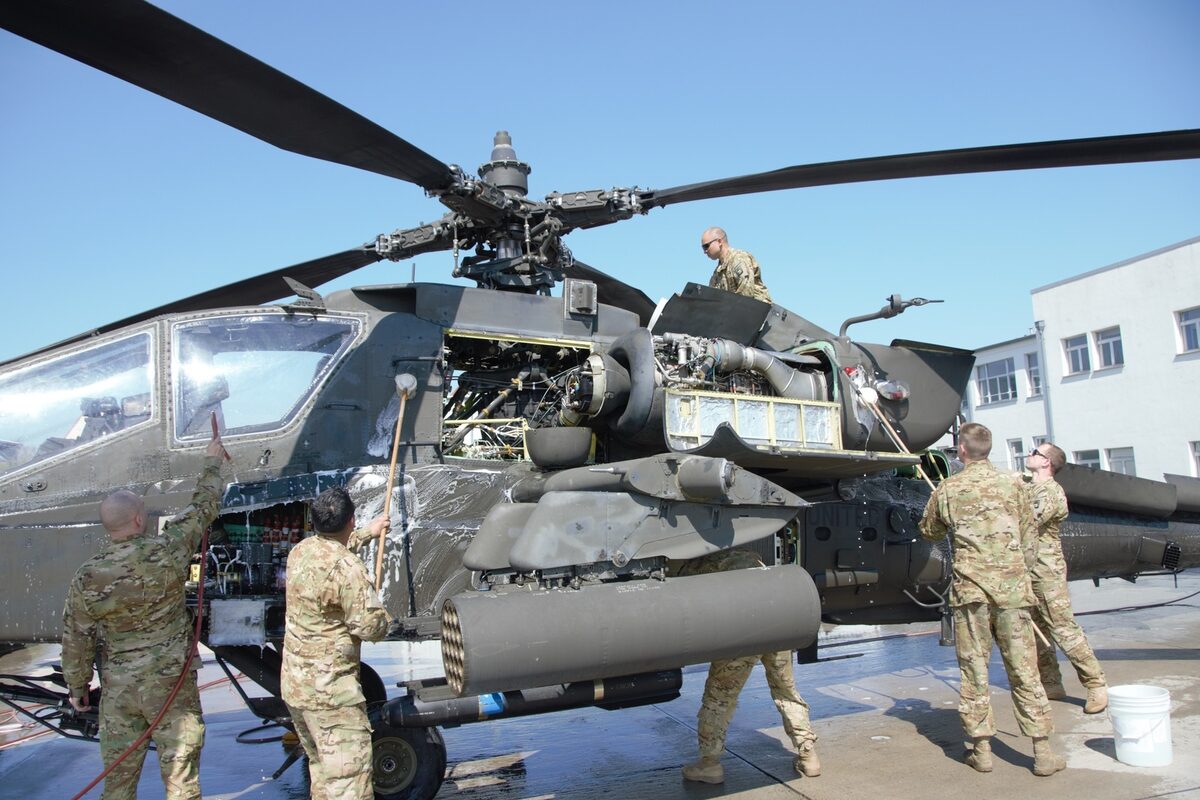
The Army just secured nearly a decade of missile-jamming hardware for its helicopter fleet, awarding Northrop Grumman a $4.84 billion contract to keep building the laser system that blinds infrared-guided missiles before they reach Apache, Black Hawk and Chinook crews. The deal means Army aviators flying into contested airspace through 2035 keep getting protection against shoulder-fired missiles and other heat-seeking threats, rather than facing a production gap as the current inventory ages.
The Department of War announced the award Tuesday, Sept. 8, 2026, crediting it to Northrop Grumman Systems Corp. Army Contracting Command at Redstone Arsenal, Alabama, structured the deal as a firm-fixed-price, indefinite-delivery/indefinite-quantity contract running through September 2035. The Army received just one bid in response to its solicitation, according to GovCon Wire. Northrop Grumman was the only company to bid.
The contract covers full-rate production of the Common Infrared Countermeasure system, known as CIRCM, for the Army's helicopter fleet. Work locations and funding will be determined as individual task orders are issued over the life of the contract.
Why the Army Nearly Quintupled the Contract Size
The scale of the new award stands out against the program's own history. When the Army first moved CIRCM into full-rate production in April 2021, it gave Northrop Grumman a contract worth $959.1 million. The new IDIQ, at $4.84 billion, is roughly five times that figure, even though it covers the same basic mission: equipping Army helicopters with laser-based defenses against infrared-guided missiles.
That jump reflects a shift in how many systems the Army now plans to buy and how long it wants Northrop Grumman locked in as the sole supplier. An IDIQ contract sets a ceiling and a window rather than a fixed order, so the $4.84 billion figure is the maximum value the Army could draw against CIRCM orders placed between now and the September 2035 end date, not a guaranteed lump payment. Actual spending will depend on the individual task orders the Army issues year by year, tied to how many Apache, Chinook and Black Hawk units still need new or replacement countermeasure sets. Still, the size of the ceiling signals the Army expects to keep buying CIRCM systems in volume for the next nine years, rather than transitioning to a different countermeasure architecture or letting the program taper off as newer survivability concepts mature.
CIRCM has already built a substantial track record inside the fleet. Northrop Grumman has delivered several hundred shipsets since CIRCM entered full-rate production, and the systems have logged more than 30,000 operational flight hours across Army aviation units. That combination of a fielded, flight-proven system and a single qualified vendor is likely part of why only one bid came in on a contract worth billions: standing up a competing infrared countermeasure architecture, compatible with Apache, Black Hawk and Chinook airframes, would be a heavy lift for any rival at this stage of the program.
That fielding history built up in stages. GovCon Wire reports that Northrop Grumman received roughly $155.1 million in July 2023, followed by orders of $142 million and $144 million the following month, and that the Army declared CIRCM operationally ready that year on four helicopter variants — the UH-60M, HH-60M, CH-47F and AH-64E. A fourth award in 2024 covered 336 more shipsets on top of the roughly 500 units already delivered at that point, per GovCon Wire.
How the Laser System Defeats Incoming Missiles
CIRCM is built to counter one of the most persistent threats facing Army helicopters: infrared-guided missiles, including man-portable air-defense systems, or MANPADS, that shoulder-fired teams can launch from the ground. GovCon Wire describes CIRCM as "an infrared-guided missile defense system that uses a dual-jammer configuration to protect military aircraft from missile threats."
In practice, the system has to detect that a missile has been launched and is tracking the aircraft, then aim a laser at the missile's seeker with enough precision and speed to jam the infrared signal the missile relies on to steer toward the helicopter. Because the countermeasure has to work in the seconds between launch and impact, the detection and jamming functions have to operate automatically across a wide range of flight conditions and threat geometries.
The system is already fielded across three of the Army's primary helicopter platforms: the AH-64 Apache, the CH-47 Chinook and the UH-60 Black Hawk. Extending production through 2035 keeps that defensive capability flowing to all three fleets as older aircraft cycle through upgrades and new airframes come online, rather than leaving any platform without a current-generation countermeasure. Because CIRCM is a laser-based system rather than a flare or chaff dispenser, it also avoids the logistical burden of resupplying expendable countermeasures in the field, which matters for units operating far from a resupply chain during a sustained deployment.
What It Means for Contractors
For Northrop Grumman, the award locks in nearly a decade of predictable, high-volume production work on a system it has already fielded at scale, with no competitor positioned to challenge the sole-source arrangement in the near term. A long-duration IDIQ gives the company planning certainty for its CIRCM production line and the supply chain feeding it, even though the actual dollar amount the Army ultimately spends depends on how many task orders get placed against the ceiling between now and September 2035.
For other contractors, the deal is a reminder of how difficult it is to break into a survivability-system program once a vendor has fielded hundreds of shipsets and tens of thousands of flight hours without a public failure. Companies looking to compete for future Army aircraft-survivability work will likely need to target the next generation of countermeasure requirements, rather than trying to unseat an incumbent with this much operational history built into a single-bid, multibillion-dollar production vehicle. Suppliers in the electro-optics and laser-countermeasure space gain a long runway of visibility into Northrop Grumman's production schedule, since the nine-year window gives them a clearer basis for their own capacity decisions than a shorter contract renewal would.
Public reporting on this award does not include a statement from an Army program official or a Northrop Grumman executive, so the public record for this specific award consists of the contracting details themselves rather than spoken remarks from either side.
