
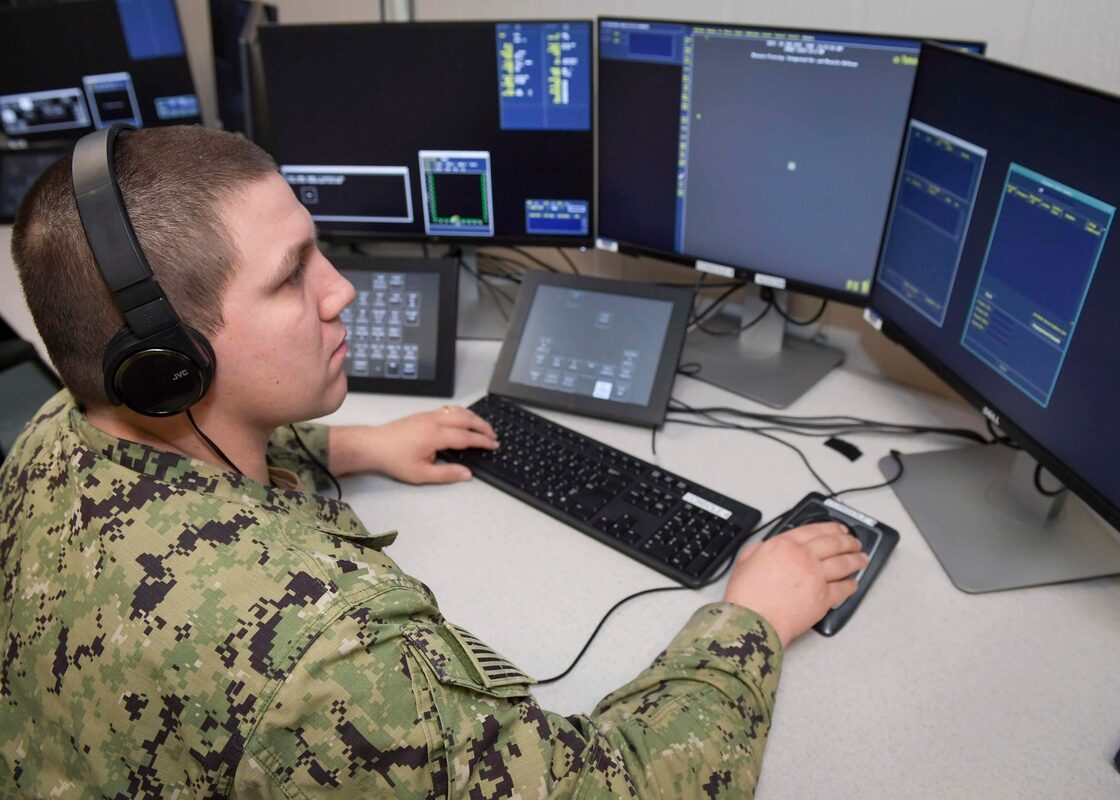
The Navy has committed up to $49.5 million to bring generative artificial intelligence into the courseware that trains sailors on surface and undersea combat systems, and it did so without a competition. Dignitas Technologies LLC of Orlando, Florida, received the firm-fixed-price and cost-plus-fixed-fee indefinite-delivery/indefinite-quantity contract on June 30, 2026, according to the Defense Department contract announcement.
The award, contract N6134026D1009, carries a ceiling of $49,500,000 and runs through June 2029. The Naval Air Warfare Center Training Systems Division in Orlando is the contracting activity, and all work will be performed in Orlando. The Pentagon listed the action as not competed and tied it to the Small Business Innovation Research program.
Background
Naval Air Warfare Center Training Systems Division, known across the training community as NAWCTSD, buys and sustains the simulators, courseware, and instructional systems that prepare sailors before they ever touch operational hardware. Its portfolio spans surface warfare, undersea warfare, and aviation training, and the command routinely turns to small businesses in the Orlando simulation cluster to build and refresh those systems.
This contract ties directly to an SBIR topic, N252-112, titled "Generative Artificial Intelligence for Course and Content Creation and Conversion." The topic sits within a broader Navy push, reflected in earlier solicitations such as topic N241-011 on generative AI for scenario generation and communications analysis, to use large language and generative models to speed the production of training material. Course and content creation has long been a labor-intensive, manual process: subject-matter experts and instructional designers write, storyboard, and convert curriculum by hand, and every hardware change or doctrine update forces another round of rework. The Navy's interest in generative AI centers on compressing that cycle. That interest is not abstract. Every time a weapon system receives a software update or a tactics manual is revised, the associated training material falls out of date, and instructors lose hours reconciling slides, simulator scripts, and assessments. Generative models that draft and convert that content promise to shrink the lag between a fleet change and the training that reflects it.
The SBIR program moves ideas through three phases. Phase I proves feasibility, Phase II builds a prototype, and Phase III fields the technology at scale, often through production or services contracts. What makes Phase III distinctive is its acquisition treatment: federal law lets agencies award Phase III work sole-source, without a new competition, provided the effort derives from work done under an earlier SBIR phase. That is the mechanism behind the Dignitas award, and it explains why a $49.5 million ceiling could be set outside full and open competition.
Key Details
The contract covers development, procurement, modernization, technical refresh, and sustainment of Navy Surface and Undersea training devices, systems, courseware, and curriculum. In practice that language gives NAWCTSD a single vehicle to order both new capability and long-term upkeep, spreading task orders across the roughly three-year period as requirements firm up.
The dual pricing structure matters. The firm-fixed-price portion suits well-defined deliverables, such as a fixed set of courseware conversions or a defined modernization package, where the government wants cost certainty. The cost-plus-fixed-fee portion covers the less predictable development and integration work, where the scope of applying generative AI to varied curriculum is harder to bound in advance. Combining both on one IDIQ lets the contracting office match the pricing arrangement to the risk of each task order.
The Pentagon announcement is explicit that the effort supports SBIR topic N252-112 and that the contract was not competed. Because a sole-source award tied to an SBIR topic is a Phase III action under the program's rules, that lineage is the legal basis for the non-competitive award. Completion is expected in June 2029. No funds will be obligated at the time of award beyond the establishment of the vehicle itself; individual task orders will draw against the $49.5 million ceiling as they are issued. The three-year window also gives the command room to phase adoption, starting with lower-risk courseware conversion before committing to broader, AI-generated curriculum across the surface and undersea training pipelines.
For Dignitas, the award converts earlier SBIR research into a multi-year production and sustainment relationship. The company is part of Orlando's dense simulation-and-training industry, which grew up around NAWCTSD, the Army's PEO STRI, and the University of Central Florida's modeling and simulation programs. Winning the Phase III vehicle positions the firm as the named provider for generative-AI courseware work on Navy surface and undersea training systems for the life of the contract.
What It Means for Contractors
The most transferable lesson here is strategic, not technical. SBIR Phase III is one of the few paths in federal contracting that lets a company reach a large, sole-source award without bidding against the field. A firm that wins a modest Phase I or Phase II topic, then delivers, earns a protected on-ramp: the sponsoring agency can hand it follow-on production or services work traceable to that original research, and competitors cannot force a re-compete. Dignitas turned an SBIR topic into a $49.5 million ceiling. Small businesses eyeing the defense market should treat SBIR not as grant money but as a positioning move toward exactly this kind of vehicle.
The award also signals where Navy training dollars are heading. Generative AI for course and content creation is no longer a research curiosity; the service is buying it as a fielded capability with sustainment attached. Contractors in the training, simulation, and instructional-design space should expect more solicitations that ask not just for courseware, but for the AI tooling to generate and convert it faster. Companies that can pair generative models with the security, accreditation, and configuration-management discipline the Navy demands will have an edge, because the government still needs auditable, doctrine-accurate output, not raw model text.
Finally, the structure of this deal is a template worth studying. A combined firm-fixed-price and cost-plus-fixed-fee IDIQ, capped at $49.5 million over three years, gives the government flexibility to buy both defined deliverables and open-ended development under one roof. Firms pursuing similar work should be ready to price both ways and to demonstrate they can manage the accounting and reporting that cost-reimbursement task orders require. For teams already holding SBIR topics in adjacent areas, the message is direct: the Phase III door is open, and the Navy is walking through it with generative AI.
