
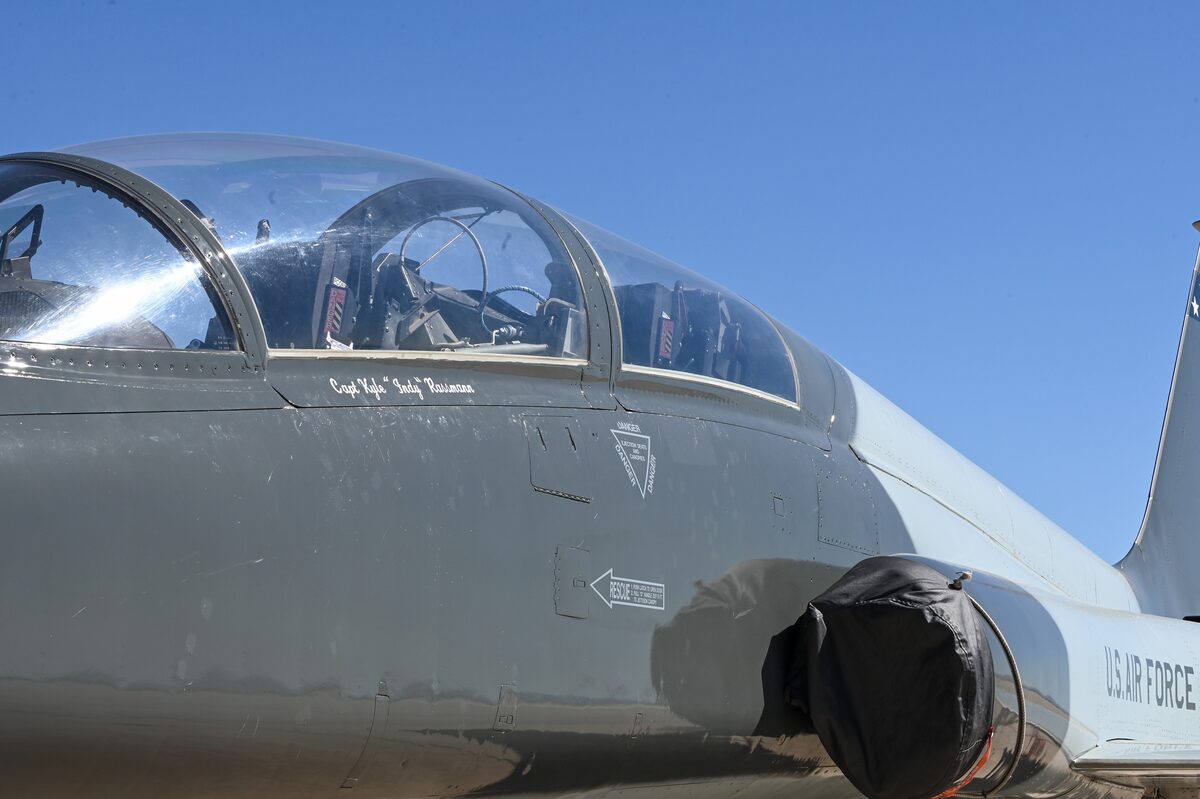
The Air Force's T-38 trainer fleet — the jet that every fighter pilot in the service flies before strapping into an F-15, F-16 or F-35 — just had its engine parts pipeline locked in through the end of the decade. The Defense Logistics Agency has awarded GE Aerospace a maximum $319,548,644 modification to keep J85 engine supplies flowing to the Air Force and Navy, according to the Aug. 28, 2026 Department of War contracts announcement.
The action, designated P00045, exercises the first of two remaining option periods on a six-year, three-month base contract — a two-year, four-month option running through Dec. 31, 2028. It is a firm-fixed-price, requirements-type deal, meaning GE Aerospace is obligated to fill whatever quantity of J85 parts and components the government orders over that option period. One one-year, five-month option period is left on the underlying contract, SPE4AX-20-D-9445, after this one.
What the $319.5 Million Option Actually Buys
The contract covers J85 engine supplies — the parts and components needed to keep the engine running, rather than new engine production. The J85 has powered the T-38 Talon since the trainer entered service in the 1960s, and it also equips F-5 variants still flown by the U.S. and allied air forces. Because the T-38 remains the Air Force's primary supersonic trainer for new pilots headed toward the F-15EX, F-22 and F-35, a gap in J85 spare parts availability translates directly into aircraft sitting on the ramp instead of training sorties in the air.
The award language is specific about scope. "This is a firm-fixed-price, requirements contract for J85 engine supplies," the Department of War announcement states, with using military services listed as the Air Force and Navy. Funding comes from a mix of fiscal 2026 through 2029 defense appropriated funds and defense working capital funds, reflecting the multi-year nature of a requirements contract where obligations get added as orders are placed rather than all at once at award.
Defense Logistics Agency Weapons Support in Richmond, Virginia, is the contracting activity managing the deal — DLA's role as the Pentagon's parts-and-supplies broker means it aggregates engine sustainment demand across the services rather than leaving each branch to negotiate its own J85 support separately. Consolidating the Air Force's and Navy's J85 parts needs into one requirements contract also gives GE Aerospace a single, predictable order stream to plan production against, instead of juggling separate, smaller buys from each service.
Why GE Aerospace Is Betting on AI for J85 Sustainment
The Aug. 28 modification is a straightforward exercise of a contract option, not a new competition. But it lands on top of a separate, more novel arrangement GE Aerospace struck with DLA earlier this year. In February 2026, the company won what it describes as its first digitally enabled "TrueChoice Defense" contract for the J85, applying artificial intelligence and data analytics — developed in partnership with Palantir — to forecast parts demand and flag supply constraints before they cause a shortage.
That AI-driven effort and the Aug. 28 supply modification both sit on the same J85 sustainment ecosystem, even though they are separate contract actions. Asha Belarski, general manager of military customer support for GE Aerospace Defense & Systems, described the goal behind the February AI contract this way: "By integrating data across the enterprise and applying AI to predict demand and identify constraints earlier, we are helping the Air Force keep more aircraft available to ensure our airmen get the training required to execute on their mission," she said, according to ExecutiveBiz. Her comment describes the predictive-analytics contract rather than the Aug. 28 parts-supply modification itself, but it frames why DLA is willing to keep extending GE Aerospace's role on an engine program built around avoiding exactly the kind of parts bottleneck that grounds trainer jets.
A Requirements Contract Built for a Six-Year Horizon
The structure of SPE4AX-20-D-9445 matters as much as the dollar figure. A requirements contract does not commit the government to a fixed quantity; it commits GE Aerospace to supply however much DLA orders during the period, up to the ceiling implied by the funding obligated. That structure lets DLA scale J85 parts orders up or down as flying-hour demand shifts, without having to renegotiate pricing or run a new competition every time requirements change. The tradeoff is that GE Aerospace carries planning risk on production capacity, which is part of why the February AI-forecasting contract — aimed at giving both sides earlier visibility into demand swings — sits alongside the core supply contract rather than replacing it.
With one more option period left on the base contract after this one, DLA is well positioned to keep GE Aerospace supplying J85 parts well past 2028 if that final option is exercised on schedule. The performance completion date tied to this modification, Dec. 31, 2028, marks only the end of the current option period, not the end of the underlying six-year, three-month base contract's full potential run.
What It Means for Contractors
The award illustrates an approach DLA has taken on the J85 program: pairing a long-running, options-heavy requirements contract with a separate digital or AI layer meant to improve forecasting on top of it, rather than folding predictive analytics into the base supply vehicle itself. For companies chasing legacy engine sustainment work, that means two distinct pursuit paths on the J85 — the core parts-and-components requirements contract, typically won through incumbency and long-term pricing relationships, and a newer category of data-analytics add-on work that DLA is beginning to procure separately, as it did with GE Aerospace's TrueChoice Defense award in February. Subcontractors and suppliers feeding into J85 production should also note the funding mix behind this modification: fiscal 2026 through 2029 money spread across appropriated and working-capital funds signals DLA expects steady, multi-year ordering rather than a single lump-sum buy, which is the kind of demand signal smaller suppliers can plan tooling and staffing around. Companies supporting other legacy trainer or fighter engine platforms, where DLA runs similar long-horizon requirements contracts, should expect the agency to keep testing whether AI-based demand forecasting, layered on top of existing supply vehicles, becomes a standard companion award rather than a one-off pilot.
