
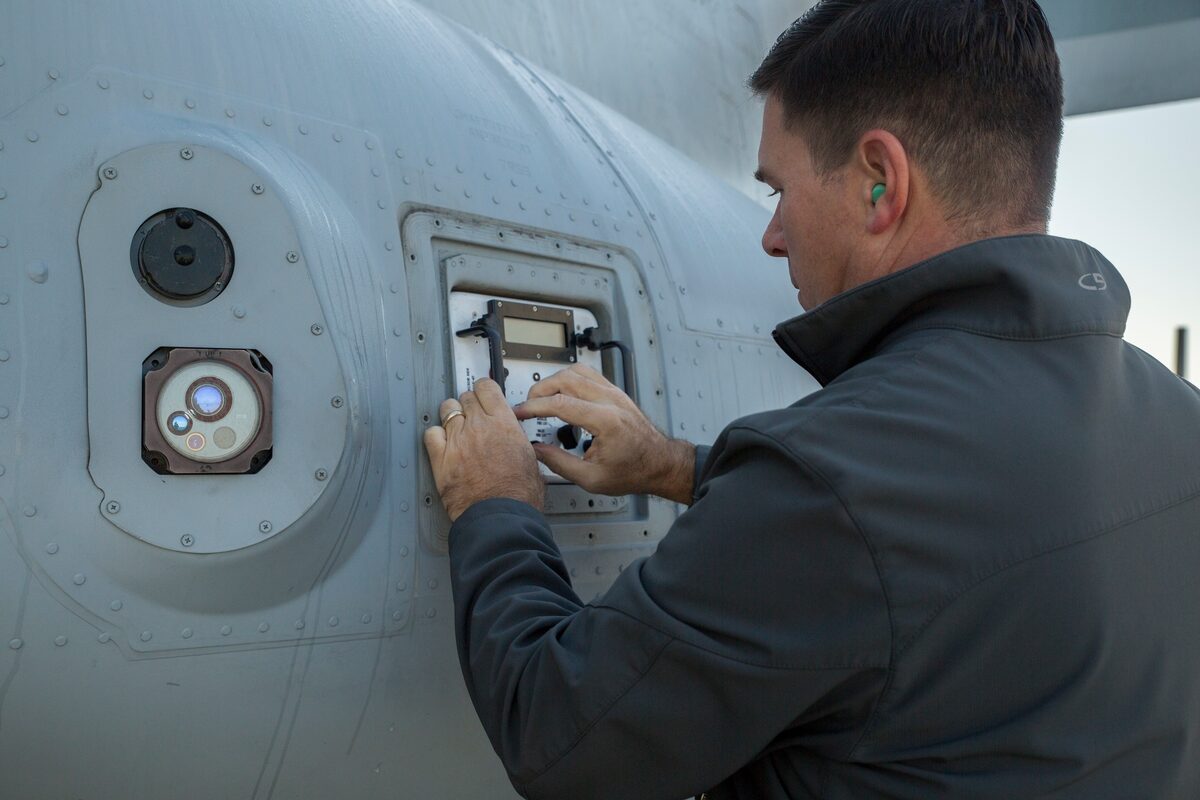
Air Force aircraft flying into contested airspace will keep drawing their self-protection countermeasures from the same Melbourne, Florida, production line for at least the next six years. The Air Force Life Cycle Management Center at Robins Air Force Base, Georgia, has awarded Symetrics Industries LLC — doing business as Extant Aerospace — a maximum $147,310,777 indefinite-delivery/indefinite-quantity contract, detailed in the Department of War's Aug. 28 contracts announcement, to keep producing line replaceable units and shop replaceable units for the ALE-47 countermeasure dispenser system. The award runs through Aug. 27, 2032, and follows a competitive acquisition in which the Air Force received two offers.
Inside the $147.3 Million ALE-47 Production Deal
The contract, numbered FA8523-26-D-0001, covers the hardware that keeps the ALE-47 dispenser fleet flying: line replaceable units, the modules technicians swap out on the flight line, and shop replaceable units, the internal components repaired or replaced in depot shops. The ALE-47 is the Air Force's standard countermeasure dispenser system, used across multiple aircraft types to release chaff and flares that defeat radar- and infrared-guided threats. Keeping a steady supply of LRUs and SRUs flowing matters directly to aircraft availability, since a dispenser with a failed component is a dispenser that can't protect the airframe it's mounted on.
According to the Department of War's own language, the announcement states plainly: "Symetrics Industries LLC, doing business as Extant Aerospace, Melbourne, Florida, has been awarded a maximum $147,310,777 indefinite-delivery/indefinite-quantity contract for the ALE-47 countermeasure dispenser system." The IDIQ structure means the $147.3 million figure is a ceiling, not a guaranteed spend — the government will place individual delivery orders against the contract as needs arise, up to that maximum, through the 2032 completion date.
That six-year window gives fleet planners and the units that depend on ALE-47-equipped aircraft a stable supply line to plan around, since the contract locks in a qualified production source for LRUs and SRUs through 2032 rather than leaving the sustainment pipeline to be re-competed sooner.
All work under the contract will be performed in Melbourne, meaning the award also functions as a jobs and capacity commitment to that single site rather than a multi-location production spread. Concentrating LRU and SRU manufacturing at one facility simplifies the Air Force's oversight of a single qualified production line, but it also means any disruption at that Melbourne site — supply chain, workforce or otherwise — has an outsized effect on ALE-47 parts availability fleet-wide until 2032.
Money obligated at the moment of award was comparatively modest against that ceiling: $1,104,613 in fiscal 2026 defense working capital funds, $1,813,528 in fiscal 2025 aircraft procurement funds for the Navy, and $2,200,686 in fiscal 2026 aircraft procurement funds for the Navy. That Navy funding line is notable because the contracting activity is an Air Force organization — a reminder that ALE-47 hardware also equips Navy airframes, and that individual delivery orders will carry Foreign Military Sales designations as allied operators of ALE-47-equipped aircraft place their own requirements against the vehicle. Foreign Military Sales designations are cited on individual delivery orders under the contract rather than built into the base award itself.
Extant Aerospace's Roll-Up Strategy Behind the Award
Extant Aerospace's win reflects more than a decade of consolidation in the electronic-warfare parts business. Extant Components Group acquired Symetrics Industries in 2010, and the combined operation has completed more than 50 acquisitions and exclusive license agreements since — deals with L3Harris, Collins Aerospace and GE among them, according to GovConWire's reporting on the award. That roll-up strategy has left the company supporting more than 10,000 part numbers, a breadth that positions it as a go-to supplier when the Pentagon needs a single source that can produce legacy components across multiple aircraft and dispenser generations rather than sourcing each part separately.
The Melbourne facility that will build the ALE-47 hardware is itself in the middle of an expansion. In July, Extant Aerospace announced an expansion of its Melbourne facility, adding manufacturing space and jobs to support continued production growth, according to GovConWire's reporting. The timing lines up: a company investing in floor space and equipment ahead of a multiyear IDIQ award is a company betting the government will keep placing delivery orders against it through the contract's full term, rather than letting the ceiling go largely unused.
The two-offer competition also matters for how the award reads. IDIQ vehicles for legacy sustainment parts frequently draw a single qualified bidder when a manufacturer holds proprietary technical data or is the only source with a working production line for out-of-production hardware. A field of two competitors for ALE-47 LRU and SRU work suggests at least one other firm believed it could meet the Air Force's technical and manufacturing requirements for this dispenser family, even though Extant Aerospace ultimately prevailed.
What It Means for Contractors
For companies in the electronic-warfare and aircraft-survivability supply chain, the award is a signal that the ALE-47 architecture is well positioned to remain in Air Force service well into the next decade. That's useful planning information for subcontractors and second-tier suppliers who feed parts into LRU and SRU production, since a six-year completion date gives them a firm horizon for their own component contracts.
The deal is also a case study in how legacy-platform sustainment work gets won: not through a single flashy proposal, but through years of acquiring smaller suppliers, license agreements and proprietary technical data packages until a company becomes the only realistic source — or one of very few — capable of competing for a program's replacement-parts business. Firms chasing similar sustainment IDIQs on other aging platforms should note that the winning bid here came from a company that had already spent 16 years buying up the supply base before this specific competition was ever announced. For prime contractors managing ALE-47-equipped aircraft fleets, the award removes near-term supply uncertainty for a critical self-protection component, and the Navy funding lines built into the initial obligation confirm that Navy aircraft, not just Air Force platforms, will draw parts from this same production run.
