
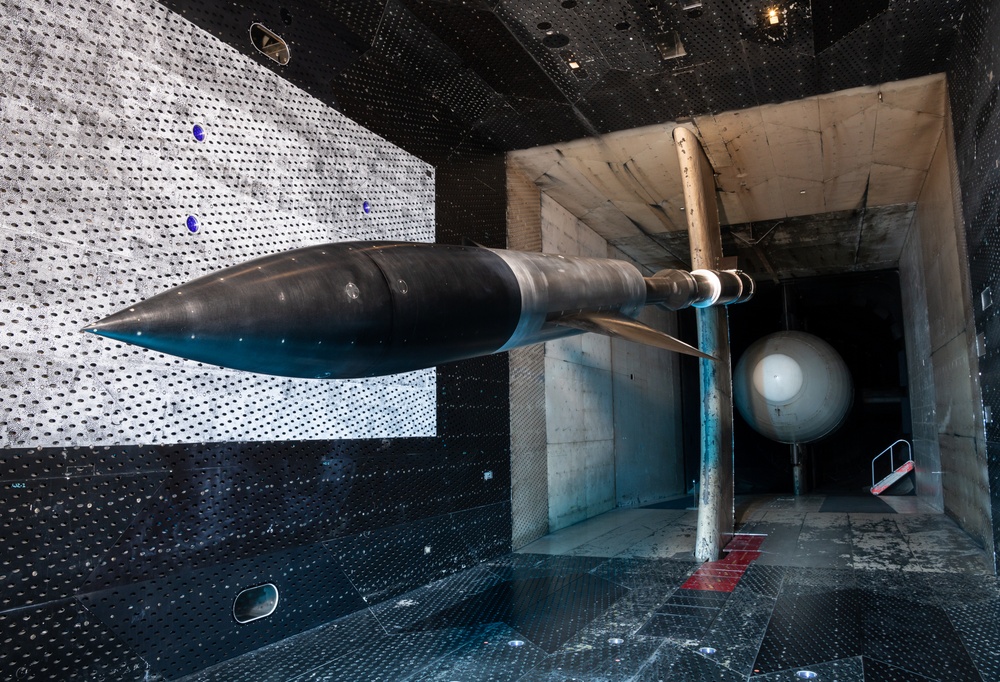
The Air Force's flagship ground-test complex just locked in eight construction and engineering firms to keep rebuilding wind tunnels, engine test cells and plant systems that largely date to the 1950s and 1960s. On Sept. 4, the Air Force Test Center at Arnold Air Force Base, Tennessee, awarded the Facilities Acquisitions for Restoration and Modernization III contract, a $900 million-ceiling, firm-fixed-price, multiple-award IDIQ with work expected to be completed by Sept. 4, 2034. Every company that bid won a seat.
The eight awardees, per the Department of War's daily contract list, are Healtheon Inc. of New Orleans (FA9101-26-D-B008); Edgewater Technical Associates LLC of Los Alamos, New Mexico (-B009); exp Federal Inc. of Chicago (-B010); Burns & McDonnell Engineering Co. Inc. of Kansas City, Missouri (-B011); Amentum Technology Inc. of Tullahoma, Tennessee (-B012); Shimmick Construction Co. Inc. of Irvine, California (-B013); Turner Construction Co. of Huntsville, Alabama (-B014); and Sea Pac Engineering Inc. of Los Angeles (-B015). The government obligated $8,000 in fiscal 2026 research, development, test and evaluation funds at award, which works out to the $1,000 contract minimum per awardee set out in the RFP cover letter, times eight.
What the $900M FARM III Ceiling Buys at Arnold and Six Satellite Sites
The contract announcement describes the work as "mechanical, electrical, instrumentation, data systems, and controls, and design-build projects for military ground testing facilities." Beyond Arnold itself, the announcement lists work at Holloman AFB, Kirtland AFB and White Sands Missile Range in New Mexico; Wright-Patterson AFB in Ohio; Mountain View, California, home of the National Full Scale Aerodynamics Complex; and White Oak, Maryland, home of Tunnel 9.
The statement of work attached to the RFP lays out why the Air Force keeps signing these vehicles. "AEDC provides the most comprehensive set of aerospace ground test facilities in the world," the SOW states, listing wind tunnels spanning subsonic through hypersonic speeds, altitude test cells sized for large commercial-type turbofans and fighter engines, large rocket motors, and facilities that simulate space environments and reentry speeds and temperatures.
The same document is blunt about the state of the plant. Facilities at Arnold and its geographically separated units "were primarily built in the 1950s and 1960s with a few additions in the 1990s." It continues: "For decades, the restoration and modernization of test plant and test infrastructure was underfunded, resulting in diminished test capability and increased energy and maintenance costs." Air Force leadership secured funding for major investment beginning in fiscal 2017, and FARM I carried that spending through FY22. FARM II followed but expires in FY27, which is the gap FARM III fills.
How the Air Force Picked Eight Winners Without a Price Tradeoff
The Air Force ran this competition under the Highest Technically Rated Offeror method rather than a conventional best-value tradeoff. The RFP cover letter, dated April 24, 2026, states the requirement "is being solicited as full and open competition, utilizing Highest Technically Rated Offeror (HTRO) method for evaluation," with a target of eight contracts, a $900 million not-to-exceed value, and an eight-year period built from a three-year base, a three-year option and a two-year option. Task orders cap at $50 million each. Proposals were due May 26, 2026.
A December 2025 request for information, the second in the market research effort, explained the logic of HTRO to industry. The approach "allows awards to the highest technically rated proposals that are also found to have a realistic and reasonable price without using trade-offs between cost or price and technical," the RFI stated. It also asked bidders to comment on a draft HTRO scoring matrix and to disclose their Joint Certification Program status, which the SOW requires of any contractor needing access to export-controlled data.
Eight offers came in and eight contracts went out, so the HTRO gate did not eliminate anyone. The real competition begins now at the task-order level. The SOW says task orders "will be competed by Fair Opportunity Proposal Request (FOPR) using either a Lowest Price Technically Acceptable (LPTA) or a full tradeoff source selection process," with the method defined in each order. Task orders can be design-build, two-phase design-build or straight construction.
The RFP cover letter frames the objective plainly: "The ultimate goal is to support the critical research, development, test, and evaluation (RDT&E) mission at AEDC."
Working Around a 24/7 Test Schedule
FARM III contractors will not get an empty building to work in. The SOW makes clear that construction bends to the test calendar. "For purposes of scheduling, AEDC maintains a 24/7 testing schedule," it states. Any outage a contractor needs on a test facility, plant equipment or support utility must be requested in writing and coordinated with the Mission Integration Group through the government representative. Outages of three days or less require at least 60 days' notice; longer outages require 120 or 180 days. Contractors must do as much preliminary work as possible before an outage begins and confirm in advance that the system can be brought back online before the outage window closes.
SAM.gov's award notice for Turner Construction, posted Sept. 4 under solicitation FA910126RB011, records contract FA910126DB014 at the shared $900 million ceiling with a Sept. 4, 2026 award date, under NAICS 236220 with product service code Y1QA.
What It Means for Contractors
For the eight primes, the award is a hunting license, not a paycheck. The $1,000 guaranteed minimum per company, satisfied by a task order for attending a virtual post-award conference, means revenue depends entirely on winning fair-opportunity task orders over the next eight years, and the $50 million per-order cap keeps individual projects mid-sized. Firms with an Arnold-area presence, such as Amentum in Tullahoma, start with a logistics advantage, but the satellite sites in New Mexico, Ohio, California and Maryland spread the opportunity across the country.
For subcontractors and specialty trades, the mix of awardees signals demand for controls engineers, instrumentation integrators, high-voltage electrical crews and mechanical contractors comfortable with large plant equipment. Companies that missed the FARM III window can still position for task-order teaming, and the RFI's emphasis on Joint Certification Program status suggests primes will favor partners already cleared to receive unclassified military technical data.
For the broader test-and-evaluation market, FARM III confirms that the modernization money the Air Force began spending in FY17 is still flowing. With FARM II expiring in FY27 and hypersonic, engine and space testing all part of Arnold's portfolio, the Air Force chose an eight-year vehicle over a shorter bridge, a sign that the service expects the plant restoration effort to continue well into the 2030s.
Sources
- SAM.gov Award Notice: FA910126RB011 FARM III RFP (Turner Construction Co., FA910126DB014)
- Department of War: Contracts for Sept. 4, 2026
- SAM.gov Solicitation FA910126RB011: FARM III RFP Cover Letter and Statement of Work
- SAM.gov Sources Sought FA9101-25-R-FARMIII: RFI No. 2
- GlobalSecurity.org mirror: Contracts for Sept. 4, 2026
