
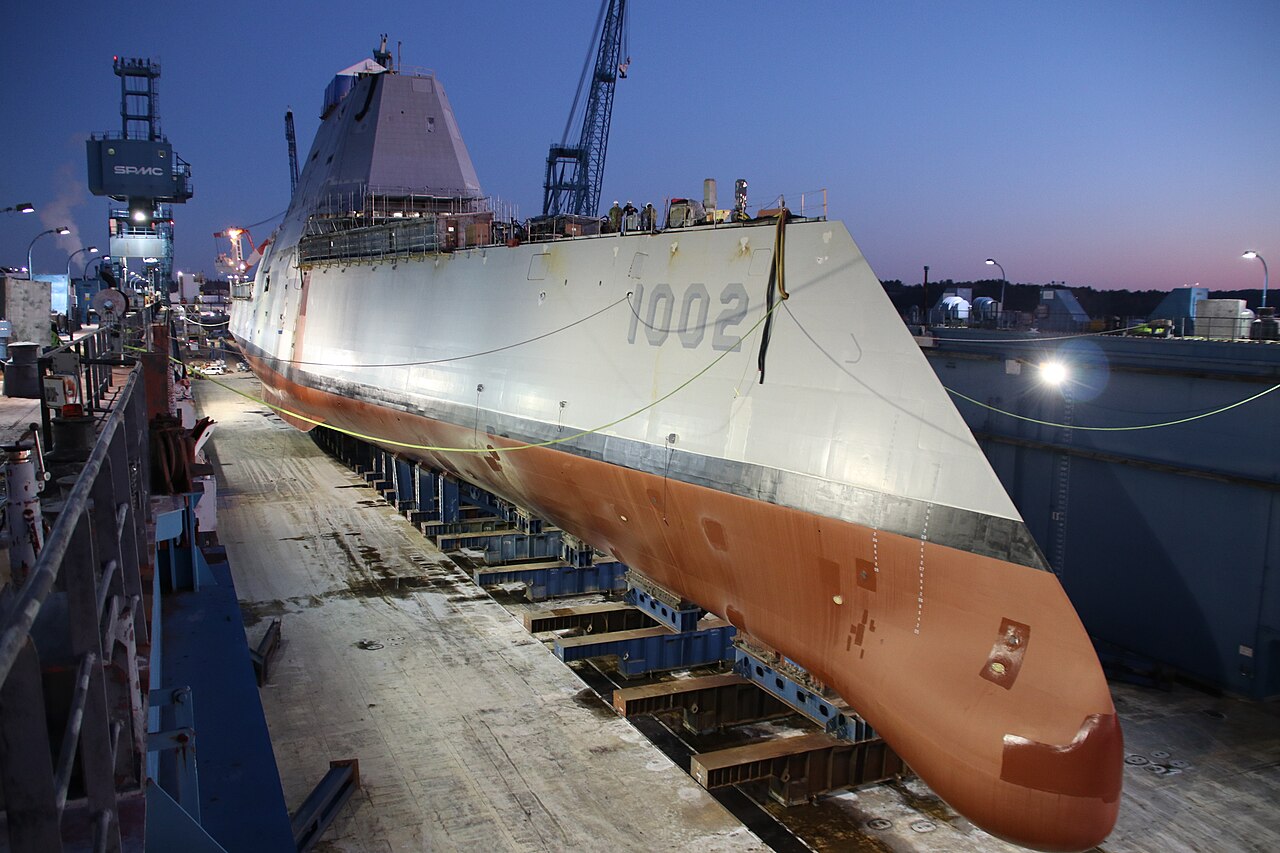
The last of the Navy's three Zumwalt-class destroyers is heading toward open water. HII's Ingalls Shipbuilding division has received a $99 million contract modification to run sea trials for the future USS Lyndon B. Johnson (DDG 1002), a ship the Navy is also fitting out as its second platform for the Conventional Prompt Strike (CPS) hypersonic weapon. The award moves a hull that arrived at the Pascagoula, Mississippi, yard in January 2022 into the sea trials phase that precedes delivery.
Ocean News & Technology reported the modification on Oct. 20, 2026, and Times of Defence followed on Oct. 21. Both outlets put the value at $99 million. Neither report gave a contract number or a specific award date, and this article does not state either.
What the $99M Modification Covers
According to Times of Defence, the money pays for "comprehensive combat system testing and sea trials" on DDG 1002, which the outlet describes as "the third and final Zumwalt-class stealth guided-missile destroyer." Ocean News describes the scope more narrowly as conducting sea trials for the ship. The two descriptions fit together: Ocean News says the ship went to Ingalls to complete installation, activation and testing of its combat systems, and the new funding carries that work through system testing and onto the water.
Times of Defence frames the award as support for "the final phase of the Navy’s multi-stage delivery strategy at Ingalls Shipbuilding in Pascagoula, Mississippi." That phrase matters for anyone tracking the program. For DDG 1002, construction and completion were handled at different yards rather than the Navy taking a finished warship from a single builder.
Ingalls Shipbuilding president Brian Blanchette tied the award directly to that approach. “This award reflects the Navy’s continued confidence in the Ingalls team to execute the critical system test and sea trials work essential to the Navy’s phased delivery approach,” Blanchette said, according to Ocean News. He added: “Our shipbuilders are proud to help deliver DDG 1002 and prepare her for future fleet operations.”
Why a Bath-Built Destroyer Is Finishing in Pascagoula
Times of Defence reports that the ship arrived at Ingalls in January 2022 following initial construction at General Dynamics Bath Iron Works in Maine. Ocean News says the ship arrived "to complete the installation, activation, and testing of the combat systems." Times of Defence lists Ingalls as the "Combat System / CPS Retrofit Yard" for the ship.
That arrangement means two of the largest U.S. surface shipbuilders have each touched DDG 1002. Bath did the initial construction; Ingalls has handled combat-system work and, now, the trials that will test whether the integrated ship performs as designed. The $99 million modification covers the step that takes the ship from pierside work to underway testing.
Ocean News describes the Zumwalt class as featuring "a state-of-the-art electric propulsion system, wave-piercing tumblehome hull, stealth design," and says the ships will be capable of "deterrence, power projection, sea control, and command and control missions." Those design features have made the class an unusual testbed. With only three hulls, each ship carries a large share of the program's integration risk.
How DDG 1002 Becomes a Hypersonic Strike Ship
The sea trials will cover more than a conventional destroyer. Ocean News reports that while at Ingalls the Lyndon B. Johnson "is also receiving modernization upgrades that include integration of the Conventional Prompt Strike (CPS) weapon system, as the Navy’s second CPS-equipped platform." Times of Defence says the ship follows its sister, USS Zumwalt (DDG 1000), in that conversion.
Times of Defence provides more detail on the physical changes, though Ocean News does not confirm them. The outlet says the modernization removes the ship's "legacy 155 mm Advanced Gun Systems (AGS)" and installs "four large-diameter 87-inch Multiple Launch Tubes" to carry CPS hypersonic glide vehicles. In its own assessment, Times of Defence says the Zumwalt class faced operational redundancy after long-range projectile procurement was abandoned because of unsustainable unit costs.
If the outlet's account holds, the Lyndon B. Johnson that goes to sea will differ physically from the ship that first arrived at Pascagoula. Sea trials on a converted hull test more than propulsion and navigation. They also put a weapon the class was not originally designed to carry into the mix of systems being tested.
What Comes Next for the Zumwalt Program
Neither outlet published a schedule for when the trials will start or when the Navy expects to accept the ship. Blanchette's statement ties the work to preparing DDG 1002 "for future fleet operations," and Times of Defence calls the funding the "final phase" of the delivery strategy at Ingalls. Taken together, the sources describe this modification as the last phase of the Ingalls delivery strategy, but they do not say when the ship will join the fleet.
As the second CPS-equipped platform, DDG 1002 will also draw scrutiny. Its results will be an early indication of whether the conversion can be repeated on a second hull rather than remaining a one-off engineering effort.
What It Means for Contractors
The modification keeps a high-profile combat-system and weapons-integration job anchored at Ingalls in Pascagoula. Firms that supply test, engineering and trials support to shipyards on the Gulf Coast may see that work continue through the trials period, since the award covers system testing as well as time at sea.
The award also shows how the Navy handles low-quantity, high-complexity ships. With construction at Bath Iron Works and combat-system completion at Ingalls, the work on DDG 1002 spans two shipbuilders, and this $99 million award is a modification, which means it changes an existing Ingalls contract rather than opening a new one. Subcontractors who want a role on similar programs should build relationships with the prime holding the phase they want to support, not just the original builder.
Contractors in the hypersonics supply chain should also watch this ship. Ocean News and Times of Defence both identify DDG 1002 as the second CPS-equipped platform. Its trials should produce shipboard integration experience relevant to anyone supplying launcher hardware, ship power and thermal management, or combat-system integration for long-range strike weapons.
Finally, the absence of a published contract number and award date in the outlet reports means firms tracking the obligation should confirm details through official Navy contract announcements before relying on them for capture planning.
