
The Navy has locked in nearly six years of engine parts logistics for its F/A-18 E/F/G fleet, awarding General Electric Co. a $2.87 billion performance-based logistics contract covering the components that keep the Super Hornet and Growler's F414 engines running through 2031. The award, one of the largest single-line entries in the Department of War's September 1 contract announcement, gives GE responsibility for sustaining 17 separate F414 engine components rather than just selling parts as they wear out.
The contract, worth $2,874,696,513 on a not-to-exceed, ceiling-price basis, was issued to GE's Lynn, Massachusetts plant, with 90 percent of the work performed there and the remaining 10 percent in Jacksonville, Florida. Naval Supply Systems Command Weapon Systems Support in Philadelphia is the contracting activity. Work runs for five years with no option periods, and the government expects the effort completed by August 2031.
What the $2.87 Billion Covers
The Navy's contract notice describes the scope in a single sentence: GE "is being awarded $2,874,696,513 for a not-to-exceed/ceiling-price performance-based logistics contract to provide logistics support for 17 F414 engine components in support of the Navy's F/A-18 E/F/G aircraft." That is the F/A-18E and F/A-18F Super Hornet strike fighters and the EA-18G Growler electronic-attack variant, all three built around the F414 turbofan.
Performance-based logistics contracts differ from traditional parts-buying arrangements in a specific way: instead of the government ordering individual spares and repairs as failures occur, the contractor is paid to guarantee a level of parts availability and reliability across the covered components for the life of the agreement. For an engine family that has powered the Navy's carrier-based strike fighters for two decades, that shifts the sustainment risk — and the incentive to keep failure rates down — onto GE rather than the fleet's maintenance depots.
Why the Navy Went Sole-Source
The award notice specifies that only one offer was received, and the contract was solicited and negotiated as a sole-source procurement rather than a competed award. That is typical for engine sustainment work tied to a proprietary design: GE built the F414 and holds the technical data and repair processes that make it the only realistic source for logistics support on components specific to that engine. The Pentagon's contract announcements routinely note offer counts precisely because a single-offer, sole-source award draws more scrutiny than a competed one, and this one clears that bar by pointing to GE's position as the engine's original manufacturer.
Funding at award is only a fraction of the ceiling value. The Navy obligated fiscal 2026 working-capital funds through delivery order N00383-26-F-UA01, committing $198.22 million and obligating $148.67 million of that — 75 percent — at signing. The remaining ceiling will be funded incrementally as the Navy issues additional delivery orders against the five-year vehicle, a structure common to large PBL contracts where the total ceiling represents a spending cap rather than money guaranteed to be spent.
A trade outlet covering the award, Investing.com, reported that General Electric "received a $2.87 billion contract from the U.S. Department of War to provide logistics support for F414 engine components used in the Navy's F/A-18 E/F/G aircraft." The outlet added that "the five-year performance-based logistics contract covers 17 F414 engine components and has no option periods," with the work expected to be completed by August 2031 — a timeline that lines up exactly with the Navy's own contract notice.
An Engine the Navy Cannot Afford to Ground
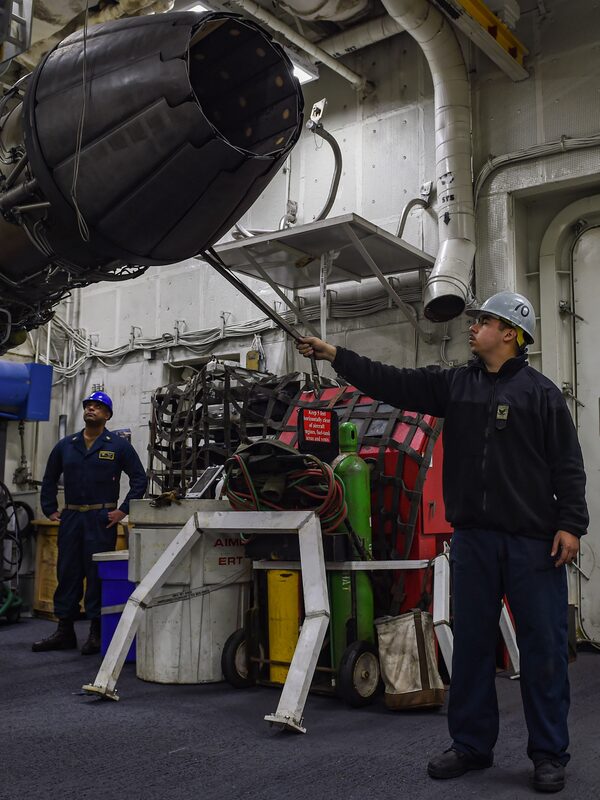
The F414 is not a niche program. General Electric's turbofan powers every F/A-18E/F Super Hornet and EA-18G Growler in the Navy's carrier air wings, making it one of the most heavily flown engine families in naval aviation. Seventeen components under a single PBL umbrella suggests the Navy is consolidating sustainment for a meaningful slice of that engine's supply chain under one contractor rather than managing separate spares contracts component by component — a pattern the service has leaned on increasingly for legacy tactical aircraft it plans to keep operating for years even as newer platforms come online.
The Super Hornet and Growler fleets fly off Navy carrier air wings, and each sortie puts wear on the specific engine hardware this contract now covers. A five-year sustainment horizon without option periods also means the Navy has committed to a fixed end date rather than an open-ended relationship it could extend or cut short year by year, which gives both the service and GE a firm planning window for spares production, depot scheduling, and workforce staffing at the two award locations through August 2031.
The split between Lynn and Jacksonville also matters for how the work actually gets done. Lynn has been GE Aerospace's military engine manufacturing hub for decades, while the Jacksonville share points to depot-level repair and overhaul capacity closer to Navy fleet concentrations on the East Coast. Structuring the contract across both sites lets GE draw on original-manufacture expertise at Lynn while keeping a portion of the sustainment workload closer to where the aircraft actually operate.
What It Means for Contractors
This award reinforces a pattern the Pentagon has followed for years on legacy engine programs: once an original equipment manufacturer wins a PBL contract for a platform's sustainment, that relationship tends to run in five-year increments with the incumbent holding a structural advantage on the next award. Competitors hoping to break into F414 sustainment work would need to clear the same sole-source justification GE relies on — proprietary technical data and repair processes the government doesn't otherwise control — which is a high bar absent a deliberate Navy decision to open the data rights.
For subcontractors and suppliers, the more immediate opportunity sits inside GE's own supply chain in Lynn and Jacksonville rather than at the prime-contract level. A $2.87 billion ceiling spread across 17 components and five years of incremental delivery orders means GE will be sourcing repair parts, testing services, and possibly overhaul capacity at scale, and only 75 percent of the initial delivery order's committed funds were obligated at signing — meaning more orders, and more subcontracting demand, are still coming as the Navy funds the remainder of the working-capital commitment through 2031.
