
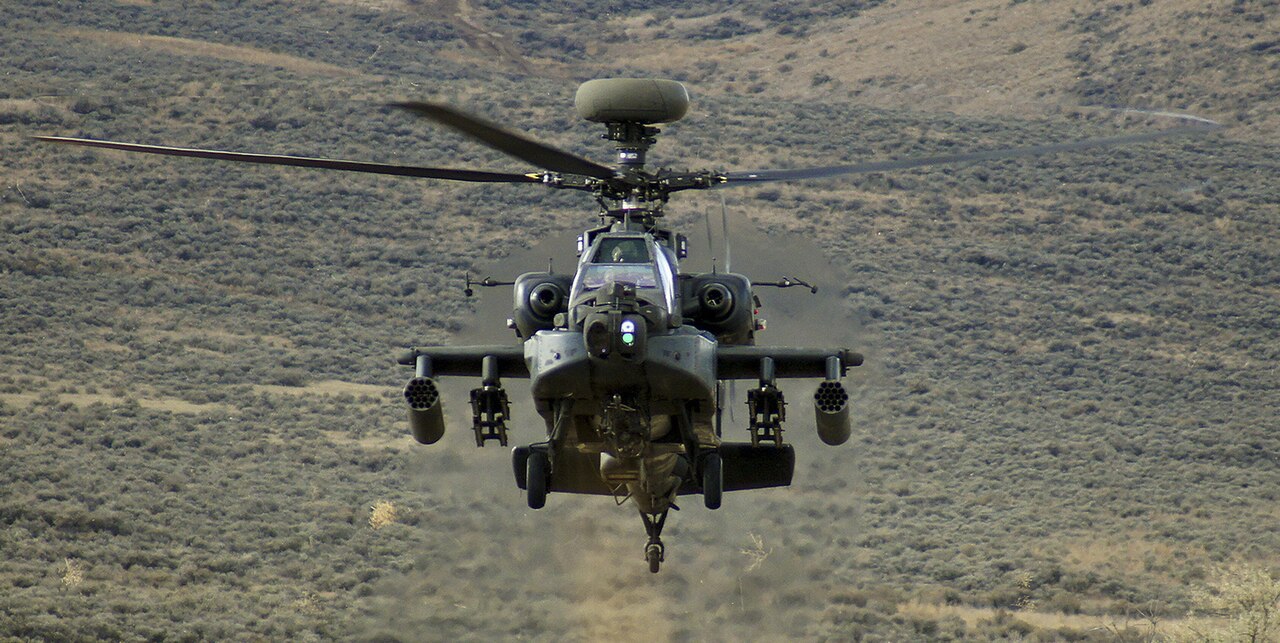
Israel has kept its place in Boeing's AH-64E Apache production line, but it paid for that place with money from a civilian program, after a budget fight in Jerusalem had already pushed the deal past a U.S. deadline. Israel is set to acquire 12 Apache "Echo" attack helicopters from Boeing, Defense News reported, citing an Israeli ministry of defense announcement this week. Deliveries are scheduled for the beginning of the next decade.
The deal was signed on Wednesday, Oct. 14, the same day an urgent Cabinet phone vote approved a funding source. That source was a long-term, non-defense national program. Business daily Globes reported that most of the money came from the government's five-year plan for Israel's Arab society.
How a Missed Oct. 7 Deadline Nearly Sank the Apache Buy
The helicopter purchase stalled for months over a dispute between Israel's finance and defense ministries. According to Defense News, the finance ministry wanted budget adjustments and a defined funding source. The defense establishment wanted the procurement approved as "urgent," regardless of the wider budget debate.
The U.S. granted several extensions while the two ministries argued. The last of them ran out on Oct. 7, 2026, and Israel missed it. Defense officials told Globes that the final signing deadline "passed last week following four extensions the Ministry of Defense had managed to secure from the US administration." Globes had reported the previous week that the deal was cancelled after the Ministry of Finance rejected the proposed financing solutions.
The missed deadline raised a practical worry in Israel: Boeing could give the production slot to other international customers. Defense News reported that the concern was delivery delays and higher prices. Israeli defense officials asked their U.S. counterparts for one more extension. The Americans agreed to what Israeli officials called a "final window," on the condition that Israel sign immediately. That condition led to the Cabinet phone vote and the same-day signing.
Where the NIS 1 Billion Came From
Globes reported that the government approved an additional NIS 1 billion, most of it reallocated from the five-year plan for Israeli Arab society. "NIS 1 billion of the extra money is earmarked for the purchase of Apache helicopters for the IDF," Globes wrote. Defense officials put the figure at about $288 million and said it comes from future budgets.
The reallocation hits the plan's 2027-2029 allocations. It came alongside a separate across-the-board budget cut of about NIS 2.6 billion to fund urgent defense procurement from the 2026 budget. Globes called the cut unusual given its timing, on the eve of Knesset elections, and said the choice of the Arab society plan as a funding source "is a political move." According to Globes, the Ministry of Finance learned of that choice only on the morning of the vote.
Defense officials described a much larger gap behind the scramble. "The defense establishment is facing a severe budget shortfall of NIS 40 billion for 2026," they told Globes, adding that funds promised by a prime ministerial decision in June had not been transferred. They said the money for the Apache deal itself will come from deferring payments on other defense transactions. In their account, the cut to future years' budgets is a technical accounting step the finance ministry required before it would allow the signing.
The NIS 1 billion is the funding diverted to make the signing possible. It is not the price of the helicopters. Neither Defense News nor Globes reported a contract value for the Boeing sale, and no U.S. foreign military sales notification for the 12 aircraft was reviewed for this article.
Why Smotrich Called the Apache Deal a Mistake
Finance Minister Bezalel Smotrich opposed the purchase on the day it was signed. Speaking at an Israel Investment Houses Association conference, he said: "There is a deal to purchase 12 Apache helicopters that is due to be signed today. I believe this deal is a mistake, and I stated this at the Ministerial Committee on Procurement."
He argued that the mission could be met for less money. "The functionality provided by Apache helicopters can be achieved by cheaper means," Smotrich said, pointing to AI-powered drones that can be "developed, purchased, maintained, and operated for this purpose."
Smotrich also explained why the funding fight came to a head. He said the purchase was approved in August on a specific payment schedule, but payment turned out to be required sooner, and the law did not allow him to authorize the Accountant General to sign a financial commitment. He described the reallocation as temporary and said, "We never committed to the five-year plan for Arab society." He said funding sources would be sorted out during the 2027 budget discussions.
What the AH-64E 'Echo' Adds to the IDF Fleet
The AH-64E is a twin-engine, tandem-seat attack helicopter. Defense News reported that its weapons and targeting suite carries up to 16 Hellfire missiles, 76 2.75-inch rockets and an M230-series 30mm automatic chain gun with up to 1,200 rounds.
The E model also brings networking that earlier Apaches lack. It has Link 16 connectivity, manned-unmanned teaming that lets the crew control drones, and a modular open systems approach designed so hardware and software changes can be integrated over time. That drone-control feature bears on Smotrich's objection: the aircraft Israel signed for is a crewed helicopter built to work alongside unmanned systems.
What It Means for Contractors
For Boeing and the U.S. Apache supply base, the deal adds a 12-aircraft order with deliveries starting early next decade. It also shows how a production slot works in practice. The U.S. gave Israel four extensions, then one last window with a sign-now condition, and Israeli officials worried openly that the slot would go to another customer. The production line ran on its own schedule, and the buyer's domestic politics had to fit around it.
The deal also shows that a foreign government's approval does not always settle its financing. Smotrich said the purchase was approved in August, yet the deal nearly collapsed in October because the payment schedule moved and Israeli law blocked the commitment. Suppliers working on foreign sales should track the buyer's budget calendar and treasury approvals, not just the ministry of defense's decisions.
The funding is also unsettled. Defense officials describe a NIS 40 billion shortfall for 2026 and say the deal's money comes from deferring payments on other transactions. Smotrich says the Arab society plan diversion is temporary and will be revisited in the 2027 budget. Companies holding other Israeli defense contracts should watch whether those deferred payments touch their programs. They should also watch how the next government, chosen in the coming Knesset elections, handles the 2027 defense budget.
