
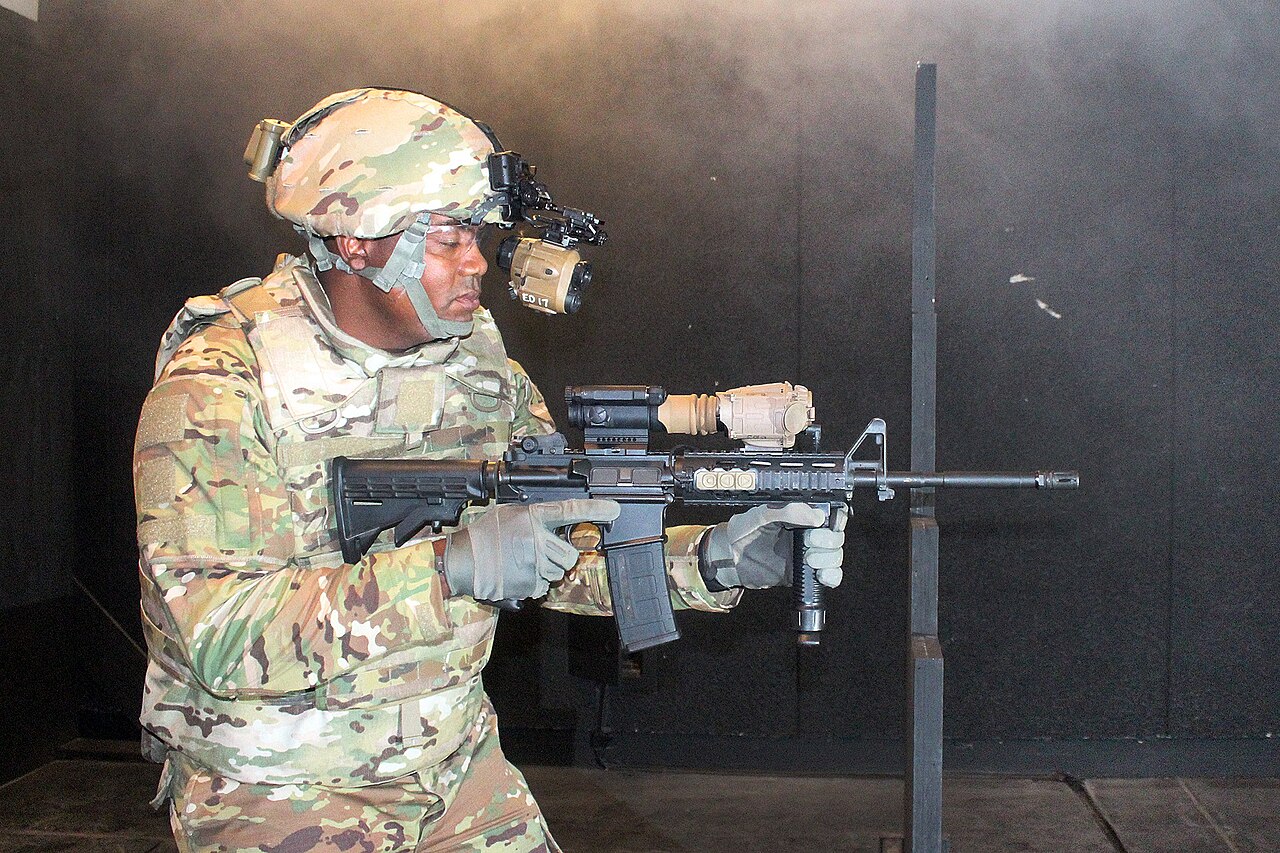
The Army is buying more of the thermal weapon sight that lets soldiers see what their weapon sight sees through a helmet display, extending a production line that Leonardo DRS has been feeding since 2022. The company announced Oct. 13 that it received a $63 million production order from the U.S. Army for its Family of Weapon Sights – Individual, or FWS-I, system. The order did not require a new competition: the Army placed it under its existing indefinite-delivery/indefinite-quantity contract for thermal weapon sight systems supporting dismounted soldiers.
The release does not give a delivery schedule, a quantity of sights, or a period over which the company expects to recognize the revenue. It does not name the Army contracting office that issued the order.
What the $63M FWS-I Order Buys
Leonardo DRS describes FWS-I as "a lightweight, uncooled thermal imaging system designed to wirelessly integrate" with soldier-worn vision devices, naming the Enhanced Night Vision Goggle–Binocular (ENVG-B) and the Integrated Visual Augmentation System (IVAS). According to the release, "This wireless connection allows soldiers to view thermal imagery from the weapon sight through their helmet-mounted display, enabling rapid target acquisition without needing to shoulder the weapon."
The sight uses uncooled infrared technology, which the company says provides thermal imaging "without the need of cryogenic cooling." Its clip-on design, according to the release, "provides flexibility for use across multiple weapon platforms."
Army Recognition, a defense trade outlet, adds program detail that the DRS release does not carry. It reports that the battery-operated sight can work as a stand-alone thermal weapon sight, a handheld observation device, or an in-line clip-on system mounted ahead of an existing day optic, and that the clip-on arrangement preserves the zero of the primary day optic. The outlet cites Army program data listing a weight below two pounds, an 18-degree field of view, a stated range exceeding 960 meters and approximately seven hours of operation with one battery change. Leonardo DRS specifies 1x-to-3x magnification, according to the same report.
The capability the Army is paying for is less the sight itself than the link. Army Recognition says the Army describes its Rapid Target Acquisition capability as spatially aligning the FWS-I thermal image and weapon reticle with the soldier's field of view, allowing that information to be overlaid in the helmet-mounted display.
How the FWS-I IDIQ Has Grown Since 2022
The new order is the latest in a series. According to Army Recognition, Leonardo DRS "announced the underlying five-year FWS-I contract, valued at $579 million, in October 2022, followed by a production order of more than $134 million in 2023 and another $117 million order in August 2024." The October 2026 release itself does not restate that history; the figures come from Army Recognition's reporting.
Taken together, the orders Army Recognition lists plus the new award come to more than $314 million placed against a five-year vehicle the outlet values at $579 million. A five-year term announced in October 2022 would run to roughly late 2027. Neither the company nor the Army has said publicly whether options or a follow-on contract are planned.
Defense Daily carried the award in its Oct. 16 Defense Watch column, reporting that the $63 million order was for continued deliveries and "was placed under the company's current FWS-I IDIQ contract." The same column reported that L3Harris Technologies received a $55 million full-rate production award from the Army for its NOVA night-vision goggle systems, a reminder that the service is spending on several layers of soldier sensing at once.
Why DRS Executives Frame FWS-I as Connected-Soldier Spending
Company leadership pitched the order as part of the Army's broader push to network individual soldiers rather than as a stand-alone optics buy. "Modernization at the tactical edge depends on giving soldiers the information they need without adding unnecessary complexity," said John Baylouny, president and chief executive officer of Leonardo DRS. He added that "The FWS-I production order reflects the Army's continued focus on advanced sensing, connected soldier systems and mission-ready capability."
Jerry Hathaway, senior vice president and general manager of Leonardo DRS Electro-Optical Infrared Systems, focused on the hardware. "This cutting-edge technology ensures soldiers will have the most advanced weapon sight systems on the battlefield today," Hathaway said. "FWS-I combines advanced uncooled thermal imaging with soldier-worn display integration to help improve target acquisition and situational awareness for dismounted soldiers."
The release ties the award to DRS's broader electro-optical and infrared business, noting that the company also supplies EO/IR technology for mounted and unmounted operations, airborne platforms and aircraft survivability.
What It Means for Contractors
For firms tracking soldier-lethality spending, the FWS-I order shows how much of the Army's dismounted sensing budget can move through orders on established IDIQ vehicles rather than through new solicitations. A $63 million order placed on an existing contract generates no new competition; the opportunity window for most companies opened and closed when the base contract was awarded in 2022. Firms that want a share of future thermal-sight work should watch for the next generation of this vehicle, given the roughly five-year term Army Recognition reports.
The wireless link to ENVG-B and IVAS-class displays also matters below the prime level. FWS-I's value depends on interoperability with helmet-mounted systems, and the Army also funds other soldier-worn night-vision equipment, as the L3Harris goggle award in the same Defense Daily column shows. Suppliers of uncooled infrared detectors, batteries, wireless modules, mounts and display integration software could find demand in these supply chains as production orders flow down on the prime vehicle.
Small businesses and component makers should note the details the release leaves out: quantity, delivery timing and production location. With more than $314 million in orders reported against the $579 million vehicle, the remaining ceiling and the program's out-year funding will decide how much additional production work reaches the supplier base before any recompetition.
Sources
- Leonardo DRS Strengthens Dismounted Soldier Modernization With $63 Million FWS-I Production Order (Leonardo DRS GlobeNewswire release, Oct. 13, 2026, via Finviz)
- U.S. Army to Receive Advanced Leonardo DRS FWS-I Thermal Weapon Sights Under $63M Order (Army Recognition)
- Defense Watch: RTX C-UAS Award, MQ-25 Software Test, PrSM Inc. 4, Taiwan V-BAT, Autonomous Black Hawk (Defense Daily, Oct. 16, 2026)
