
Background
The Military Sealift Command (MSC) operates the U.S. Navy's non-combatant fleet, including cargo ships, tankers, and charter vessels that move equipment, fuel, and supplies for the military worldwide. MSC's authority to charter commercial vessels is a longstanding mechanism for supplementing organic sealift capacity without committing major amphibious ships to routine logistics missions. Naha Port, on the main island of Okinawa, is Japan's largest commercial port in the Ryukyu island chain and the primary maritime gateway for U.S. forces stationed there. Japan's southwestern islands — stretching roughly 750 miles from Kyushu to Yonaguni, just 70 miles from Taiwan — have become the central geography in U.S. Pacific defense planning since the Marine Corps Force Design 2030 restructuring that stood up the Marine Littoral Regiment concept. Roll-on/roll-off (RO/RO) vessels with bow ramps are distinct from standard cargo ships: military vehicles, trucks, and equipment drive directly aboard via the bow ramp without crane operations, and can be off-loaded onto a beach, a shallow pier, or a purpose-built ramp without fixed port infrastructure. That flexibility is operationally essential in the Ryukyus, where many islands have minimal port facilities. Schuyler Line Navigation Co. LLC, headquartered in West Palm Beach, Florida, provides maritime transportation services to the U.S. government and military, including MSC, SDDC, and other Department of Defense customers.Key Details
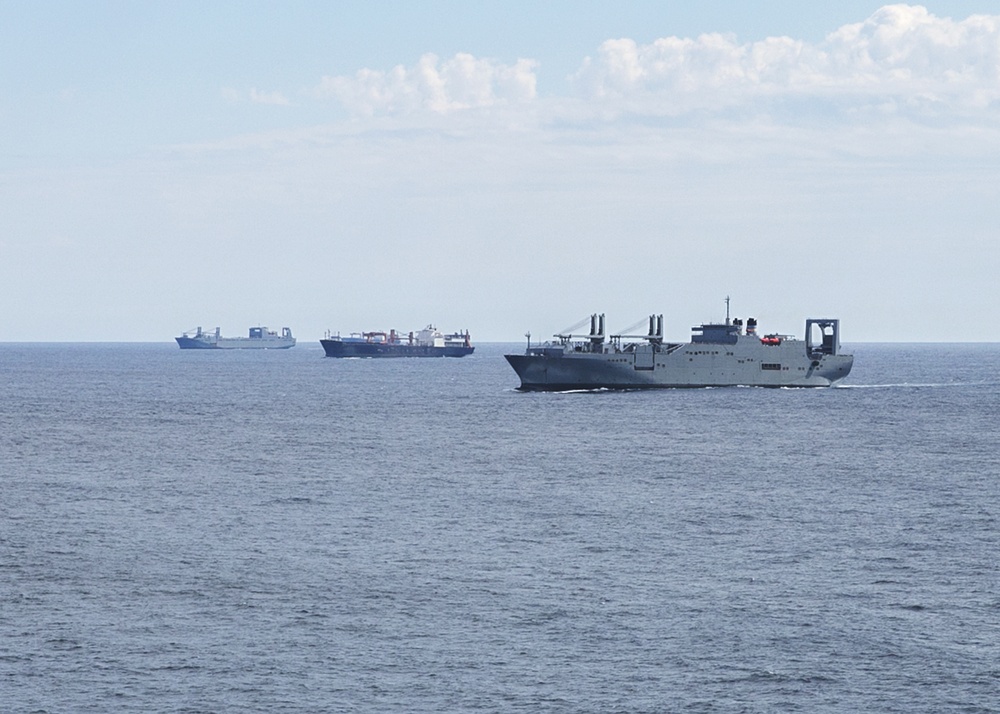
The contract covers four U.S.-flag, bow-ramp-equipped RO/RO landing craft vessels, each with a minimum capacity of 2,100 square feet of vehicle and cargo deck space. Combined, the four hulls must provide no less than 12,600 square feet of usable deck area under the contract's minimum capacity floor. The base award is $37,140,000 for the initial 180-day charter period, with a 180-day option period that would extend operations through July 24, 2027 and raise the total contract ceiling to $60,180,000. Vessel operations begin July 30, 2026, in Naha, Japan. The contract was competitively awarded following nine proposals received via the Government Point of Entry website. The contracting activity is Military Sealift Command, Norfolk, Virginia. Funding is reimbursable Navy funds obligated for fiscal year 2026. A 180-day charter at $37.1 million implies a daily charter rate of approximately $206,300 across four hulls, or roughly $51,600 per vessel per day for this class of U.S.-flag bow-ramp landing craft. The contract is firm-fixed-price, which places cost risk on Schuyler Line Navigation rather than the government and signals that MSC had sufficient pricing data to structure the award without a cost-reimbursable vehicle.Operational Context
The charter lands in Naha at a moment when U.S. forces in Okinawa are supporting the 12th Marine Littoral Regiment's island-chain operations. The Marine Littoral Regiment concept, developed under Force Design 2030, calls for small, dispersed units to move equipment and supplies between islands rapidly, without the logistical signature of large amphibious ships. Organic Marine Corps connectors — landing craft utility vessels and amphibious combat vehicles — provide some of that mobility, but chartered RO/RO landing craft extend the regiment's sustainment reach across dozens of islands between Okinawa and the Sakishima group. By positioning four bow-ramp RO/RO vessels in Naha, MSC creates a commercial sealift pool that could shift vehicles, ammunition, and sustainment loads between island positions without requiring destroyer escorts or major amphibious ship support. The bow-ramp design means vehicles can be driven directly onto beaches and low-draft piers rather than requiring crane infrastructure at every stop. The option period, if exercised, would keep the vessels on station through July 24, 2027, covering the U.S.-Japan joint exercise cycle and aligning with annual bilateral training events in the region.What It Means for Contractors
The Naha port vessel contract underscores how military sealift requirements in the Indo-Pacific are generating steady work for mid-tier maritime contractors capable of operating in forward-deployed, austere environments with minimal logistical support.
For U.S.-flag maritime carriers, the Schuyler Line award illustrates a recurring MSC requirement that has grown as Pacific force posture shifts toward distributed operations. Firms with U.S.-flag RO/RO landing craft or bow-ramp-equipped vessels should monitor MSC's solicitation activity on SAM.gov for similar requirements as the Marine Corps continues building out island-chain logistics capability. The contract vehicle is a time charter rather than a voyage charter, meaning MSC controls scheduling and routing for the charter period. That structure requires contractors to provide vessels and crews continuously for the duration rather than on a trip-by-trip basis, which favors operators with reliable maintenance programs and crew rotation pipelines. The 12,600-square-foot combined capacity floor, and the four-vessel minimum, suggest MSC specified the contract around a particular operational concept rather than issuing an open-ended sealift solicitation. Bidders who proposed fewer vessels or smaller deck footprints would have been non-compliant regardless of price. The competitive nature of the award — nine proposals received — indicates active market interest in this class of government maritime work. The West Palm Beach, Florida base of operations for Schuyler Line reflects a structure common among government maritime charterers: U.S.-east-coast management of vessels deployed to forward theaters, a model that can satisfy U.S.-flag documentation and crewing requirements while maintaining shore-side administrative infrastructure in the continental United States.