
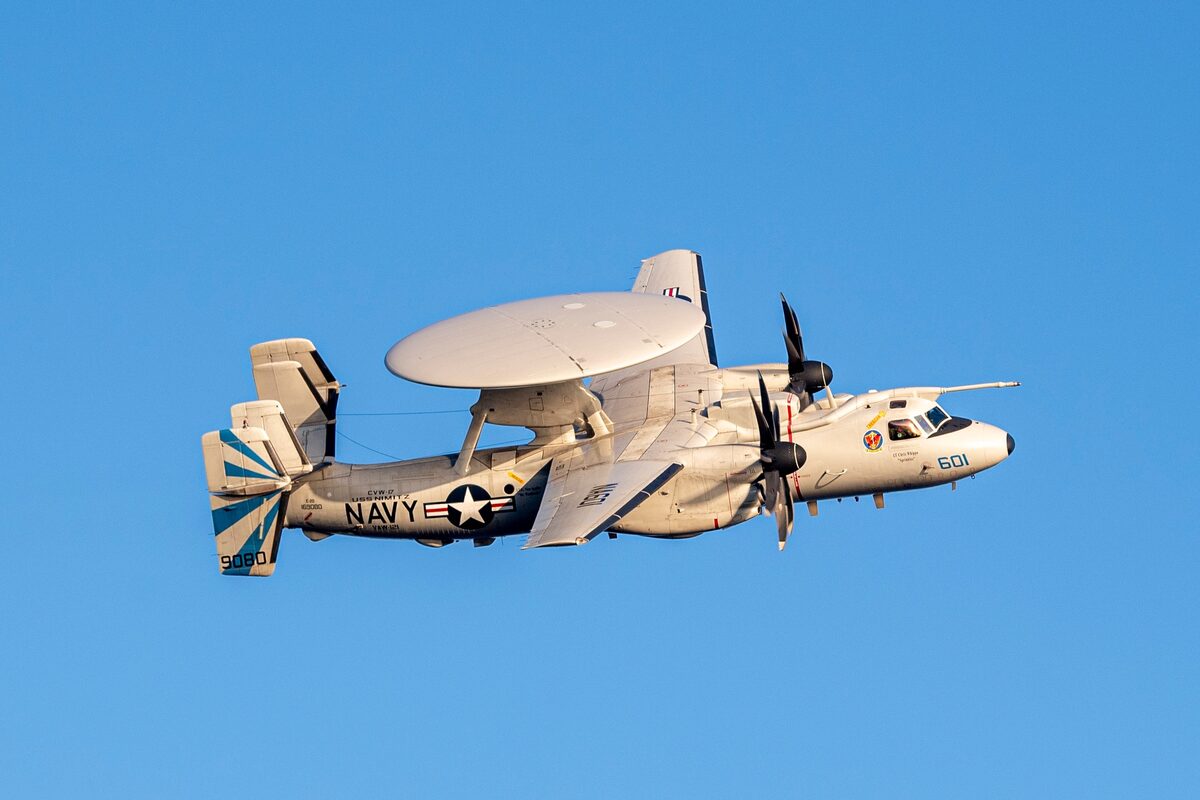
The Navy will pay Northrop Grumman up to $1,196,000,000 for three more E-2D Advanced Hawkeye Block II aircraft under a cost, no-fee undefinitized contract listed in the Department of War contract announcement for July 22, 2026. Naval Air Systems Command at Patuxent River, Maryland, awarded contract N0001926C1017 without competition under 10 U.S. Code 2304(c)(1), and obligated $583,394,000 in fiscal 2026 Navy aircraft procurement funds at the time of award. The award covers production, delivery and associated support, and work is expected to be completed in December 2031.
Three airframes, five and a half years, and roughly half the ceiling committed on day one. Those numbers describe a program that is being kept alive between multiyear buys rather than one running at rate, and the contract vehicle chosen tells the same story: the Navy started the work before it finished negotiating what the work costs.
Background
The E-2D is the Navy's carrier-based airborne early warning aircraft. It is the airplane the carrier air wing depends on to see targets the ships cannot. Northrop Grumman Systems Corp., Aerospace Systems, is listed in the announcement at Melbourne, Florida, and the two Florida sites named in the work split — Melbourne at 29.88 percent and St. Augustine at 17.68 percent — together account for nearly half the contract.
Procurement has run on multiyear contracts. The first, awarded in 2014, covered 25 aircraft and was later increased to 26, with reported savings of $586.6 million, or 13.9 percent measured against five single-year procurements. The second multiyear procurement was valued at approximately $3.2 billion for 24 Navy aircraft plus an option for nine foreign military sales aircraft, with projected savings of $410.6 million, or 11 percent over the five years of the contract, and production of the 24 Navy aircraft expected to be complete in 2026. Northrop had delivered 37 E-2Ds to the Navy as of that reporting.
That timing is the point. The second multiyear is finishing this year. Rather than opening a third multiyear, the Navy has bought three aircraft on a standalone production contract that stretches deliveries and support into the end of 2031. It is a bridge buy, and bridge buys almost always cost more per unit than the multiyear arithmetic that preceded them, because the savings argument for a multiyear rests on committing to volume and stable rates up front.
Key Details
The award is undefinitized, which means Northrop starts work while the government and the contractor keep negotiating price and terms. The Navy obligated $583,394,000 against a $1,196,000,000 not-to-exceed ceiling — the ceiling caps exposure, but the final number lands wherever definitization lands. Undefinitized contract actions exist for exactly this situation: a schedule that will not wait for a completed negotiation. The tradeoff is structural. A cost, no-fee arrangement with terms still open leaves cost risk sitting with the government until definitization closes it out.
The "no fee" element is worth reading literally. As announced, the contract carries no fee — the ceiling covers cost, not profit on top of it. That is unusual language for a production contract, and the more plausible reading is that the profit structure is still being negotiated rather than that the Navy has agreed to build three carrier aircraft at zero margin.
The place-of-performance breakdown maps the supplier base with more precision than most announcements: Melbourne, Florida (29.88 percent); St. Augustine, Florida (17.68 percent); Liverpool, New York (13.85 percent); Indianapolis, Indiana (4.95 percent); Largo, Florida (3.66 percent); San Leandro, California (2.52 percent); Woodland Hills, California (2.42 percent); Aire-sur-l'Adour, France (2.09 percent); Rolling Meadows, Illinois (1.72 percent); Wimborne Minster, Dorset, United Kingdom (0.01 percent); and various locations within the continental United States (21.22 percent).
Two entries stand out. The French and British shares are called out explicitly on a carrier-based airborne early warning aircraft — a mission set where foreign content usually draws scrutiny. Neither share is large: France at 2.09 percent and the United Kingdom at 0.01 percent, the latter small enough that it plausibly represents a single specialized component or service. But they are disclosed, they are in the official announcement, and they are the kind of line item that gets read closely by anyone tracking supply chain provenance rules.
The other notable figure is the 21.22 percent assigned to "various locations within the continental U.S." Roughly a fifth of the work has no named site, which is standard practice in these announcements and standard frustration for anyone mapping subcontracting opportunity from the public record.
What It Means for Contractors
For suppliers already on the E-2D, this award buys time. A December 2031 completion date on three aircraft means the production and support tail extends more than five years past award, which stabilizes demand signals for the Liverpool, Indianapolis, Largo, San Leandro, Woodland Hills and Rolling Meadows sites named in the split. Companies with content on the program should be planning for a low-rate, long-duration environment rather than the tempo of a multiyear.
For companies not on the program, the sole-source justification closes the front door. Prime-level competition is not coming for E-2D airframes. The realistic entry point is subcontract and sustainment work — components, test equipment, depot support, mission-system refresh — and the place-of-performance percentages are the best public map of where that work physically sits.
The undefinitized structure carries a practical warning for subcontractors. When a prime starts work under a not-to-exceed ceiling with terms unsettled, that uncertainty flows downstream. Suppliers may be asked to begin long-lead work under letter contracts or undefinitized purchase orders of their own, with pricing to follow. Firms in that position should insist on written ceilings, documented cost accumulation from the first day of work, and clarity on what happens if the definitized value comes in below the ceiling. Cost documentation assembled after the fact rarely survives a government audit.
The funding profile is also a planning input. With $583,394,000 obligated against a $1,196,000,000 ceiling, the balance depends on future appropriations and definitization outcomes. Suppliers should not treat the ceiling figure as the amount of money in motion. Roughly half of it is committed today.
Finally, the bridge-buy pattern itself is a signal worth tracking. Programs that finish a multiyear and then buy three aircraft at a time are programs where the next procurement decision is still open. Whether that becomes a third multiyear, a series of annual buys, or a wind-down toward some future carrier-based airborne early warning capability will shape supplier demand more than this $1.2 billion action does.
Sources
- Contracts for July 22, 2026 — U.S. Department of War
- Contracts for July 22, 2026 (GlobalSecurity.org mirror)
- Navy Awards Northrop Grumman $1.2B E-2D Hawkeye Block II Production Contract — ClearanceJobs
- Northrop Grumman garners $3.2 billion multiyear E-2D Hawkeye aircraft production contract — Military Embedded Systems
