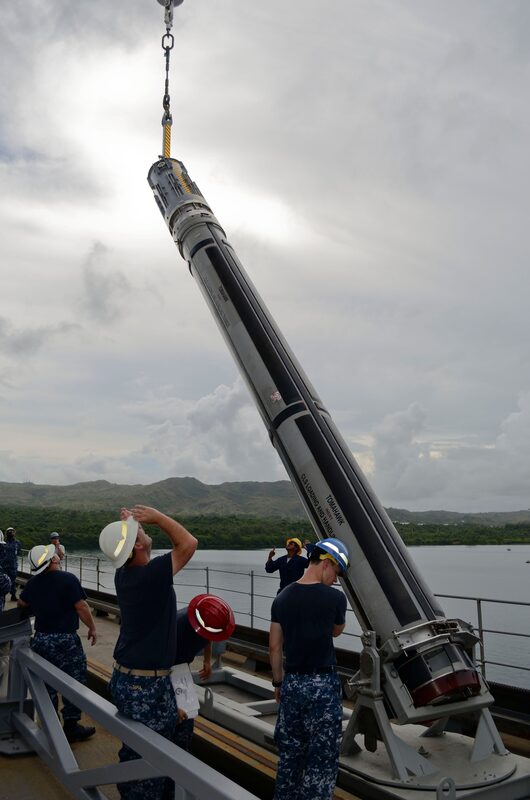
The Navy has ordered Raytheon Missiles and Defense to restart a shuttered production line for one of the launch systems that fires Tomahawk cruise missiles from submarine vertical launch tubes, according to a Department of War contract announcement published July 13, 2026. The not-to-exceed $101,976,000 order covers the non-recurring engineering needed to bring the MK 45 Capsule Launch System back into production after years of dormancy.

Background

The MK 45 Capsule Launch System is part of the Tomahawk Weapon System family, the hardware that houses a missile canister inside a submarine's vertical launch tubes and manages the sequence that ejects the weapon before its rocket motor ignites at the surface. Submarines carrying Tomahawk strike packages rely on capsule launch hardware like the MK 45 to translate a fire-control order into a missile leaving the tube cleanly, without damaging the boat or the surrounding tubes. Production lines for legacy submarine launch hardware have sat idle for extended periods as the Navy's shipbuilding and modernization dollars concentrated on new-construction Virginia-class and Columbia-class boats. That idle time creates a specific problem: components, vendors, and manufacturing processes that were qualified a decade or two ago no longer exist in the supply base. Restarting a line is rarely a matter of flipping a switch. It requires re-qualifying parts, finding new suppliers for components that original vendors no longer make, and in some cases redesigning subsystems around what is actually available today. That is the situation Raytheon Missiles and Defense now faces in Tucson, Arizona, where the new order tasks the company with getting the MK 45 line producing again to support what the contract describes as a limited production quantity of updated capsule launch systems for the Navy. Raytheon's Tucson site is best known for producing tactical missiles, but the facility also handles specialized launch and fire-control hardware under long-running Navy support agreements. The basic ordering agreement underpinning this action, N0001925G0009, gives the Navy a standing vehicle to issue task orders to Raytheon for this class of work without re-competing the agreement each time, which is why the MK 45 restart could move forward as a single order rather than a fresh procurement.

Key Details

The Department of War's July 13 daily contracts announcement lists the award as order N0001926F0259, issued against basic ordering agreement N0001925G0009. It is structured as an undefinitized cost-plus-fixed-fee order with a not-to-exceed value of $101,976,000, meaning Raytheon can begin work immediately while the government and the company continue negotiating the final definitized price. The scope covers non-recurring engineering tied to restarting MK 45 production, and the Department of War's listing spells out four specific work streams:
  • Obsolescence mitigation — identifying and re-qualifying parts and suppliers for components that are no longer available from original sources
  • Design, development, fabrication, integration, inspection, and testing work needed to stand the line back up
  • Updates to the system's technical data package, the engineering documentation that defines how the hardware is built and maintained
  • Redesign of the Eject Initiation Subsystems, the components responsible for triggering a missile's departure from its launch capsule
Work is split geographically, with 98% performed at Raytheon's Tucson facility and the remaining 2% performed in Camden, Arkansas. The order carries an expected completion date of July 2030, giving Raytheon roughly four years to move from re-engineering work to delivering hardware. The MK 45 order is a standalone Raytheon action with its own scope, funding line, and delivery schedule, distinct from the other submarine-related and munitions contract actions the Department of War lists on any given day.

What It Means for Contractors

The MK 45 restart is a useful data point for any contractor watching how the Navy is handling aging weapons-system infrastructure. Rather than initiating a clean-sheet replacement program, the Navy is paying to reconstitute an existing qualified design — a path that tends to be faster and cheaper than starting over, but that carries its own contracting profile worth understanding. Obsolescence-driven restart work like this typically opens doors below the prime level. Re-qualifying a supply chain for a line that has been idle means Raytheon will need to identify replacement sources for parts whose original manufacturers have exited the business, discontinued a product line, or gone out of business entirely. Small and midsize manufacturers with relevant machining, electronics, or specialty-materials capabilities are the ones most likely to pick up that subcontracted work, particularly firms already familiar with military qualification standards and testing documentation requirements. The undefinitized structure of the order is also worth noting. A not-to-exceed cost-plus-fixed-fee order that begins work before a final price is negotiated is a common vehicle when the government needs engineering to start quickly but the full scope isn't yet priced with precision — often the case with obsolescence mitigation, where the exact list of parts needing redesign or re-sourcing isn't fully known until the engineering team digs in. Contractors bidding into similar undefinitized actions should expect the same dynamic: early funding to start work, with pricing negotiations continuing in parallel. The four-year timeline to a July 2030 completion date also signals a genuine production-line rebuild rather than a quick parts fix. Technical data package updates and Eject Initiation Subsystem redesign are not trivial line items — they represent real engineering effort that will consume Tucson and Camden capacity for years, and subcontractors should expect Raytheon's sourcing decisions to firm up as the obsolescence mitigation phase matures. For firms tracking the broader submarine-industrial base, the order underscores that the Navy's modernization spending isn't confined to new-construction hulls. Legacy launch and weapons-handling hardware supporting the existing fleet is drawing its own dedicated funding, and companies with obsolescence-mitigation, technical-data-package, or precision-fabrication capabilities have a concrete opening to pursue. The Camden, Arkansas, portion of the work, though only 2% of the total effort, is also worth flagging for contractors in that region. Camden hosts a cluster of missile and munitions manufacturing capacity, and even a small allocation of a $102 million order can translate into real subcontracted demand for local machine shops and specialty fabricators cleared to work on Navy launch hardware. Contractors interested in positioning for follow-on MK 45 production should watch for Raytheon's supplier outreach in the coming months, since obsolescence mitigation efforts typically generate new subcontracts as the prime works through its parts list and identifies gaps the original supply chain can no longer fill.

Sources