
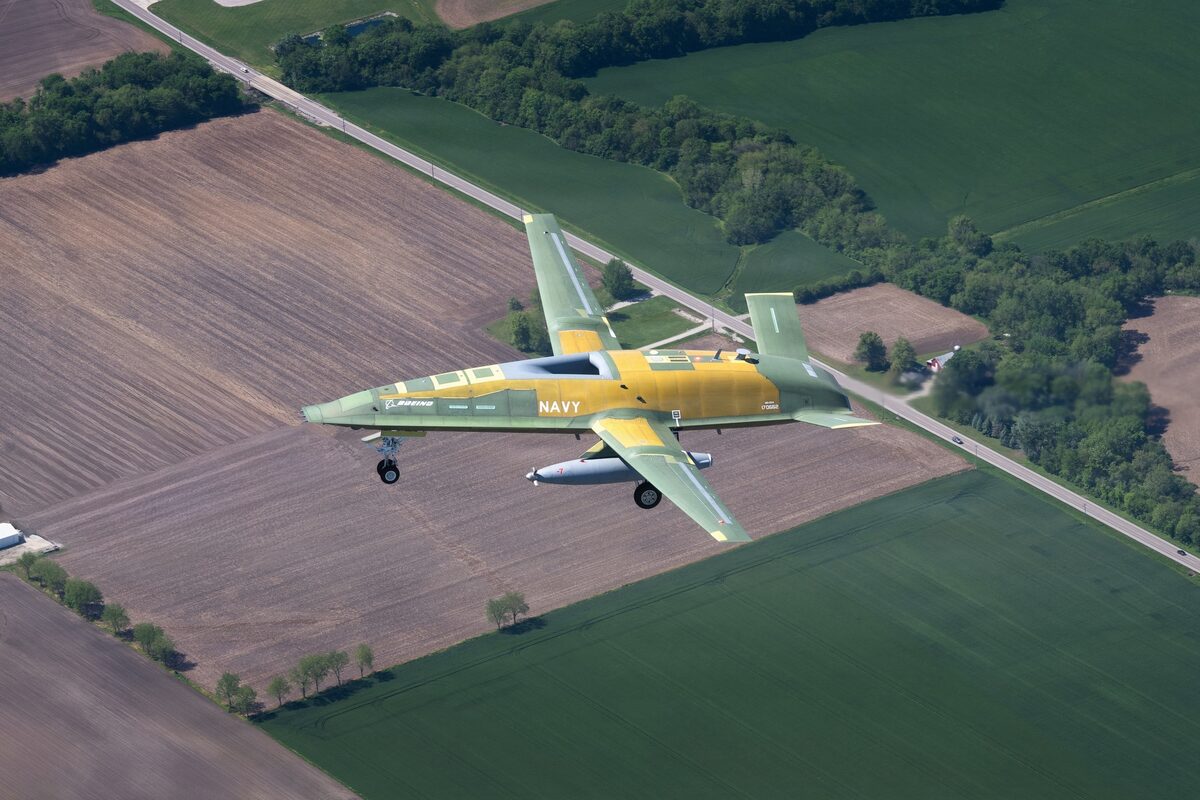
The Navy has opened the door for defense contractors to build its first carrier-launched robotic fighter, doubling the price it is willing to pay per aircraft and setting up a new competition among companies already building similar drones for the Air Force. Naval Air Systems Command's Future Advanced Capability Program Office, known as PMA-228, published the request for information on August 31, 2026, asking industry to deliver two prototype uncrewed aircraft under Increment 1 of the Navy's carrier-based Collaborative Combat Aircraft program. Companies have until September 18 at 5:00 p.m. Eastern to respond.
The solicitation, numbered N00019-27-RFI-PMA228-CCA, is not itself a contract award. It is the Navy's first formal step toward putting robotic wingmen aboard aircraft carriers, following the Air Force's own Collaborative Combat Aircraft program, which has already sent Anduril and General Atomics into production on land-based variants. The Navy's version has to survive a different environment entirely: catapult launches, arrested landings, and rolling decks at sea.
Why the Price Tag Doubled to $30 Million
The most striking number in the RFI is the cost ceiling. The Navy is telling industry it will accept a unit price of up to $30 million per aircraft, twice the $15 million target the service floated for the same concept back in 2024. That jump signals the Navy has concluded that a cheaper, more expendable drone cannot survive the demands of carrier aviation — catapult stress, salt air, and the tight quarters of a flight deck all add engineering cost that a runway-only design does not carry.
The RFI does not explain the increase in those terms, but the shift matters for how contractors will price their proposals. A $15 million target pushed designs toward attritable, largely disposable airframes. A $30 million ceiling opens room for more durable, more capable aircraft that can be recovered and reused across many sorties, closer in cost to a lightly built crewed fighter than to a cruise missile.
What a Carrier-Qualified Robotic Fighter Has to Do
PMA-228's requirements read like a checklist built specifically for flattop operations. Prototypes must achieve full carrier qualification — catapult launch and arrested landing — within three years, and they must be able to operate in sea states up to Sea State 5, meaning waves as high as 13 feet. The aircraft has to work aboard both Ford-class and Nimitz-class carriers, and its footprint on deck cannot exceed that of a fourth-generation crewed fighter, a constraint that limits how large a wingspan or tail height a bidder can propose.
Weapons capacity is also spelled out precisely: up to four externally mounted weapons, each capped at 2,500 pounds, for a maximum total weapons payload of five tons. The aircraft must also plug into the Navy's existing MD-5 Unmanned Carrier Aviation Mission Control System — the same system that already operates the Navy's MQ-25 Stingray tanker drone — rather than requiring a new control architecture. According to the RFI, as reported by Defense News, the platform must be capable of "executing single- and multi-aircraft strike missions."
Naval News, which reviewed the specifications, reported that the Navy is seeking an autonomous, uncrewed fighter meant to add mass to carrier air wings, with a footprint limited to roughly the dimensions of an F/A-18E/F Super Hornet. The outlet also noted the Navy's requirements leave room for non-marinized, commercial off-the-shelf components, provided a bidder can lay out a credible path to sea-proofing them before carrier qualification testing begins.
Anduril and General Atomics Lead as Air Force CCA Builders
Both General Atomics and Anduril are seen as leading contenders because each is already under contract to build a Collaborative Combat Aircraft for the Air Force — General Atomics' YFQ-42A and Anduril's YFQ-44A — giving both companies a design base to adapt rather than a clean-sheet aircraft to invent from nothing. Defense News reported that conceptual images circulated by the two firms suggest designs resembling smaller versions of manned stealth fighters, an early signal of how each might approach the carrier variant.
A separate but related data point underscores the Navy's broader push into uncrewed carrier aviation: Naval News reported that scale models of Boeing's MQ-25 Stingray — the aerial-refueling drone the Navy has already qualified for carrier operations — have demonstrated armed configurations carrying Long Range Anti-Ship Missiles, part of what the outlet described as a broader shift toward expanding carrier strike reach with uncrewed aircraft. That effort is separate from the CCA RFI, but the two programs will share infrastructure, since the MD-5 control system the CCA prototypes must integrate with is the same one already flying the MQ-25.
The government's own framing of the document keeps expectations in check. The SAM.gov posting carries the standard information-request disclaimer, stating plainly: "THIS REQUEST FOR INFORMATION (RFI) IS ISSUED SOLELY FOR INFORMATION AND PLANNING PURPOSES AND DOES NOT CONSTITUTE A SOLICITATION." No contract, prototype award, or down-select decision is guaranteed to follow directly from the September 18 responses — the Navy is gathering industry capability data before it decides how to structure the actual competition.
What It Means for Contractors
For Anduril and General Atomics, the RFI is a chance to extend Air Force CCA investments into a second, separately funded Navy program rather than starting from zero. Both companies already have flight-test data, autonomy software, and manufacturing lines built around their Air Force designs, which should shorten the runway toward carrier qualification compared with a company entering cold.
The doubled cost ceiling also changes who can credibly compete. A $15 million target favored smaller, more attritable designs and could have opened the field to newer entrants pitching low-cost airframes. A $30 million ceiling raises the bar on structural engineering, carrier-suitability testing, and integration work with the MD-5 control system — costs that established fighter and drone manufacturers are better positioned to absorb than smaller firms without existing carrier-aviation experience.
Because this is an RFI rather than a formal solicitation, no contract obligations exist yet, and the Navy is not committed to a set number of down-selected vendors. Companies that respond by September 18 will shape how PMA-228 structures the eventual prototype competition, including the schedule for the actual solicitation, the number of vendors invited to bid, and whether the $30 million ceiling holds once real cost proposals come in.
