
The Naval Air Systems Command awarded a $36.5 million firm-fixed-price contract to Rolls-Royce Corp. on July 13, 2026, covering the production and delivery of 10 AE 1107C Lot 28 turboshaft engines for the Navy's CMV-22B Osprey fleet.
Background
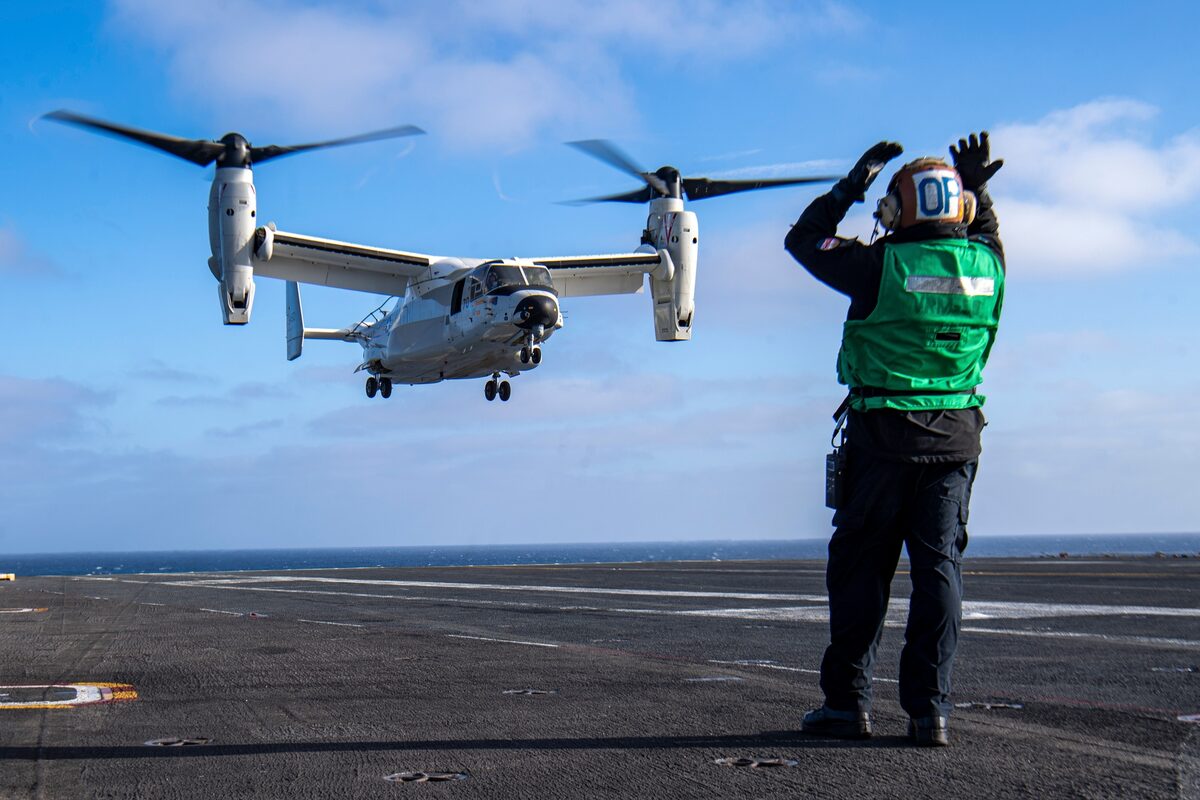
The CMV-22B is the Navy's carrier onboard delivery aircraft, built to replace the aging C-2A Greyhound in the mission of ferrying personnel, mail, and cargo between shore bases and aircraft carriers underway. Unlike the fixed-wing Greyhound, the tiltrotor CMV-22B can land vertically on a flight deck, giving carrier strike groups more flexibility in sea state and deck-cycle timing. The Navy's Osprey variant shares its airframe lineage with the Marine Corps' MV-22B and the Air Force's CV-22B, but it carries a longer-range fuel system and a modified cargo compartment built for outsized logistics loads.
Powering all three services' Osprey variants is the AE 1107C-Liberty, a turboshaft engine rated above 6,000 shaft horsepower that Rolls-Royce developed specifically for the V-22 tiltrotor family. Rolls-Royce's Indianapolis, Indiana facility has produced the engine since the V-22 program's early flight-test years, and the Navy has continued to buy the powerplant through incremental annual production lots rather than a single bulk purchase. Lot 28, the batch covered by this award, follows the same incremental sequencing the program has used for years to match engine deliveries with airframe production schedules.
NAVAIR manages Osprey propulsion buys separately from the airframe contracts that cover final assembly and integration, which is why an engine lot like this one is negotiated and announced through Patuxent River, Maryland, on its own schedule rather than bundled with airframe production news. That split acquisition structure means engine lots and airframe lots do not always announce on the same day, and a delay or acceleration in one does not automatically shift the other. For the CMV-22B specifically, the Navy has been building out its carrier onboard delivery squadrons in stages since the type reached initial operational capability, and steady annual engine buys like Lot 28 are one of the clearest public indicators of how fast that fleet is still expanding.
Key Details
- Contractor: Rolls-Royce Corp., Indianapolis, Indiana
- Value: $36,500,000, fully obligated at time of award
- Contract number: N0001926C0110
- Scope: Production and delivery of 10 AE 1107C Lot 28 turboshaft engines for the CMV-22B Osprey
- Contract type: Firm-fixed-price, sole-source award
- Work location: 100% performed in Indianapolis, Indiana
- Contracting activity: Naval Air Systems Command, Patuxent River, Maryland
- Funding: Fiscal year 2024 aircraft procurement (Navy) funds
- Completion date: May 2028
NAVAIR did not compete the award, reflecting Rolls-Royce's position as the only qualified source for the AE 1107C engine line. The Navy structured the deal as a firm-fixed-price purchase, meaning Rolls-Royce assumes the cost risk of manufacturing the 10 engines within the agreed price rather than billing the government for cost overruns. The roughly 22-month window between the July 2026 award and the May 2028 completion date is consistent with the lead times turboshaft engine manufacturing typically requires for a lot of this size.
Trade-press coverage of the award, published the same week as the War Department's contracts release, described the deal in the same terms as the official listing: a production buy tied directly to the Navy's CMV-22B carrier onboard delivery fleet, with no competing offerors named.
What It Means for Contractors
The award is a reminder of how much of the V-22 sustainment and production base runs through single-source arrangements that never touch the open competition process. For companies that supply castings, forgings, gearbox components, or other AE 1107C subassemblies to Rolls-Royce's Indianapolis plant, a Lot 28 buy signals continued near-term production volume and gives suppliers a concrete data point for capacity planning through the May 2028 completion window. Firms already qualified into that supply chain have a predictable, if narrow, revenue stream; firms outside it have effectively no path into engine production itself, since NAVAIR is not going to open AE 1107C manufacturing to competition while Rolls-Royce remains the only certified source.
The more accessible opportunity for outside contractors sits downstream of the engine itself. As the CMV-22B fleet grows and logs more flight hours, NAVAIR's demand for depot-level maintenance, repair and overhaul work, spares provisioning, and field-service support tends to expand in parallel with production lot buys like this one. Companies with Navy aviation depot experience, tooling for turboshaft engine maintenance, or existing V-22 sustainment contracts should treat this award as a signal that the fleet is still ramping rather than leveling off, which typically precedes follow-on sustainment solicitations rather than replacing them.
Contractors tracking CMV-22B program funding should also note the funding source: FY2024 aircraft procurement dollars, obligated in full at award nearly two years after appropriation. That gap illustrates the typical lag between congressional appropriation and contract execution for major weapon-system components, useful context for firms modeling when future Osprey-related lots are likely to hit the street. Companies bidding into adjacent V-22 support work, including the Marine Corps MV-22B and Air Force CV-22B lines that share the same engine family, can also use this award as a benchmark for current AE 1107C unit pricing when preparing cost estimates for related proposals.
Finally, the sole-source structure underscores a broader lesson for firms eyeing the defense engine market: breaking into a program like the AE 1107C requires qualifying as an alternate source years in advance of any single contract action, typically through a separate engineering and qualification effort rather than through a response to a production solicitation. Absent that groundwork, competitors should expect Rolls-Royce to continue winning every future CMV-22B engine lot on a sole-source basis for the remainder of the V-22 production run.
For small and mid-size businesses without a direct line into engine manufacturing, the practical takeaway is to look at where NAVAIR spends money around a sole-source award rather than trying to compete for the award itself. Facilities support, logistics, packaging and shipping for engine components between Indianapolis and fleet concentration points, and technical documentation work tied to engine acceptance and fielding are all areas where the prime contractor and the Navy typically rely on smaller subcontractors. Firms that track individual contract actions like this one, rather than only the headline production news, tend to spot those secondary opportunities earlier than competitors who wait for a formal solicitation to post.
