
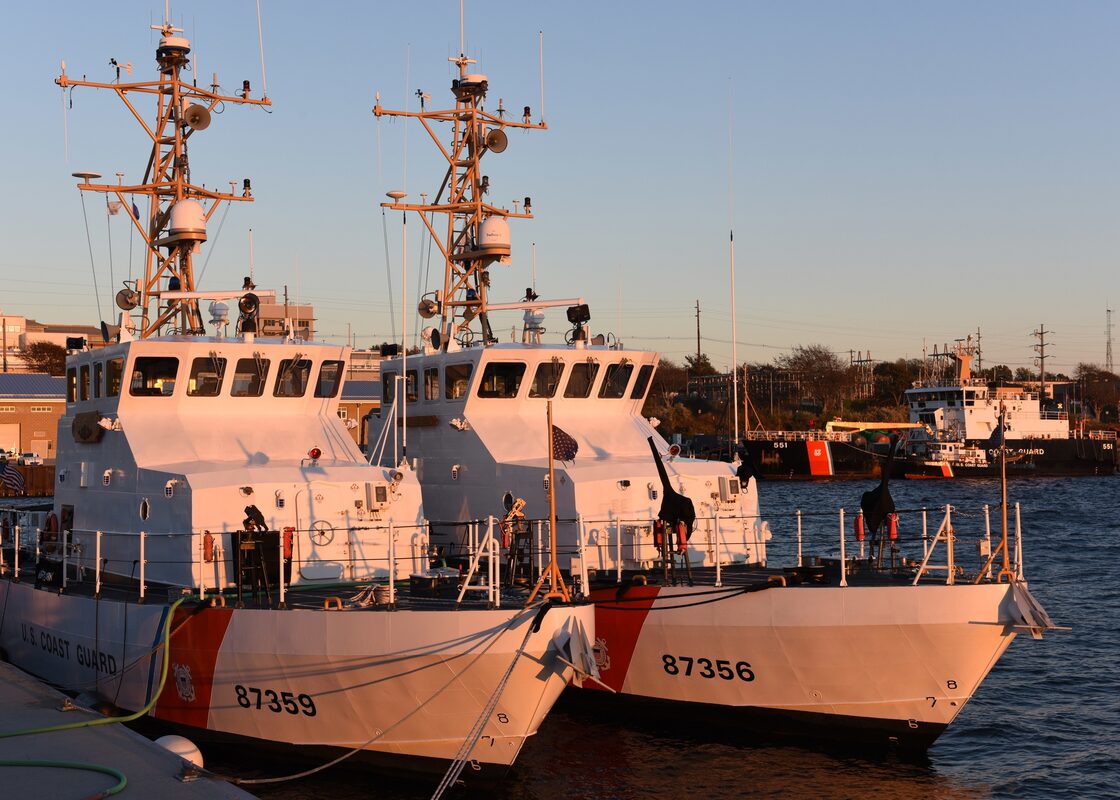
Naval Station Newport's pier for Coast Guard cutters is getting rebuilt from the pilings up, after decades of tying up at a facility engineers had already condemned. The Navy has awarded Skanska USA Civil Northeast Inc. a $271.2 million contract to rebuild the deep-water pier at Naval Station Newport's Coddington Cove, clearing the way for cutters to shift from a crumbling 1950s-era structure to a wider, higher pier engineered to survive the storms and rising seas the old one could not.
The Navy's contracting arm confirmed the award in its daily notice of Department of War contract actions. Skanska USA Civil Northeast Inc., of Waltham, Massachusetts, "is awarded a $271,226,000.00 firm-fixed price contract for construction services for Design-Bid-Build United States Coast Guard Offshore Patrol Cutters Homeport Pier." Work will be performed at Naval Station Newport, Rhode Island, according to the announcement. Naval Facilities Engineering Systems Command, Mid-Atlantic, in Norfolk, Virginia, is the contracting activity, and the contract carries the number N40085-26-C-0032. The Navy received three offers before making the award, and expects the work to wrap in March 2030.
Why the Old Pier Had to Go
The pier being replaced, known as Pier 1, stretched 1,585 feet along Coddington Cove and dated to the mid-1950s. Decades of exposure to storms and wave action left it in bad enough shape that the Navy condemned it outright. Phase one of the project, already complete, tore the old structure down. This second phase is the actual rebuild: Skanska will construct a new pier roughly 1,000 feet long and 80 feet wide, set at a higher deck elevation specifically to reduce the wave damage that doomed its predecessor and to account for future sea-level rise. The contract also covers a new bulkhead, a laydown area, parking, stormwater management and utility work — the supporting infrastructure a modern homeport pier needs, not just the concrete deck itself.
Sen. Jack Reed, D-R.I., announced the award and framed it as a fix for a facility that had become a liability. "It will transform the pier from an aging, high-maintenance structure into a resilient, efficient, multi-functional waterfront hub that can serve for generations to come," Reed said, according to What's Up Newp.
Where the $271 Million Is Coming From
The contract draws on two pots of money: fiscal year 2022 Major Acquisition Systems Infrastructure funds and fiscal year 2025 dollars appropriated under the One Big Beautiful Bill Act for the Department of Homeland Security and the Coast Guard specifically. That mixed funding line reflects the project's split identity — a Navy-run construction contract building a facility the Coast Guard will actually operate. Not all of the obligated money has an open-ended shelf life. Of the total, $51,108,836 is set to expire at the end of the current fiscal year, which puts real pressure on the Navy and Skanska to keep the multiyear build moving rather than let early-phase funding lapse unused.
Four Berths, No Announced Tenants Yet
The new pier will provide four berths sized for major cutters, but the Navy and Coast Guard have not said which vessels will actually tie up there once it opens. Newport currently homeports five Coast Guard cutters: the buoy tenders Oak and Sycamore, and the medium endurance cutters Legare, Campbell and Tahoma. The project's name — the Offshore Patrol Cutters Homeport Pier — signals that at least part of the intent is to prepare Newport for the Coast Guard's new-generation Offshore Patrol Cutters. Whether some combination of the existing Newport ships, incoming Offshore Patrol Cutters, or both end up at the new berths is a decision the Coast Guard has left for later.
A Second Federal Project Lands Next Door
The pier rebuild is not the only major federal investment landing at Coddington Cove. NOAA is separately relocating its Marine Operations Center-Atlantic to the same site from Norfolk, Virginia, in a move valued at $147 million. The NOAA facility, on a five-acre site at Coddington Cove, broke ground in May 2024 and was projected for completion in summer 2027; it will coordinate NOAA's Atlantic and Great Lakes fleet operations and homeport four research vessels, with a pier, floating dock and offices of its own. Roughly 60 people currently work at the Norfolk office NOAA is vacating, with more staff assigned to the ships themselves. Together, the two projects are expected to bring hundreds of federal employees, military personnel, family members and support staff into the Newport area, and the Defense Department's Community Cooperation program has already funded outreach and planning work with Newport, Middletown and Portsmouth to prepare for that influx. For a small state congressional delegation, landing two separate federal facility investments on the same stretch of waterfront is a notable concentration of infrastructure spending.
What It Means for Contractors
The award is a reminder that Navy facilities work tied to Coast Guard missions routes through Naval Facilities Engineering Systems Command rather than through Coast Guard acquisition offices directly — contractors chasing Coast Guard infrastructure dollars need to be tracking NAVFAC's solicitations, not just the Coast Guard's own contracting shop. The design-bid-build structure and three competing offers also indicate NAVFAC ran this as a conventional low-bid competition rather than a design-build or sole-source vehicle, which matters for firms sizing up whether to compete on the next phase of Coast Guard homeport work elsewhere. And the $51.1 million in soon-to-expire FY2022 funding is a concrete data point for subcontractors and suppliers: early mobilization and procurement on this job likely needs to move fast enough to draw down against that money before it lapses, rather than waiting for the full four-year window to March 2030 to play out. Firms bidding on adjacent Coddington Cove work — the NOAA relocation among them — should also expect a multi-year construction zone shared between two federal projects, which typically means coordinated site logistics, laydown space and utility tie-ins negotiated between contractors rather than assumed.
