
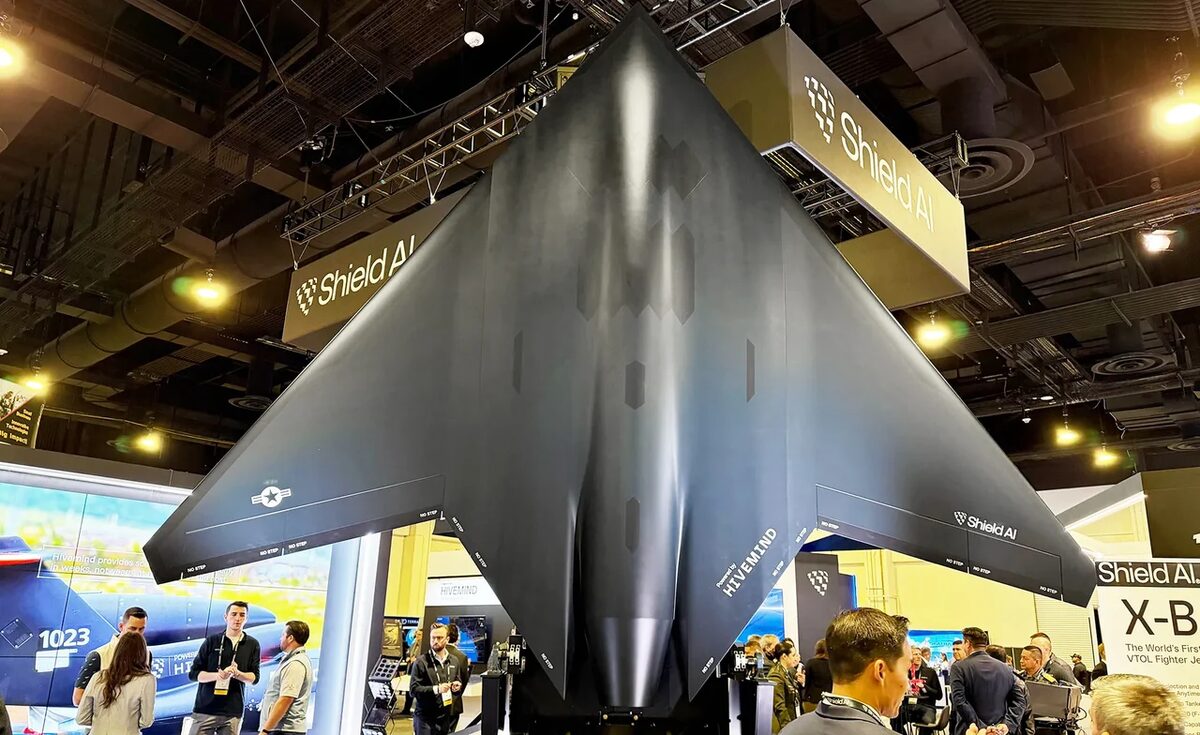
The Navy is putting another $150 million behind Shield AI's X-BAT, an AI-piloted fighter built to take off and land vertically from ships, and the money comes just as the company says its first full-scale prototype is weeks from completion. Defense One reported that Shield AI expects to begin flying the unmanned jet by the end of 2026. The new money arrives as a modification to an existing other transaction agreement, and the venture-backed company has promised to match it dollar for dollar.
Shield AI announced the award on Oct. 8, 2026. According to Defence Industry Europe, the company will put $150 million of its own capital alongside the Navy's contribution, bringing announced public and private commitments to the program to $400 million.
How the $400 Million X-BAT Total Adds Up
The $400 million figure combines two rounds of government money and two matching private commitments. The first came in August, when the government committed $50 million under the Runway Independent Maritime Expeditionary Strike (RIMES) effort. Defence Industry Europe reports that the earlier action involved the Navy's Portfolio Acquisition Executive for Aviation Rapid Capability Cell and the Defense Innovation Unit (DIU), and that Shield AI independently committed $50 million in private capital alongside it.
The October action is a separate $150 million modification to the same agreement. The Navy executed it under the existing Other Transaction agreement, and the government funding comes from the Office of the Under Secretary of War for Acquisition and Sustainment through its Defense Exportability Features program, according to Defence Industry Europe. Shield AI's matching $150 million brings the October tranche to $300 million in combined commitments.
Armor Harris, Shield AI's senior vice president of aircraft, framed the award as the second step in a staged development effort. "The Navy has been funding the development through the newly created Rapid Capability Cell. So there was an initial $50 million investment earlier this year. This is basically the next round of investment, which is $150 million to continue the development of the platform," he told Defense One.
Milestone Payments, Not a Lump Sum
The Navy will not hand over the $150 million at once. Defense One reports that the money will be released to Shield AI as the company meets developmental milestones. Harris described the structure directly: "There will be a follow-on phase in the future if Shield AI and X-BAT continue to perform well—all leading up to fielding an early operational capability in about 2029. So basically, the way that the OTA is structured is that there's milestone-based payments for Shield achieving specific objectives along the way."
That arrangement puts the technical risk on the contractor. If the aircraft slips, the payments slip with it, and the follow-on phase Harris described depends on continued performance.
When Will X-BAT Fly?
Shield AI is building two full-scale prototypes. "We've been building two prototype vehicles—they're full scale. The first one will be done in the next couple of weeks here," Harris told Defense One. He said the company would then move into flight testing at the end of the year, going straight to vertical takeoff and landing tests as the final de-risking step.
Defence Industry Europe reports that 500 engineers at Shield AI and its suppliers, including GE Aerospace, are building flight-test aircraft. The team has completed engine light-off and integration of the thrust-vectoring nozzle, and Shield AI said weapons bay aerodynamics have been validated in low- and high-speed wind-tunnel tests.
"We are testing early and often while working on the aircraft, mission systems, ship suitability and production in parallel," Harris said in the company's announcement. "That approach helps us identify and resolve issues earlier, reduce development risk and move more quickly toward flight testing."
Defense One also reports that the company recently named two sites for production and flight testing of the jet.
What the Navy Wants From a Runway-Independent Fighter
X-BAT is a low-observable, multirole aircraft designed to take off and land vertically from ships, islands and austere sites. Shield AI's Hivemind software serves as its AI pilot, which the company says enables operations in GPS-denied and communications-constrained conditions.
The aircraft is part of DIU's RIMES project, an industry-wide effort to give combatant commanders runway-independent, long-range strike assets that extend the reach of surface and expeditionary forces without fixed airfields.
J.J. "Yank" Cummings, Shield AI's head of mission solutions for the U.S. Navy and a former commanding officer of USS Gerald R. Ford, pitched the design in carrier terms. "X-BAT is being built to enhance the lethality, survivability and combat power of U.S. Naval Aviation," he said. "Its runway-independent design and small deck footprint can increase sortie generation and extend long-range air combat power from CVNs, LHAs, LHDs and ESBs."
Harris told Defense One the company developed X-BAT with Naval Air Systems Command (NAVAIR) and the Naval Air Warfare Center Aircraft Division (NAWCAD), which he called "the experts for naval aviation."
Shield AI also plans to sell the aircraft abroad. Harris said there has been "a tremendous amount of international interest in X-BAT because of its multi-role capabilities, its ability to be runway independent, and basically what's called the cost-per effect." He said interested countries include those "looking to augment F-35 and F-16 capabilities." The government's share of the October money flowing through the Defense Exportability Features program fits that ambition.
What It Means for Contractors
The X-BAT award shows how the Navy is using other transaction authority to grow a single agreement in stages. The service modified an existing OTA twice in roughly two months, each time paired with an equal private-capital commitment from the vendor. Companies pursuing similar autonomy or aviation work should expect cost-sharing to be part of the pitch, not an afterthought.
The funding path is also worth tracking. The August action ran through the Navy's aviation Rapid Capability Cell and DIU, while the October money came from the acquisition and sustainment office's Defense Exportability Features program. Firms that build export-ready designs from the start may find another door into development funding.
Milestone-based payments tie cash flow to technical progress. Suppliers working under a prime on an OTA like this one should understand that the prime's revenue, and potentially their own, depends on hitting test events on schedule. GE Aerospace and the rest of the X-BAT supplier base now face a flight-test campaign that is expected to begin before year's end, with an early operational capability targeted for about 2029.
