
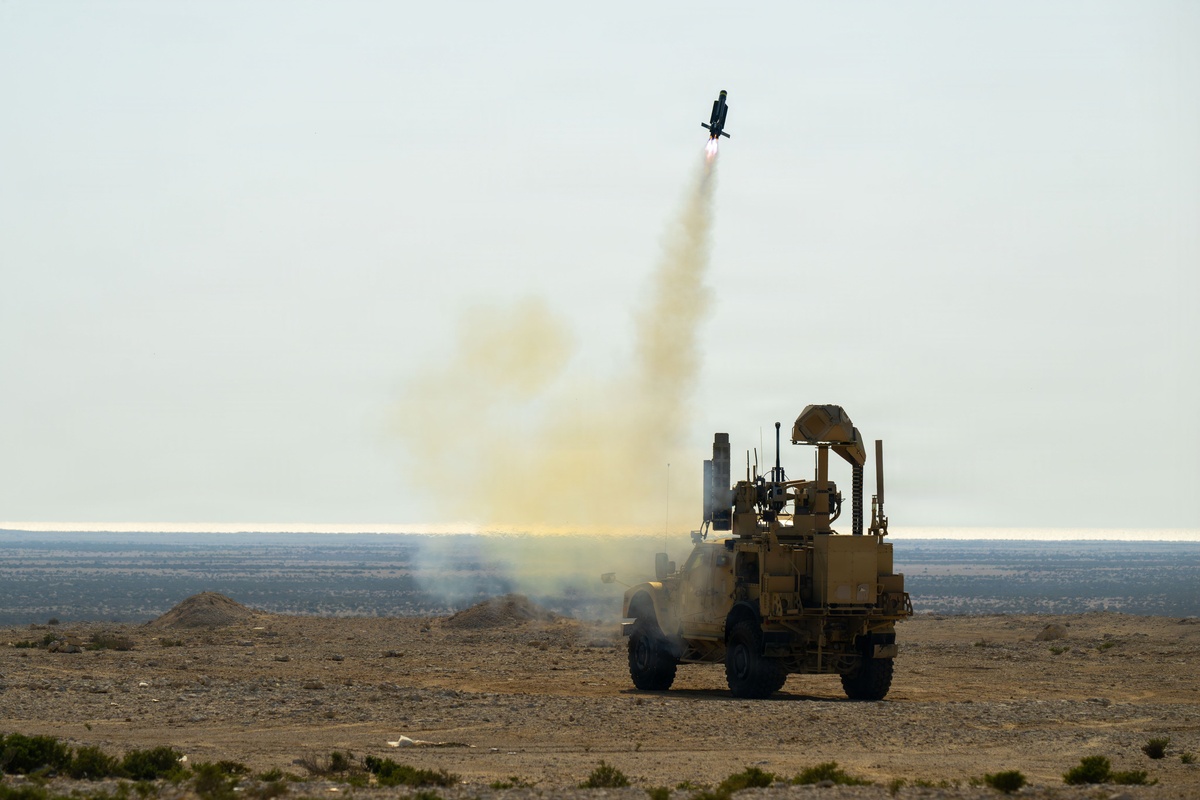
The Energy Department's National Nuclear Security Administration has awarded Kratos Defense & Security Solutions a sole-source, single-award indefinite-delivery/indefinite-quantity contract worth approximately $156 million to put counter-drone systems on the convoys that move nuclear weapons, weapon components and special nuclear material. The award, announced July 21, 2026, funds Project Solar Shield, which extends the airspace defense NNSA already fields at its laboratories, plants and sites to assets that do not sit still.
The customer is NNSA's Office of Secure Transportation, the organization responsible for the ground and air movement of the nation's nuclear stockpile. Fixed-site counter-unmanned aircraft system installations do not help a convoy in the middle of an interstate. Solar Shield is the government's answer to that gap, and it lands in a corner of the counter-drone market that sits outside the Pentagon entirely.
Background
NNSA's existing counter-UAS program is administered by the Office of Defense Nuclear Security under the direction of the NNSA Administrator, and it covers the Nuclear Security Enterprise's laboratories, plants and sites that hold sensitive nuclear materials or conduct sensitive operations. Those locations fall inside FAA-designated "No Drone Zone" restrictions under Title 14 CFR Part 73 and Part 99.7. The agency's published capabilities go well beyond posting signs: continuous airspace monitoring and detection, assessment and tracking of a drone's origin, nature and intent, electronic countermeasures to disrupt command-and-control links, the authority to employ force to physically disable or destroy an unauthorized aircraft, and coordination with federal, state and local law enforcement.
Lewis E. Monroe III, associate administrator and chief of Defense Nuclear Security, framed the program's posture in NNSA's own materials: "As threats evolve, so do we. Dominating NNSA airspace to protect our national security."
That architecture was built around perimeters. The Office of Secure Transportation's mission is the opposite of a perimeter. OST "provides safe and secure transportation of nuclear weapons and components and special nuclear materials, and conducts other missions supporting the national security of the United States," which means its protective envelope has to travel with the cargo through whatever airspace it happens to be under at the time. Every improvement in small drone range, autonomy and payload widens the distance between what a fixed installation can defend and what a highway convoy can.
Solar Shield puts Kratos on the defensive side of the unmanned aircraft problem set, integrating sensors, effectors and vehicles into a deployable government system rather than selling an airframe. Dave Carter, president of the company's Defense & Rocket Support Services division, called the program "the first large scale government production contract of its kind built around this integrated approach."
Key Details
The contract is sole-source and single-award, structured as an IDIQ worth approximately $156 million. Kratos says the selection was made against OST's technical, cost, schedule, operational, safety, redundancy, integration and long-term sustainment requirements. Work will be performed at secure Kratos facilities and is expected to begin immediately; the company disclosed no further detail, citing security considerations.
The scope is systems integration. Kratos will combine its C-UAS system, mobile platform design, command-and-control and power management technologies into a single integrated offering — mobile platforms meant to detect, track, identify and respond to hostile drones in real time, supporting mission requirements wherever OST operations occur. Power management earns its place on that list. Mobile radar, radio-frequency detection and electronic countermeasure payloads all draw current that a vehicle-mounted system has to generate, distribute and cool on the move, which is usually where truck-mounted counter-drone concepts run into trouble.
Company leadership described the shape of the deliverable in similar terms. Carter said the resulting platform gives OST "a highly modular and scalable mobile C-UAS capability, designed to support evolving mission requirements," and tied its value to combining C-UAS, mobile platform design, command-and-control capabilities and resilient power management "into a single mission-ready solution." Chief executive Eric DeMarco pointed at volume as much as capability: "We believe that Kratos' technology, system and integration capabilities in the C-UAS mission area are industry leading, and also our ability to mass produce large quantities of relevant systems at an affordable cost."
Two procedural points are worth tracking. First, because this is a Department of Energy action rather than a Defense Department one, it does not appear in the daily Pentagon contract announcements that most of the govcon press monitors. Awards of this size can move through DOE with far less public visibility than a comparable Navy or Army buy. Second, the sole-source justification runs against the direction the Defense Department has taken on counter-drone procurement, where the emphasis has been on competitive marketplaces, rapid demonstration events and multiple-award pools designed to keep vendors interchangeable. NNSA went the other way for a mission where the escort force, the vehicles and the operating procedures are all purpose-built and closely held.
What It Means for Contractors
The obvious read is that counter-UAS money is no longer a Pentagon-only line item. Civilian agencies and non-defense security organizations face the same drone problem with none of the Defense Department's authorities or acquisition infrastructure. Vendors that have organized their capture teams exclusively around DoD counter-drone programs of record are looking at a narrower market than the one that exists. Civilian customers buy through different vehicles, evaluate against different safety and legal constraints, and in NNSA's case operate under an explicit authority to employ force against an aircraft in flight.
The second read is about what OST actually bought. It did not buy a sensor, a jammer or a vehicle. It bought integration, sustainment and the accountability that goes with a single throat to choke across a system that has to work in transit, at unpredictable locations, with a cargo that permits no failures. Component makers should treat Solar Shield as a subcontract opportunity, not a lost prime bid. The award language points at C-UAS sensors and effectors, platform engineering, command-and-control software and power systems, and Kratos has framed the job as combining those elements. Long-term sustainment was an explicit evaluation factor, which usually signals follow-on task orders for spares, training, software updates and refresh.
Third, the sole-source structure is a reminder that competition norms vary sharply by agency. A single-award IDIQ with no competitive base is difficult to unseat and difficult to protest after the fact, particularly where the justification rests on the specificity of the mission. Firms interested in this lane should engage NNSA and OST early through market research and industry outreach rather than waiting for a solicitation that may never post. The counter-drone requirements coming from civilian agencies protecting critical infrastructure are still being written, and the vendors shaping them now will be the ones named in the resulting justifications.
Sources
- Kratos Receives Mobile Counter-Unmanned Aircraft System (C-UAS) Approximate $156 Million Single Award Contract by U.S. Department of Energy Office of Secure Transportation — Kratos Defense
- Protecting NNSA Facilities: Counter Unmanned Aircraft Systems — Department of Energy / NNSA
- Office of Secure Transportation — Department of Energy
- Kratos Secures Potential $156M DOE Solar Shield C-UAS Contract — GovCon Wire
- US energy department selects Kratos to protect nuclear transports from drone attacks — Unmanned Airspace
