
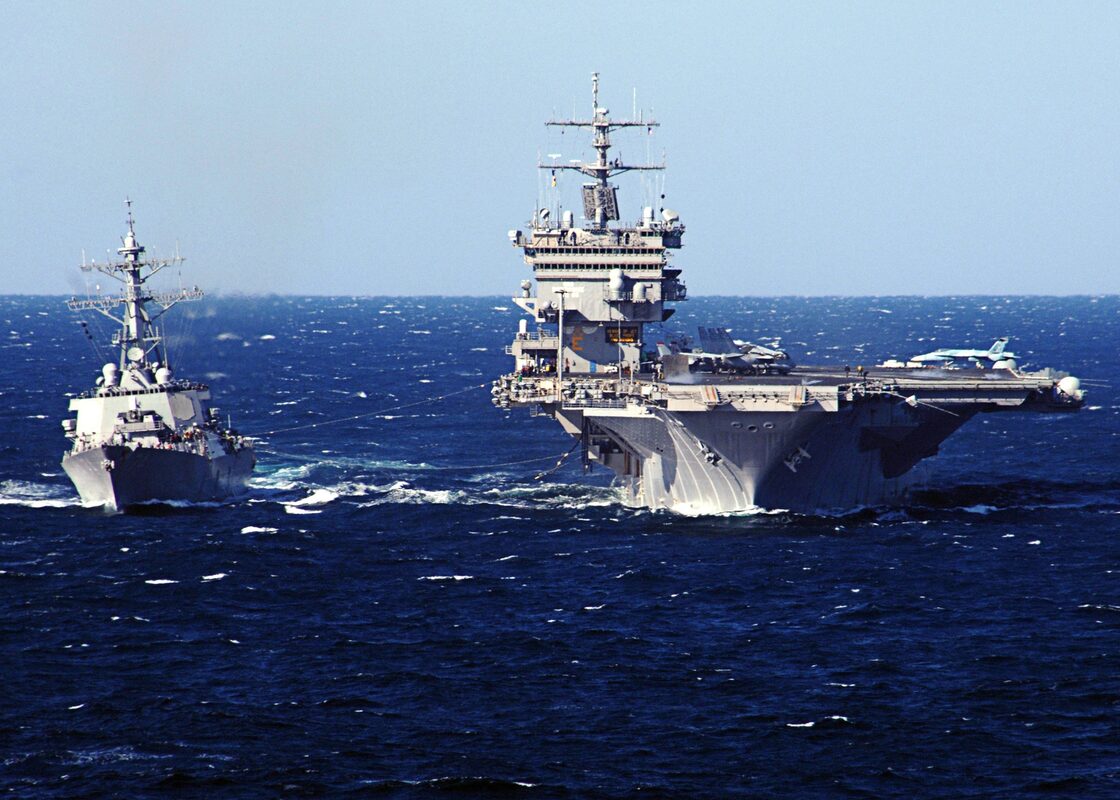
The Navy has re-awarded the job of scrapping the world's first nuclear-powered aircraft carrier, and the second time around it costs $118 million less. In its July 15, 2026 daily contracts announcement, the Department of War disclosed that NorthStar Maritime Dismantlement Services LLC of Vernon, Vermont, was awarded a $418,497,668 firm-fixed-price contract, N00024-26-C-4137, for the dismantling, recycling, and disposal of ex-Enterprise (CVN 65). The award follows a court decision that halted NorthStar's original 2025 contract for the same work and forced the Navy to reopen the competition.
Background
Ex-Enterprise is the retired CVN 65, commissioned in 1961 as the first nuclear-powered aircraft carrier and, per Naval News, serving the nation for over 50 years before being defueled. Naval News reported in June 2025 that the initial NorthStar award — a $536.7 million firm-fixed-price contract, awarded through full-and-open competition — was the first contract to commercially dismantle a nuclear-powered carrier. Quoting a Navy press release, Naval News wrote that the award "marks the first time a U.S. nuclear-powered warship will be dismantled through a commercial effort," a departure from the public-shipyard approach used for earlier nuclear vessels. The same press release said leveraging private-sector decommissioning expertise "is achieving an estimated $1 billion in cost savings compared to conducting the effort in public shipyards."
That first award did not survive. SlashGear reported that the Procurement Integrated Enterprise Environment — the same PIEE solicitation module the Navy used to run the competition — left users locked out and enduring long loading times on the April 2025 bid deadline, and that the problems kept HII Shipcycle LLC from submitting a bid; its request for leniency was denied. According to SlashGear's account, in February 2026 a judge ordered the Navy to halt the existing contract and reopen the bidding. SlashGear reported that the Navy said it would "fully comply with the decision and offer interested parties a chance to resubmit," that NorthStar appealed in March 2026, and that a new contract was expected in June 2026.
The July 15 announcement is what came out the other end. The Navy competed the requirement again through PIEE, and NorthStar won it back — at a lower price and on a longer schedule.
Key Details
The contract line items, per the Department of War announcement:
- Contractor: NorthStar Maritime Dismantlement Services LLC, Vernon, Vermont
- Value: $418,497,668, firm-fixed-price
- Contract number: N00024-26-C-4137
- Scope: dismantling, recycling, and disposal of ex-Enterprise (CVN 65), which "will be dismantled in its entirety," with all resulting materials properly recycled or disposed of. Hazardous materials, including low-level radioactive waste, will be packaged and safely transported for disposal at authorized licensed sites.
- Place of performance: Mobile, Alabama
- Completion: September 2030
- Funding: $415,497,668 in fiscal 2025 operations and maintenance (Navy) funds obligated at time of award
- Competition: competitively procured via the PIEE solicitation module
- Contracting activity: Naval Sea Systems Command, Washington, D.C.
Set the two awards side by side and the deltas are clean. Price drops from $536.7 million to $418,497,668, a reduction of roughly $118.2 million. Completion moves from the November 2029 date Naval News reported for the original award to September 2030 — ten months later. The place of performance does not move: Mobile, Alabama, both times.
Mobile is where NorthStar's team lives. Naval News reported that NorthStar is partnered with Modern American Recycling and Radiological Services, LLC (MARRS) in Mobile, where the dismantlement work will take place, and that Waste Control Specialists LLC of Andrews, Texas, serves as the licensed facility for disposal of low-level radiological and mixed hazardous waste. That footprint did not change while the litigation ran.
One number deserves attention: the fiscal 2025 O&M funds obligated at award are $415,497,668, or $3 million under the contract value. The Navy is funding nearly the entire firm-fixed-price effort up front with prior-year operations and maintenance money — a large single obligation for a dismantlement running more than four years, through September 2030.
A caution on the litigation record: the court narrative above comes from SlashGear, a secondary outlet, not from a docket GovConFeed has reviewed. The forum and the specific rulings should be treated as reported rather than confirmed. What the primary announcement confirms is the outcome — a new contract number, a new price, a new schedule, and a fresh competitive procurement for work already awarded once.
What It Means for Contractors
The first lesson is about the buying platform itself. If SlashGear's account holds, a government-run submission portal failed on deadline day, a bidder was locked out, and the entire $536.7 million award came apart roughly ten months later. That is a systems-availability risk sitting on the government's side of the table, and it cost the eventual winner a re-run and the Navy nearly a year. Bidders should document PIEE, SAM.gov, and other portal failures in real time — timestamped screenshots, help-desk tickets, error text — because that contemporaneous record is what turns "the site was slow" into a challengeable fact. Reconstructing a portal outage after award is a losing position.
The second lesson is that winning a re-competition is not the same as winning twice. NorthStar got the work back, but at $118.2 million less than its 2025 price. A reopened competition resets pricing pressure against an incumbent whose cost structure is partially known, and competitors have had time to study the requirement. Contractors defending a halted award should model the recompete as a price fight, not a formality, and budget for the schedule slip litigation imposes. Ten months of delay landed on the completion date.
Third, this is a live proof point for commercial nuclear dismantlement as a market. The Navy is testing whether a commercial team can take apart a nuclear-powered warship at a price that beats public shipyards, and the Navy press release quoted by Naval News put the estimated savings at roughly $1 billion. Ex-Enterprise is not the last carrier the Navy will need to retire. Firms in ship recycling, radiological waste handling, and heavy marine industrial work should treat the September 2030 performance period as the reference case for how the next hull gets bought — including whether the Navy keeps the single firm-fixed-price structure.
Finally, note the teaming shape: a prime with a radiological-services partner in a specific port and a licensed low-level waste disposal firm behind it. The licenses and the shipyard real estate are the barriers to entry here, not the scrapping itself. Subcontractors holding those licenses are the scarce resource in any future carrier disposal competition.
