
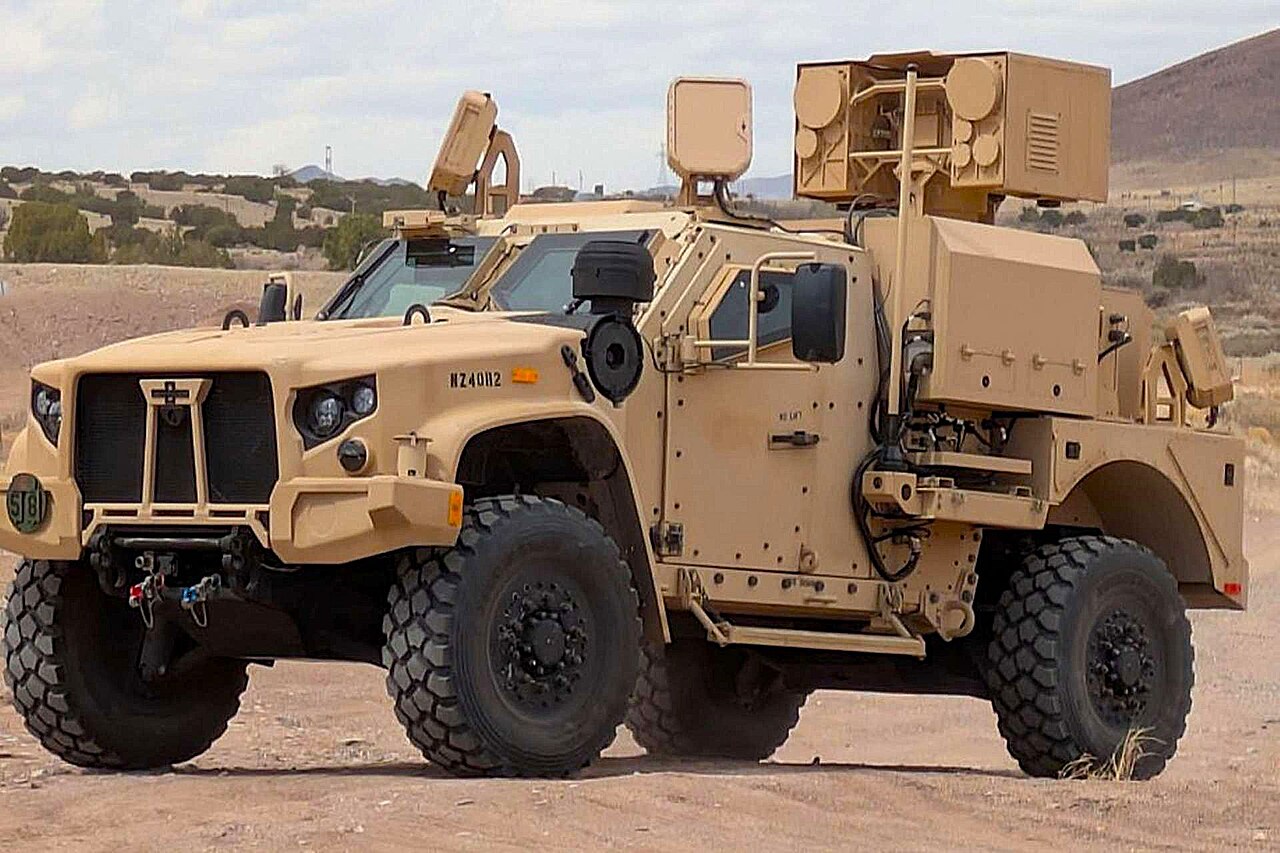
Four directed-energy weapons are about to move from test ranges into homeland airspace, putting lasers and microwaves on the front line of domestic drone defense. The Defense Department selected AeroVironment, Boeing, Epirus and Kord for a pilot program meant to expand the “operational use” of high-energy laser (HEL) and high-powered microwave (HPM) capabilities inside the United States, Breaking Defense reported, citing a Pentagon release. Congress ordered the pilot in the fiscal 2026 National Defense Authorization Act, and the Army-led Joint Interagency Task Force (JIATF) 401 will run it.
The selection gives four companies a path to show their systems working in an operational environment rather than on a closed range, and it sets up a December event where more vendors will get a chance to compete.
Which Four Systems Made the JIATF-401 Cut?
The Pentagon picked three lasers and one microwave system. According to Breaking Defense, the four selected vendors are “AeroVironment, with its Palletized HEL system; Epirus, with its Leonidas HPM system; Kord, with its Firefly HEL system; and Boeing, with its Compact Laser Weapon System.”
That mix matters. Lasers engage one target at a time with a focused beam. Epirus’ Leonidas is the lone high-powered microwave entry, a class of weapon generally designed to disrupt drone electronics over a wider area. By selecting both types, JIATF-401 can compare how each performs against the same homeland threat set and what each demands in power, crewing and airspace coordination.
Unmanned Airspace reported that the evaluation will include real-time data and feedback on the systems’ requirements, costs and best practices. Those three data streams are the inputs a program office needs before it commits to fielding and sustainment budgets.
Brig. Gen. Matt Ross, director of JIATF-401, framed the pilot as an integration exercise rather than a technology demonstration. “This pilot program will test these capabilities in an operational environment so we can understand how best to integrate and sustain them to defend the homeland,” Ross said in the Pentagon release, as quoted by Breaking Defense.
How the El Paso Airspace Closure Shaped the Pilot
Firing a laser near U.S. airports is not only a military question; it is an aviation-safety question that belongs to the Federal Aviation Administration. The task force will run the pilot in “close coordination” with the FAA, U.S. Northern Command and the military services, according to the announcement as reported by Breaking Defense.
That coordination requirement has a recent backstory. In February, the FAA temporarily closed airspace around the El Paso, Texas, airport after a miscommunication between federal agencies about the use of a counter-drone laser by Customs and Border Protection, Breaking Defense reported. The laser was later found to be on loan from the Army.
Since then, JIATF-401 and the FAA have worked to put that kind of confusion behind them. The two partnered on a risk assessment during a HEL demonstration in New Mexico, which found the system “posed a minimal risk to the National Airspace System,” according to the Pentagon release cited by Breaking Defense. Unmanned Airspace identified the site as White Sands Missile Range and reported that the FAA “established a framework for continued coordination” as a result of that testing. Breaking Defense added that the demo also produced a joint agreement for a laser system to protect the southern border.
For the pilot’s four vendors, that precedent cuts two ways. It shows the FAA is willing to clear directed-energy operations once it has run its own risk analysis. It also suggests that systems entering domestic airspace will likely need a similar safety review before they can fire.
What Happens at the December Dugway Shoot-Off?
The four selections are not the end of the competition. JIATF-401 will host a “shoot off” for the pilot program in December, Breaking Defense reported, and Ross has previously said that solutions that perform well could be bought on the spot.
Unmanned Airspace placed the event at Dugway Proving Ground and said the Defense Department will use it “to assess additional high-energy laser and high-powered microwave systems to identify promising capabilities for future operational use.” Breaking Defense likewise reported that the department and the task force will continue to “evaluate” additional directed-energy systems beyond those selected.
That structure leaves room for companies that missed the first cut. A vendor with a fieldable laser or microwave system that was not among the four appears able to compete at Dugway, and Ross’ earlier comment points to a faster buying path than a conventional multi-year program of record.
What It Means for Contractors
The pilot opens a homeland directed-energy market that, until now, has lived largely in range testing and limited demonstrations. Contractors should read several signals from the announcement.
Integration and sustainment are the evaluation criteria. Ross’ own words put integration and sustainment at the center of the pilot. Vendors competing at Dugway should be ready to document logistics, power needs, maintenance and training, not only engagement results. The Unmanned Airspace report that the evaluation covers requirements, costs and best practices points the same direction.
Airspace safety work is part of the product. The El Paso closure and the New Mexico risk assessment show that FAA coordination now sits on the critical path for any domestic directed-energy deployment. Firms that can supply the data the FAA needs for a safety determination, and that understand how the National Airspace System is managed, will be easier for JIATF-401 to field.
The December window is short. With the shoot-off scheduled for December and the possibility of on-the-spot purchases, companies with mature HEL or HPM systems have under three months to position. Subcontractors in beam control, power and thermal management, sensors and command-and-control software should also track which primes advance, since any homeland fielding will need supporting work around the weapon itself.
Both lasers and microwaves are in play. The Pentagon did not choose one approach over the other. Including a microwave system alongside three lasers, and evaluating additional HEL and HPM systems at Dugway, suggests the department wants operational evidence before it settles on a mix for homeland defense.
The four vendors now carry the pilot into an operational setting under JIATF-401, with the FAA, Northern Command and the services watching how the systems perform, what they cost to run, and whether they can operate safely near civilian air traffic.

