
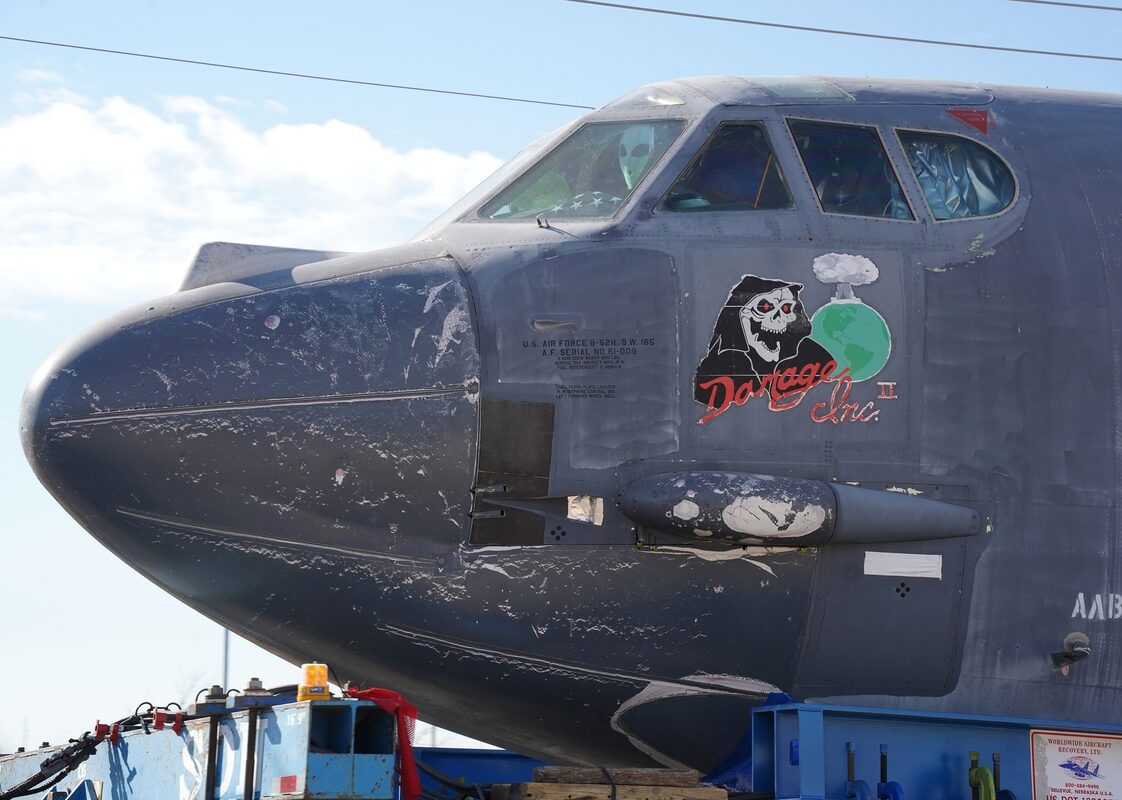
B-52 bomber crews are getting a radar overhaul that trades a decades-old spinning dish for one that steers its beam electronically in milliseconds, under a $603 million Air Force contract awarded to Raytheon. The deal locks in production and long-term sustainment of the AN/APQ-188 active electronically scanned array (AESA) radar for the B-52 fleet, replacing a mechanically scanned system that has flown on the bomber for decades.
The Department of War's Aug. 25, 2026 daily contracts release lists the award as a $603,000,000-ceiling indefinite-delivery/indefinite-quantity contract, number FA8628-26-D-B001, granted to Raytheon in El Segundo, California. The Air Force dated the award Aug. 21, 2026, with work running through Aug. 20, 2031. The Air Force Life Cycle Management Center at Wright-Patterson Air Force Base, Ohio, is the contracting activity, and the release describes it as a sole-source acquisition — meaning Raytheon was the only company solicited, a common arrangement when a single contractor already owns the technical data and production line for a system already under development. Fiscal 2026 aircraft procurement funds of $46,008,396 were obligated at the time of award to cover the first delivery order; the remaining ceiling value will be committed incrementally as the Air Force issues further orders over the life of the IDIQ.
Work will be spread across four sites: Forrest, Mississippi; El Segundo, California; McKinney, Texas; and Warner Robins, Georgia.
Why the Air Force Is Retiring the AN/APQ-166
The AN/APQ-166 has served as the B-52's primary navigation and targeting radar for decades, using a mechanically rotating antenna to sweep the sky. That approach works, but it is slow relative to modern threats and increasingly hard to sustain as parts obsolesce. The AN/APQ-188 replaces it with AESA technology, in which thousands of small transmit/receive modules steer the radar beam electronically rather than physically moving an antenna.
As Army Recognition described the shift, "AESA technology electronically steers radar energy rather than relying on the continual mechanical movement of a traditional antenna, providing faster scanning, improved reliability and considerably greater flexibility in how the sensor is employed." That flexibility matters operationally: an AESA array can track multiple targets, map terrain, and support electronic-warfare functions in rapid succession rather than mechanically re-slewing between tasks, with far fewer moving parts to fail than the mechanical system it replaces.
The radar swap is part of a broader B-52 modernization effort that Army Recognition reports also includes new F130 engines, updated mission systems and communications improvements, intended to keep the bomber — first designed in the 1950s — flying alongside newer platforms such as the B-21 Raider well into the middle of the century rather than being retired outright. Flight testing of the radar-modernized B-52 began at Edwards Air Force Base in December 2025, after the Radar Modernization Program faced technical integration and cost pressures that led the Air Force to restructure part of the effort around a smaller initial capability, Army Recognition has reported, citing the Pentagon's operational test office — making the production contract a visible sign the effort is now moving again.
How the $603 Million Ceiling Breaks Down
An IDIQ ceiling is not a guaranteed payout — it is the maximum the Air Force could spend under the contract if it exercises every delivery order over the five-year period. The $46 million obligated so far covers only the initial order; the remainder of the $603 million will flow only as the service places additional orders for production units, spares, and sustainment support through August 2031. That structure gives the Air Force flexibility to scale radar deliveries to the B-52 fleet's modernization timeline rather than committing the full sum up front, while giving Raytheon a five-year window of guaranteed work as the sole supplier.
The war.gov release states plainly: "Raytheon, El Segundo, California, has been awarded a $603,000,000 ceiling, indefinite-delivery/indefinite-quantity contract for B-52 radar production and sustainment." Beyond naming the contract number, work locations, sole-source status and the funding obligated so far, the daily contracts announcement does not break out unit pricing, quantities of radars to be delivered, or a schedule of planned delivery orders beyond the first one — all of which will surface only as future orders are announced.
What It Means for Contractors
The award reinforces a pattern that has defined the B-52 radar program from the start: once a sole-source developer builds the technical baseline for a system, it typically carries that work through low-rate production and into full sustainment without a follow-on competition, because switching contractors mid-program would mean re-qualifying an entirely new radar on an aircraft the Air Force cannot afford to ground for long. For subcontractors and suppliers in the AESA supply chain — companies that make transmit/receive modules, radar processors, or cooling systems — the five-year IDIQ signals a stable, if incrementally funded, demand pipeline running through 2031, concentrated around Raytheon's El Segundo radar work and integration activity at the other three named sites, including Warner Robins.
It also illustrates how sole-source IDIQs get funded in practice: the headline ceiling number captures attention, but the real signal for competitors and suppliers watching the program is the pace and size of individual delivery orders against that ceiling, not the topline figure itself. Companies hoping to break into the B-52 sustainment ecosystem will have more realistic entry points as teaming or supply partners on future delivery orders than as prime competitors, given the sole-source structure already in place through the contract's five-year term.
For the Air Force, locking in a fixed-ceiling IDIQ rather than negotiating each production lot separately gives program managers predictable pricing terms for a program that has already faced technical and cost pressures once. With flight testing now under way at Edwards and a funded production-and-sustainment vehicle in hand, the B-52 radar modernization effort has cleared two of its biggest remaining hurdles — flying hardware and a contract vehicle to build it — with the bulk of the $603 million ceiling still to be committed as orders are placed over the next five years.
