
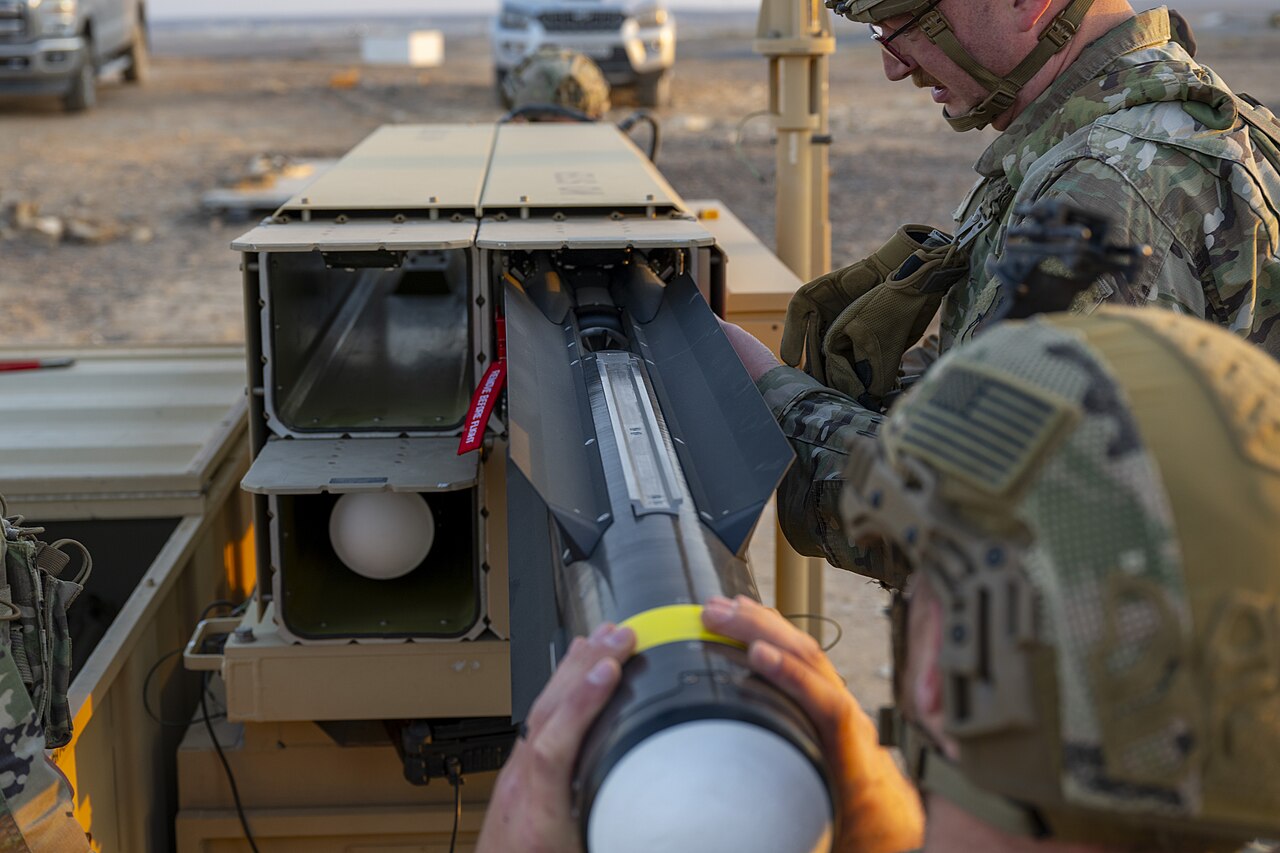
Qatar and Jordan are now buying the same drone-hunting radar and interceptors the U.S. Army fields, opening an export market for two Raytheon products that had never before been sold abroad. RTX announced Oct. 13 that its Raytheon business was awarded $729 million to deliver critical components of the LIDS counter-drone system to the U.S. Army, Qatar and Jordan. The company said these are the first international sales of its Ku-band Radio Frequency Sensor, known as KuRFS, and its Coyote effector.
LIDS stands for the Low, slow, small, unmanned aircraft Integrated Defeat System. It is the Army's program for finding and killing small drones, and KuRFS and Coyote are its sensor and its shooter. The awards cover a mix of fixed-site and mobile LIDS configurations, according to the company.
The announcement leaves several questions open. Raytheon did not say how many radars or interceptors it will deliver, when deliveries will occur, or how the $729 million divides among the three customers. The company release also did not name the contracting office or identify contract numbers.
What the $729M Buys: KuRFS Radars and Coyote Interceptors
The two products handle different halves of the counter-drone problem. KuRFS provides what RTX calls "advanced 360-degree threat detection," giving operators a full-circle picture of small aircraft approaching a site or a moving unit. Coyote is the response: a family of "low-cost kinetic and non-kinetic effectors" that, per RTX, "defeat individual drones as well as swarms, with hundreds of intercepts in combat."
That pairing matters for buyers because a radar without an affordable shot leaves a defender spending expensive missiles on cheap drones, and an interceptor without a sensor cannot find its target. LIDS packages both. The fixed-site configurations suit bases and critical infrastructure, while the mobile variants travel with maneuver forces.
"LIDS provides a proven and cost-effective layer of defense that ensures allied forces have the protection they need against hostile drones," said Tom Laliberty, president of Land and Air Defense Systems at Raytheon.
Why Did Qatar and Jordan Buy Now?
RTX did not tie the purchases to a specific event, but the regional backdrop is plain. Defence Industry Europe reported that "Iranian drone attacks that damaged sites in U.S.-allied Gulf countries have added urgency to regional procurement," and that the scale of the damage "has highlighted the need for sufficient quantities of counter-drone weapons to defend against repeated attacks."
The outlet also pointed to Russia's war against Ukraine and the recent U.S.-Iran confrontation in the Gulf as demonstrations of the need for dedicated counter-drone defenses, including kinetic weapons that destroy incoming aircraft. It noted that such systems protect personnel, military bases, critical infrastructure and important government and civilian facilities, roles that apply both to deployed forces and to installations far from a front line.
For Qatar and Jordan, buying the Army's own system carries a practical benefit: it puts their air defenders on the same hardware the U.S. Army fields. The announcement did not describe how the two countries' systems will connect with U.S. forces, and Raytheon did not discuss interoperability terms.
Can Raytheon Build Coyotes Fast Enough?
The export awards arrive as Raytheon works to raise Coyote output. Laliberty framed the expansion as a response to demand: "To stay ahead of rapidly evolving drone threats, Raytheon is accelerating production of the Coyote family of effectors."
RTX said it is investing to expand production and to integrate new technologies into the Coyote interceptor. The company listed the upgrades as faster launch times, higher speeds and greater range at higher altitudes.
Production capacity is the variable that will decide whether new foreign customers compete with the U.S. Army for the same interceptors. The release gives no production rate or delivery schedule for these orders, so the effect on Army deliveries cannot be measured from the announcement.
The Missing Split of the $729 Million
The gaps in the announcement are significant for anyone tracking the program's budget. Defence Industry Europe reported that "Raytheon did not disclose the quantities ordered or delivery schedules," and that the company "also did not provide a breakdown of the $729 million among the three customers."
Without that split, it is not possible to tell from public information how much of the $729 million is U.S. Army funding versus foreign-customer money, or what share goes to sensors versus effectors. The release also did not say whether the work arrives as one contract or several separate actions; RTX described the total in its headline as "counter-drone contracts," plural, while the body text refers to "the contract."
What It Means for Contractors
The first foreign sales of KuRFS and Coyote turn a U.S.-only program into an exportable product line, and that changes the demand signal for the supply chain behind it. Subcontractors in Raytheon's Coyote and KuRFS production base should expect volume questions as RTX follows through on its stated investment to expand production.
Firms in the wider counter-UAS market should read the award two ways. It shows that Gulf and Middle Eastern buyers are willing to adopt U.S. Army-standard counter-drone hardware, which widens the opportunity for compatible sensors, command-and-control software and sustainment services. It also shows an incumbent consolidating its position: a buyer that fields KuRFS and Coyote now has a reason to stay with that ecosystem for follow-on buys and upgrades.
Integrators and sustainment contractors should watch for follow-on work tied to the fixed-site configurations, since installations require site surveys, integration and long-term maintenance. Because Raytheon has not released quantities, schedules or the customer split, companies sizing this opportunity should wait for official contract announcements that name the contracting office and contract values before building bid plans around it.
