
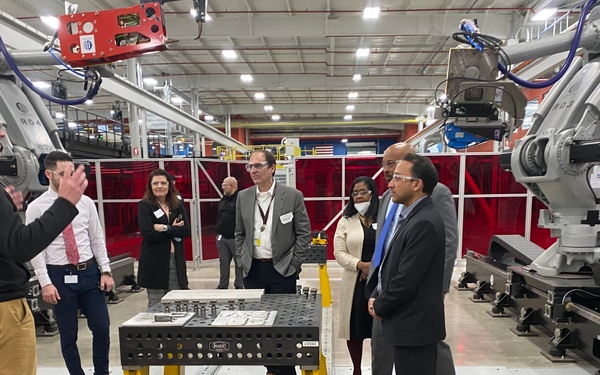
Small manufacturers that build munitions, drones, microelectronics, and ship components for the U.S. military are getting a direct line to federal capital and a coordinated push to strip away the regulatory friction that has kept them small. The Small Business Administration and the Department of War signed a memorandum of understanding on Aug. 25 creating the Smaller War Plants Commission, a joint body tasked with mapping small-business production capacity, closing supply-chain gaps, and connecting eligible manufacturers to a federal loan guarantee up to 15 percentage points higher than the one most small businesses can get today.
The Commission takes its name from the Smaller War Plants Corporation, the World War II-era agency that financed small manufacturers converting to wartime production; its credit and contracting authorities were eventually transferred to the newly created SBA in 1953. SBA says small businesses now make up "more than 70%" of the defense industrial base, and the new Commission is built to treat that base as a strategic asset rather than a collection of subcontractors waiting for prime-contractor work to trickle down.
Why Revive a WWII-Era Agency Now
The MOU frames the Commission as a response to years of warnings that the defense industrial base has thinned out — fewer domestic suppliers of castings, forgings, microelectronics, and critical minerals, and longer lead times to surge production if a conflict demanded it. SBA Administrator Kelly Loeffler tied the effort directly to reversing that trend: "Under President Donald J. Trump, the Smaller War Plants Commission will end the era of dependence by putting the full weight of the federal government behind the small businesses that power our defense industrial base," she said in the agencies' joint announcement.
Secretary of War Pete Hegseth framed the initiative as insurance against a hollowed-out supply chain even as U.S. forces remain dominant today. "The American military is already the strongest fighting force the world has ever known," Hegseth said. "President Trump has made clear that we will keep it that way — not by accepting a hollowed-out industrial base, but by building an arsenal that can outproduce, out-innovate, and outlast any adversary."
What the Civil Reserve Manufacturing Network Actually Tracks
The Commission's first deliverable is a comprehensive inventory of small-business production capacity, built through a new mechanism called the Civil Reserve Manufacturing Network, or CRMN. The name echoes the Civil Reserve Air Fleet, the program that keeps commercial airliners on call for military airlift — CRMN is meant to work the same way: a standing registry the government can call on rather than discover after a shortage hits.
SBA and the Department of War will use that inventory to identify supply-chain gaps and stand up joint teams charged with cutting regulatory and operational barriers that keep small manufacturers out of defense contracts or slow their ability to scale. The MOU names nine priority sectors: munitions and components, drones and one-way attack systems, microelectronics, strategic and critical minerals, shipbuilding and repair components, sensors, batteries, castings and forgings, and textiles. The two agencies also committed to delivering regular progress reports to President Trump on industrial strength, supply-chain readiness, and federal investment in these areas.
A 90% Loan Guarantee Instead of the Standard 75%
The concrete financial hook for manufacturers is expanded access to SBA's Made in America Loan Guarantee, delivered through the agency's International Trade Loan program. Small manufacturers deemed eligible under the Commission's priority sectors can now access a federal guarantee of up to 90% on qualifying loans — well above the 75% guarantee available under SBA's flagship 7(a) loan program, which is the standard financing vehicle most small businesses use today.
That 15-point gap matters for lenders as much as borrowers. A higher federal guarantee lowers the risk a bank carries on its books, which in practice makes banks more willing to lend to capital-intensive manufacturers — companies that need to buy CNC machines, expand cleanroom space for microelectronics, or add forging capacity — rather than steering that capital toward lower-risk service businesses. SBA and the Department of War are betting that closing the guarantee gap, not just the regulatory gap, is what actually moves small manufacturers to invest in defense production capacity.
Trade Group Reaction
The National Small Business Association welcomed the move publicly, calling capital access, contracting opportunities, and room to grow central to fixing problems it has flagged for years. In its response to the announcement, NSBA said "ensuring small businesses have access to capital, contracting opportunities and a regulatory environment that allows them to grow will be critical to building a more resilient and competitive domestic defense industrial base." The group's endorsement signals that at least part of the small-business advocacy community sees the Commission's finance-plus-deregulation approach as the right combination, rather than deregulation alone or subsidy alone.
What It Means for Contractors
For small manufacturers already selling into the defense supply chain, the immediate action item is figuring out whether their sector — munitions, drones, microelectronics, critical minerals, shipbuilding, sensors, batteries, castings and forgings, or textiles — puts them in scope for CRMN registration and the 90% loan guarantee. Companies in those nine categories should watch for outreach or application guidance from SBA and Department of War joint teams as the Commission stands up its inventory process, and should be prepared to document production capacity, capital equipment needs, and regulatory barriers slowing expansion.
For manufacturers outside the nine priority sectors, the near-term impact is smaller, but the Commission's existence is still a signal: SBA's lending and technical-assistance apparatus is likely to tilt further toward defense production over the life of this administration. Contractors relying on the standard 7(a) guarantee should watch whether their sector gets added to the priority list as the Commission's capacity inventory turns up new gaps — CRMN is designed to be a living registry, not a one-time survey, and the MOU commits both agencies to recurring reports on where investment is and isn't reaching the industrial base.
The financing terms are live now under the Made in America Loan Guarantee program, so eligible manufacturers do not need to wait for a follow-on rulemaking to apply. The regulatory and operational barrier-cutting work — the joint teams referenced in the MOU — is the piece without a published timeline, and it's the piece most likely to determine whether the Commission changes outcomes for small manufacturers or mostly changes paperwork.
