
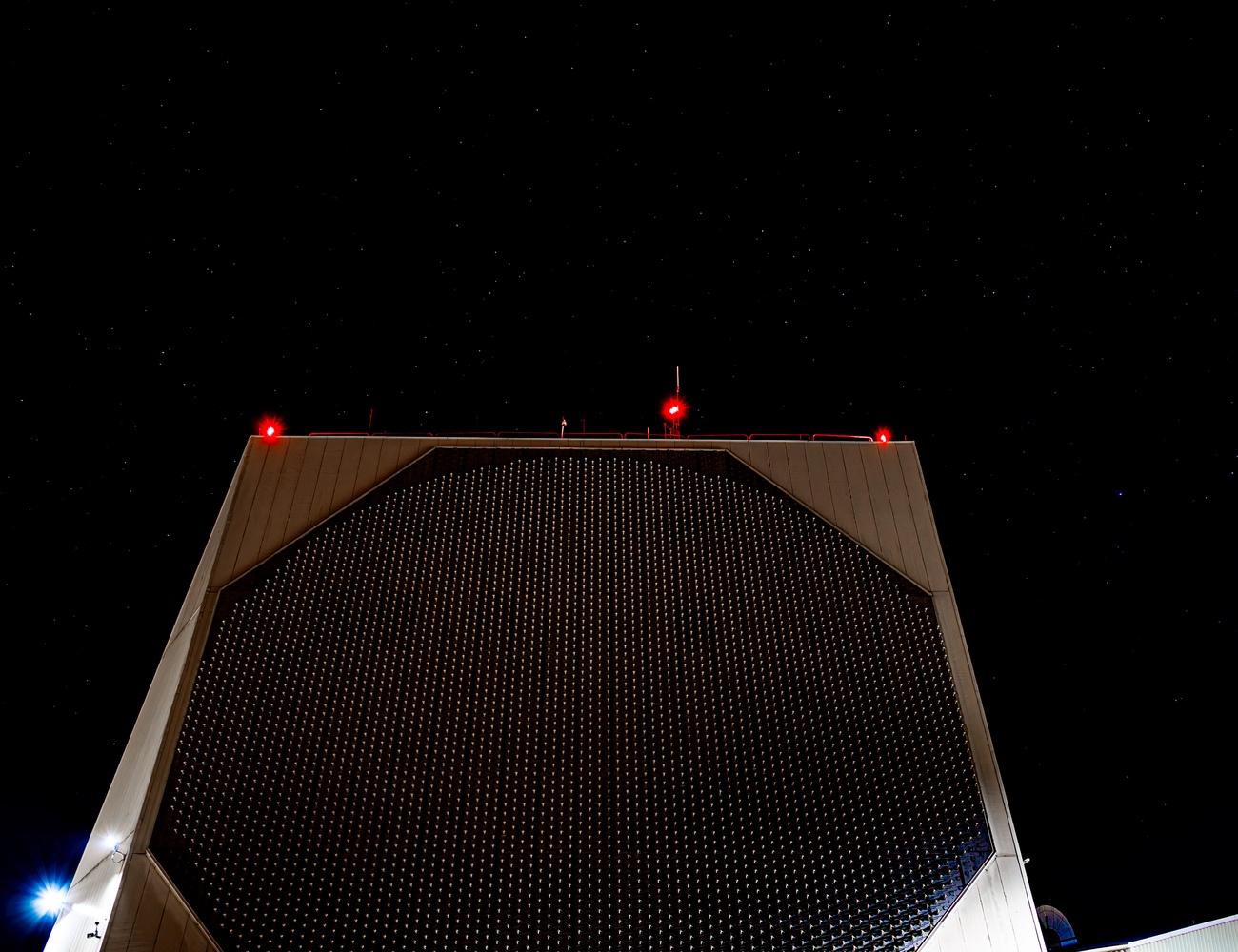
The Space Force has broken a decades-old radar monopoly into three pieces. On July 17, 2026, Space Systems Command in Colorado Springs awarded three firm-fixed-price Other Transaction Agreements for the Ground Based Radar Digitization (GBRD) program worth roughly $423.4 million combined, according to the Department of War contracts announcement. Raytheon Corp. of Woburn, Massachusetts took the largest share at $309,472,660; SciTec Innovations LLC of Princeton, New Jersey won $93,704,410; and WildStar LLC of Arlington, Texas secured $20,226,551, the smallest of the three awards. The agreements move the country's aging strategic missile-warning radars off 1970s analog hardware and onto a common, shared digital baseline.
Background
The radars in GBRD's crosshairs form the backbone of U.S. missile warning, missile defense and space domain awareness, and most were designed and fielded when analog electronics were state of the art. The program covers eight sites: five AN/FPS-132 Upgraded Early Warning Radars (three at Beale AFB in California, plus RAF Fylingdales in the United Kingdom and Pituffik Space Base, formerly Thule, in Greenland), the AN/FPQ-16 PARCS in North Dakota dating to the 1970s, Cobra Dane in Alaska, and the AN/FPS-85 at Eglin AFB in Florida. These systems feed the broader missile-warning and missile-defense enterprise, and they double as sensors that track objects in orbit.
Space Systems Command released a request for prototype proposals on May 14, 2026, and ran GBRD as a competitive acquisition. Eight offers came in. The Pentagon has been steering money toward ground-based radar as part of the broader Golden Dome push: the FY2026 reconciliation package put roughly $1.98 billion toward improved ground-based missile-defense radar, and the FY2027 Future Years Defense Program allocates about $783 million across the effort, including roughly $129 million in FY2027. Breaking Defense reported an SSC spokesperson describing the digitization approach as "transformational."
Key Details
The three OTAs carry distinct contract numbers — Raytheon under FA8723-26-9-B0003, SciTec under FA872-26-9-B001, and WildStar under FA8723-26-9-B002 — and the government obligated $107,436,000 in FY2025 research, development, test and evaluation funds at award. Work is spread across the three winners' home sites in Arlington, Princeton and Woburn, with completion expected April 21, 2028.
The acquisition structure is the part contractors should study closely. Rather than picking a single prime, the government awarded multiple vendors that will compete on their individual radar designs while jointly building a shared, common architectural baseline. GBRD develops and demonstrates that common digital baseline on an initial subset of four radar sites before rapid fielding to the remaining sites. The technical goal is to strip out the aging analog front-end and back-end hardware at each radar and replace it with a single, common virtual-stack software architecture — an approach that lets the systems fuse data across sites and, the Space Force argues, cuts the cost of sustaining eight one-off legacy designs. Each of the eight radars currently runs its own bespoke hardware and software, which forces the government to maintain separate spare-parts pipelines, training pipelines and sustainment contracts. Collapsing those onto one software baseline is where the projected savings come from.
The schedule is aggressive. Initial operational capability is targeted at the four prototype sites by the first quarter of FY2030, with full capability across all eight radars by the second quarter of FY2031. Because the baseline is common and competitively awarded across multiple OTA holders, the Space Force keeps the ability to re-compete production and sustainment work later rather than locking itself to whichever vendor writes the first line of code.
The award list itself carries a message. Raytheon built the legacy UEWRs now being digitized, so its selection is unsurprising. But the government seated a mid-tier firm, SciTec, and a far smaller newcomer, WildStar, alongside the incumbent — a deliberate widening of the vendor base on a mission set that has historically belonged to a single large radar house.
What It Means for Contractors
GBRD is a template as much as a contract. The common, competitively awarded baseline, paired with multiple OTA holders competing on designs, is the acquisition model the Space Force increasingly reaches for when it wants to avoid vendor lock and keep production competitive. Contractors watching future missile-warning and sensor modernization work should expect more of this structure: win a seat, contribute to a shared baseline, and compete task order by task order rather than banking on a single sole-source pipeline.
The seats handed to SciTec and WildStar are the clearest signal for mid-tier and smaller firms. A $20.2 million award to the smallest of the three winners on a strategic missile-defense radar program shows the government is willing to place software-defined, digitization-heavy work with smaller, non-traditional vendors when the technical approach is software rather than custom analog hardware. Firms with strong software, signal-processing and virtualization capabilities — not just legacy radar manufacturing lines — now have a credible path onto this class of program.
The Other Transaction Agreement vehicle matters too. OTAs move faster than traditional FAR-based contracts and open the door to firms that might not otherwise compete for a prototype effort, but they also demand that companies understand OT-specific rules on intellectual property and data rights. On GBRD, vendors are contributing to a shared, common architecture; teams need to price and plan around that reality rather than expecting to retain proprietary control of the core stack.
Finally, the funding backdrop favors follow-on work. With roughly $1.98 billion already directed at ground-based missile-defense radar under Golden Dome and hundreds of millions programmed across the FYDP, the four-site prototype phase is a gateway to a larger fielding effort spanning all eight radars through FY2031. Subcontractors in RF hardware, digital receivers, high-performance computing, cybersecurity and systems integration should track the prime awardees now, because the transition from prototype to full fielding is where the volume — and the supply-chain opportunities — will land.
Sources
- Contracts for July 17, 2026 — U.S. Department of War
- Space Force to overhaul legacy ground-based missile defense radar systems — Breaking Defense
- Space Force Soliciting Industry Prototypes For $783 Million Program To Upgrade Ground-Based Radars — Defense Daily
- Ground Based Radar Digitization (GBRD) — SAM.gov opportunity
