
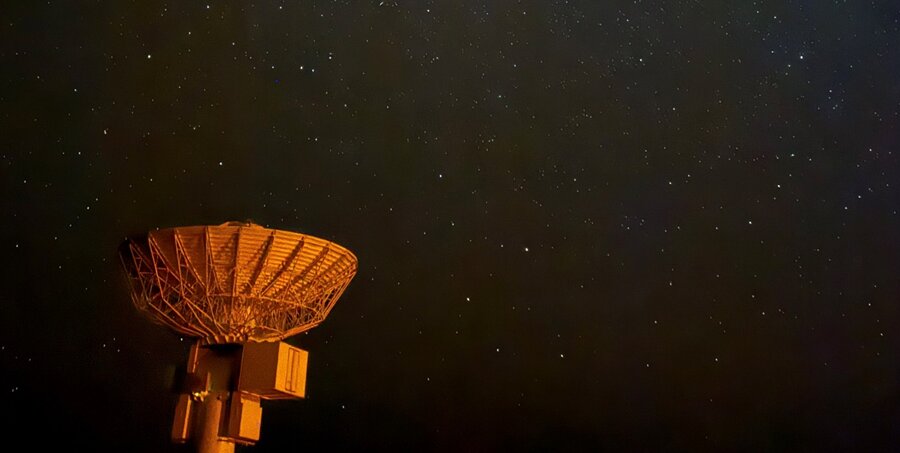
The Space Force has picked a patch of North Texas ranchland to anchor the American leg of a three-nation radar network built to watch every satellite parked in geosynchronous orbit, closing the last gap in a system the United States, United Kingdom and Australia have spent three years assembling together. The service named Lake Kickapoo, Texas, its preferred site for the third and final Deep Space Advanced Radar Capability installation, with construction targeted to begin in 2027 and the full trinational network declared operational by December 2032.
The Texas site sits roughly 120 miles northwest of Fort Worth, on the former transmitter grounds of the decommissioned AN/FPS-133 Space Fence system, shut down in 2013 after once being described as the largest continuous-wave transmitter in the world. The Space Force is requesting $442 million for the site in its fiscal 2027 budget, with an additional $1.6 billion programmed through fiscal 2031 — roughly $2 billion total to build out the American node of a network whose other two legs are already under construction or operating.
Why Lake Kickapoo Was Chosen for the Third DARC Site
DARC exists to close a specific and long-standing hole in America's ability to watch space: the geosynchronous belt, roughly 22,000 miles above Earth, where communications, missile-warning and intelligence satellites sit in fixed positions relative to the ground. Existing ground-based radars can track objects in low Earth orbit but largely lose track of anything that far out, forcing the Pentagon to rely on optical telescopes that only work in clear, dark skies. DARC's three phased-array radar sites, spaced roughly a third of the way around the globe from one another, are designed to give 24/7, all-weather coverage of that belt for the first time.
Reusing the Lake Kickapoo site lets the Space Force build on existing federal land with a legacy of large radar infrastructure rather than acquiring a greenfield parcel, a factor that has shaped site selection on the Australian and UK legs as well. Civil construction at the Texas site is expected to wrap in 2029, with operational acceptance and target readiness following in 2030 — two years ahead of the December 2032 date set for the full three-site network to be declared operational together.
Gen. Douglas A. Schiess, Chief of Space Operations, tied the selection directly to the threat environment the Space Force says it now faces in orbit. "This capability will improve visibility in our contested domain and reinforce our shared capacity to protect the space systems on which our nations rely," Schiess said, according to Air & Space Forces Magazine. In comments to Breaking Defense, Schiess framed the Texas selection as a milestone toward finishing what the three allies started: the site decision will "keep us on track to deliver a truly global deep-space sensing network with our closest allies."
What the $2 Billion Buys Through 2031
Northrop Grumman is building the radar arrays for all three DARC sites, giving the company a single prime role spanning three sovereign militaries. The Australian installation, awarded in February 2022 at $341 million, finished construction in late 2024 and was cleared for early operational use in 2025 — making it the first of the three legs to come online. The UK site, located in Wales, was awarded to Northrop Grumman at roughly $200 million in August 2024 and has since been modified to a total value of about $495 million; construction there is expected to start in April 2026, putting it roughly a year ahead of the Texas groundbreaking.
That sequencing means the Texas installation, despite anchoring the network's home nation, will be the last of the three to begin construction and the last to reach operational status. The United States, UK and Australia formalized their commitment to the arrangement in September 2023, signing a memorandum that binds the three nations to the network for 22 years — a timeline that extends well past the 2032 target for full operational capability and into the 2040s, underscoring that DARC is being built as a standing alliance capability rather than a one-off procurement.
The $2 billion figure for the Texas site alone — $442 million requested for fiscal 2027 plus $1.6 billion more through fiscal 2031 — sits on top of the roughly $341 million and $495 million already committed to the Australian and UK sites respectively, putting the combined public cost of the three-site network above $2.8 billion before the Texas budget request is finalized by Congress.
What It Means for Contractors
Northrop Grumman's position as the sole radar-array builder across all three DARC sites gives it a multi-year, multi-nation revenue stream and a strong hand in whatever follow-on sustainment, upgrade or expansion work the network generates once all three sites are operational in 2032. Firms that supported the Australian and UK builds — in civil works, site preparation, power infrastructure and long-lead radar components — are natural candidates for subcontracts on the Texas site once construction funding is appropriated, since the Space Force is already running the same basic site template a third time.
The Lake Kickapoo site's status as reused federal land with prior large-radar infrastructure also signals how the Space Force is likely to approach site selection on future space-domain-awareness programs: agencies increasingly favor parcels with existing environmental clearances, transmission history and community familiarity with large radar installations over new greenfield sites, which can shorten the environmental review and permitting timeline that often adds years to major sensor programs. Contractors bidding into adjacent space-surveillance efforts should expect the government to keep favoring legacy defense real estate where it exists.
The fiscal 2027 budget request of $442 million for the Texas site is not yet appropriated, meaning the line contractors should watch is the congressional defense appropriations process this fall and winter; a delay or reduction in that specific line would push back the 2027 construction start and, by extension, the 2030 target readiness date. Companies positioning for civil-construction or radar-integration subcontracts on the Texas leg have a roughly one-year window before ground is expected to break.
