
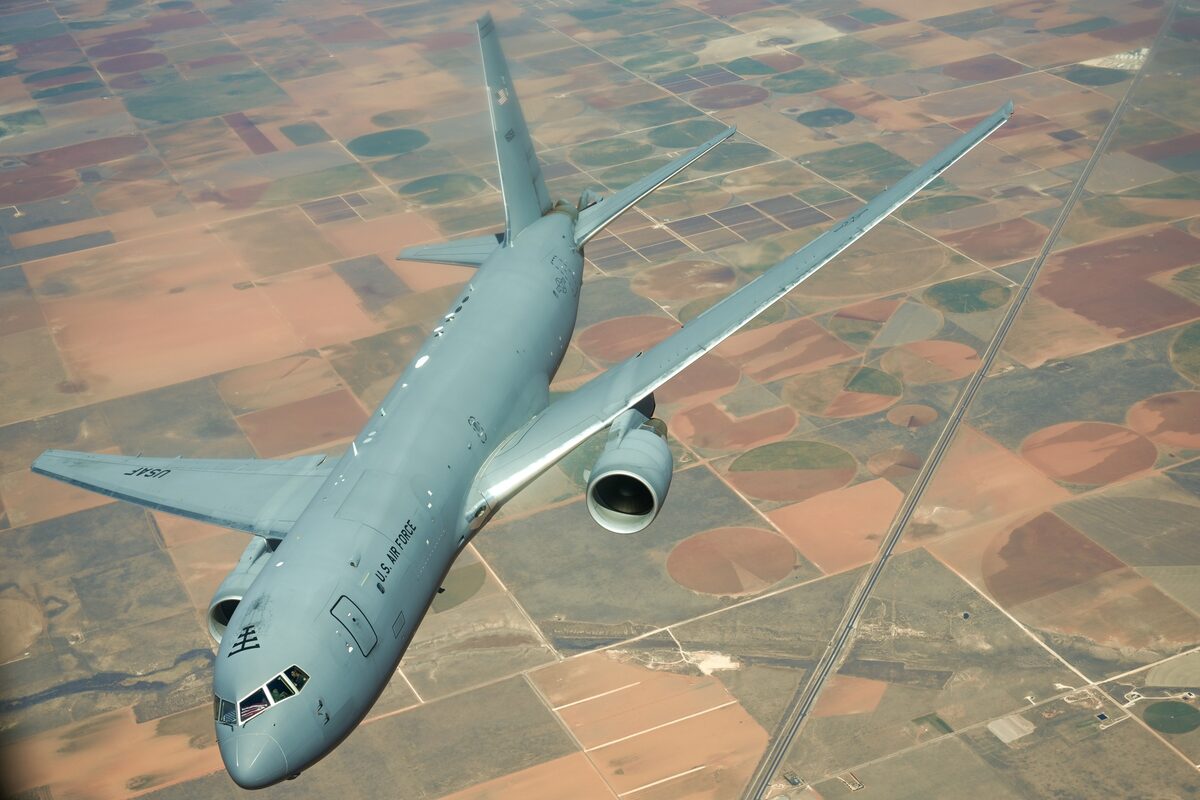
The Air Force Sustainment Center has spread a maximum $470,978,031 sustainment contract across 28 companies to keep spare parts flowing to the KC-46A Pegasus tanker fleet, according to the Department of War contract digest for June 29, 2026. The firm-fixed-price, indefinite-delivery/indefinite-quantity service contract covers the exchange or repair of commercial and non-commercial aircraft parts for the KC-46 weapon system, and trade press has framed the award as a direct attempt to ease the tanker program's persistent parts supply problem.
Background
The KC-46A Pegasus is Boeing's aerial-refueling replacement for the Eisenhower-era KC-135 fleet, built on the 767 commercial airframe. The program has been dogged for years by technical deficiencies and sustainment headaches, and keeping a relatively young fleet mission-capable depends on a steady pipeline of repairable line items, from avionics and hydraulics to landing-gear and environmental-control components. When a single supplier controls the repair of a critical part, a backlog at that vendor can ground aircraft and ripple across the fleet.
The mechanism the Air Force is using here is an exchange-and-repair pool. Rather than buying new parts outright, the service ships a worn or failed unit to a qualified vendor and receives a serviceable one in exchange, or has the original component overhauled and returned. Spreading that work across many vendors reduces dependence on any single repair source and gives contracting officers competing options when a particular shop falls behind. The contract was managed by the Materiel Support Contracting Division of the Air Force Sustainment Center at Tinker Air Force Base, Oklahoma, the hub for much of the Air Force's depot-level logistics.
Key Details
The award carries a maximum ceiling of $470,978,031 and is structured as a firm-fixed-price IDIQ service contract. It was procured competitively, and the Air Force received 28 offers, awarding a slot to each offeror under contract numbers FA8109-26-D-B001 through FA8109-26-D-B028. Work will be performed at each awardee's own facility, and the contract is expected to be complete by May 28, 2031. Fiscal 2026 working-capital funds of $14,000 were obligated at the time of award, with the bulk of the value flowing through individual task orders over the life of the vehicle.
The awardee list reads like a cross-section of the commercial-aerospace aftermarket. It includes Boeing, the prime contractor for the airframe itself, along with Collins Aerospace through its Hamilton Sundstrand unit, Honeywell, Goodrich, Crane Aerospace, and multiple Eaton Aerospace business units. Independent maintenance, repair, and overhaul specialists and parts distributors also won positions, among them AAR, STS Component Solutions, and S&K Aerospace. The pool extends beyond domestic suppliers as well, with foreign participation including TAT Technologies of Israel. Because the structure is a multiple-award IDIQ, the headline figure is a shared ceiling rather than a guaranteed payout; the 28 firms will compete for task orders as specific repair requirements surface across the life of the contract.
Defense trade coverage put the scope in plainer terms, describing the action as the Air Force spending roughly $471 million across 28 companies, managed by the Air Force Sustainment Center at Tinker, with performance running through May 28, 2031. That reporting tied the award explicitly to the tanker's parts supply problem, the sustainment-side counterpart to the better-known development troubles that have shadowed the Pegasus program.
What It Means for Contractors
For aftermarket and MRO firms, this contract is a template worth studying. The Air Force chose breadth over consolidation, awarding every qualified offeror rather than down-selecting to a handful of primes. That approach lowers the barrier to entry for component repair specialists and distributors that can demonstrate the technical capability and quality systems to service KC-46 parts. A position on a vehicle like this does not guarantee revenue, but it provides eligibility to compete for task orders without re-running a full source selection each time, which is a meaningful advantage in a sustainment market where speed of repair often matters more than unit price.
The vendor mix also signals where opportunity sits. Original-equipment manufacturers such as Boeing, Collins, Honeywell, and Eaton hold natural advantages on parts they designed, but the inclusion of independent distributors and overhaul houses shows the Air Force actively wants alternatives to OEM-controlled repair channels. Firms that can secure data rights, tooling, or licensing to repair components they did not manufacture have a path onto these pools. The presence of a foreign supplier underscores that qualification, not nationality, drives selection on commercial-derivative platforms, though contractors should expect the usual scrutiny around supply-chain provenance and sourcing restrictions.
More broadly, the award reflects how the Air Force is trying to engineer resilience into sustainment after years of single-source bottlenecks. Contractors positioned in the repairable-parts space should watch for similar multiple-award vehicles on other commercial-derivative fleets, where the same logic applies. The small obligation at award, $14,000 against a near half-billion-dollar ceiling, is a reminder that the real competition begins after the contract is signed: winning a seat is the entry fee, and task-order performance is what converts a slot into sustained work. Companies that invest in turnaround time, quality metrics, and demonstrated capacity will be best placed when the orders start flowing.
The KC-46 pool also landed the same day as a separate $450 million Air Force roofing multiple-award vehicle out of Joint Base San Antonio, a pairing that illustrates how the service is leaning on broad IDIQ structures across both weapon-system sustainment and facilities work to keep its industrial base wide and competitive.
