
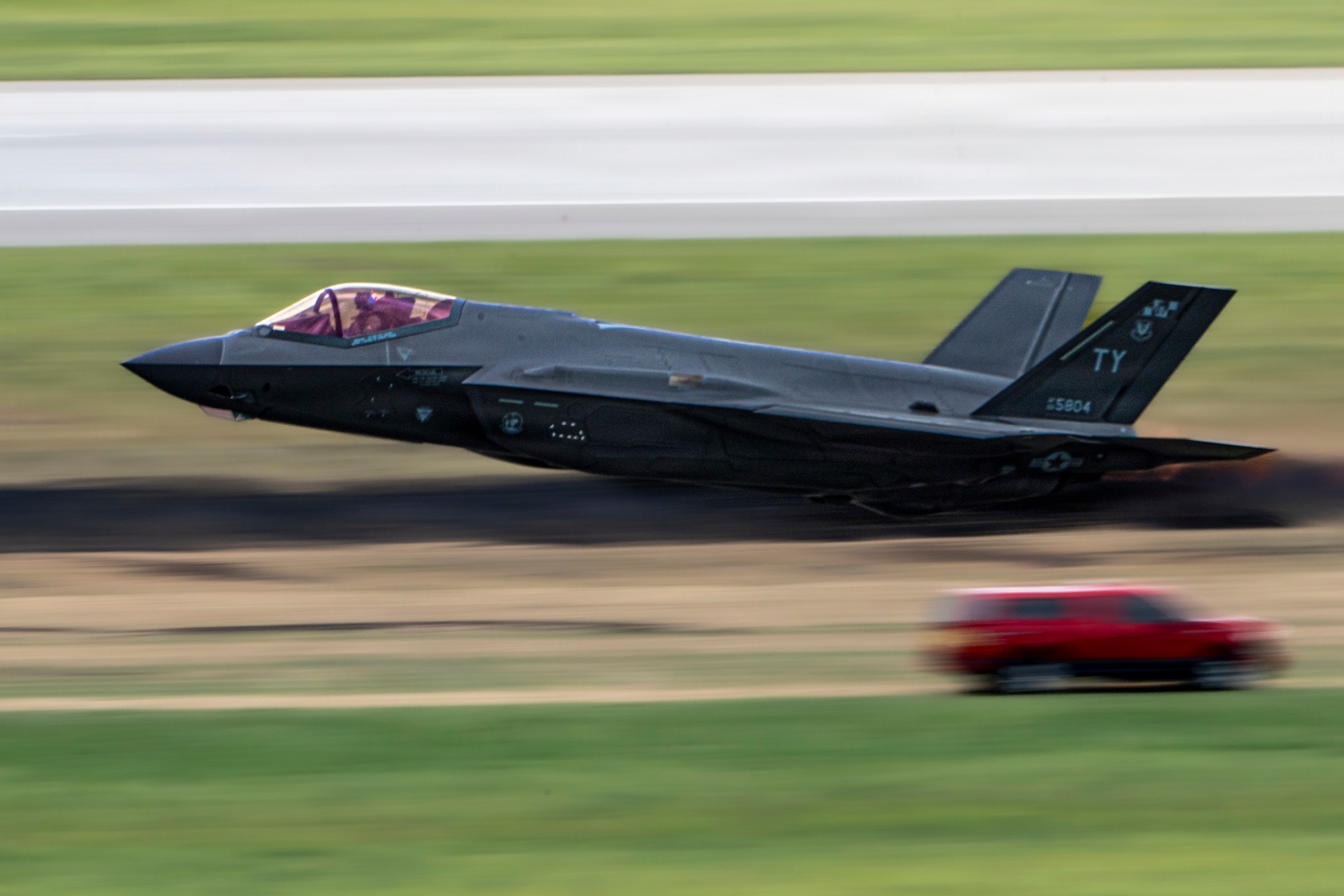
Some of the newest F-35 fighter jets rolling off Lockheed Martin's production line are being handed over to squadrons with a chunk of ballast in the nose where a radar should sit, and the Navy just put another $123.8 million behind the radar meant to fill that hole. The fixed-price-incentive contract, awarded to Northrop Grumman Systems Corp. of Linthicum Heights, Maryland, on Sept. 24, 2026, pays for long-lead materials, parts and components for a seventh lot of the APG-85 radar — 67 production units bound for Air Force, Marine Corps and Navy jets.
The money is split between $66,527,000 in fiscal 2026 Air Force aircraft procurement funds and $57,254,000 in Navy aircraft procurement funds, both obligated immediately. Naval Air Systems Command at Patuxent River, Maryland, is running the buy, which was not competitively procured — a structure typically reserved for a program's sole source — and work is expected to run through February 2031.
Why New F-35s Are Flying With Ballast Instead of a Radar
The APG-85 is supposed to replace the current APG-81 radar, swapping in gallium nitride components on an active electronically scanned array design that runs cooler and pushes more power. But the new nose structure built for Lot 17 F-35s can't accept the old APG-81 without significant rework, and the APG-85 itself hasn't been arriving on the schedule the program needs. Avionics International has tied the delay to cooling and power-consumption problems still being worked out in development, Defence Blog reported.
The practical result, as Defence Blog reported, is that brand-new jets have been leaving Lockheed's line with ballast standing in for a radar, destined for a later retrofit once a hardware fix is ready. "The U.S. Navy has awarded Northrop Grumman up to $123.8 million to buy long-lead parts for 67 AN/APG-85 radars, the new radar meant for the F-35 fighter, as brand-new jets continue to reach U.S. squadrons with ballast in their noses instead of radars," Defence Blog reported. A nose-bulkhead redesign that can accept either radar isn't expected until Lot 20, whose deliveries begin in 2028, meaning jets rolling off the line between now and then are effectively slated for a future trip back through depot-level retrofit once a radar becomes available. Export customers, including Poland, are unaffected for now — their jets still carry the APG-81, since the APG-85 isn't offered outside the United States, an arrangement that for now confines the ballast problem to U.S.-bound aircraft.
Congress Presses the Program's General on What "Mission Capable" Means
The gap surfaced in public view on June 23, 2026, when Lt. Gen. Gregory Masiello, the F-35 program executive officer, testified before the Senate Armed Services Committee's Airland Subcommittee. Sen. Mark Kelly, the Arizona Democrat serving as ranking member, asked Masiello directly whether a Marine Corps F-35B delivered without a radar could be counted as fully mission capable. The Marine Corps had by then accepted six of them.
Masiello didn't try to spin the answer. "I don't think I would count them as fully mission capable," he told the subcommittee, according to Military Times, adding that he would go into more detail on the radar's status in the closed session that followed.
The exchange landed against a backdrop of already poor readiness numbers. A Government Accountability Office report released the same month found that only one in four F-35s across the fleet were fully mission capable. Masiello offered a rosier internal figure — a 56% mission-capable rate, against GAO's 44% — and attributed the gap to differing methodology between the program office's accounting and GAO's. Neither number suggests a fleet in good health, and neither depends on whether an aircraft happens to have a working radar installed; the radar-less jets are simply one more variable layered on top of a readiness picture both sides already agree is poor.
What It Means for Contractors
The $123.8 million buy is a long-lead-materials order, not the delivery of finished radars — it locks in raw materials, parts and subcomponent production slots years before the 67 units it funds actually reach an aircraft. That structure matters for the supply chain underneath Northrop, which is dominated by small businesses. In his written statement to the Airland Subcommittee, Masiello flagged exactly that vulnerability: "Many of our suppliers are small businesses that frequently face solvency challenges during gaps between annual contract awards, forcing owners to absorb personal financial risk to maintain payroll and operations."
For companies in the APG-85 supply chain, a fixed-price-incentive, sole-source award of this size is a signal that the radar program has enough institutional momentum to keep funding flowing even while the hardware itself lags — a not-to-exceed price with incentive terms gives Northrop and its subcontractors room to be paid more if they hit performance targets, but also puts cost risk on the contractor if they don't. For competitors, the sole-source structure is a reminder that Northrop, not a rival, is building this radar for now. And for anyone selling into the F-35 program broadly, the ballast-nose story is a case study in how a single subsystem's schedule slip can ripple into readiness statistics that get read into the Congressional Record — a reminder that late deliverables on a program this size don't stay a contractor's private problem for long.
The next marker to watch is Lot 20, when the redesigned nose bulkhead is due to let jets accept either radar and the retrofit backlog can start shrinking. Until then, expect more of the same: production continuing on schedule for the airframe, and a radar supply chain racing to catch up.
Sources
- Contracts for Sept. 24, 2026 (Department of War daily contract announcements, via GlobalSecurity mirror)
- Northrop gets $124 million for delayed F-35 radar parts
- F-35 program chief warns fleet has outgrown its support system amid record-low readiness
- Statement of Lt. Gen. Gregory Masiello, PEO F-35, Before the Airland Subcommittee, Senate Armed Services Committee (June 23, 2026)
