
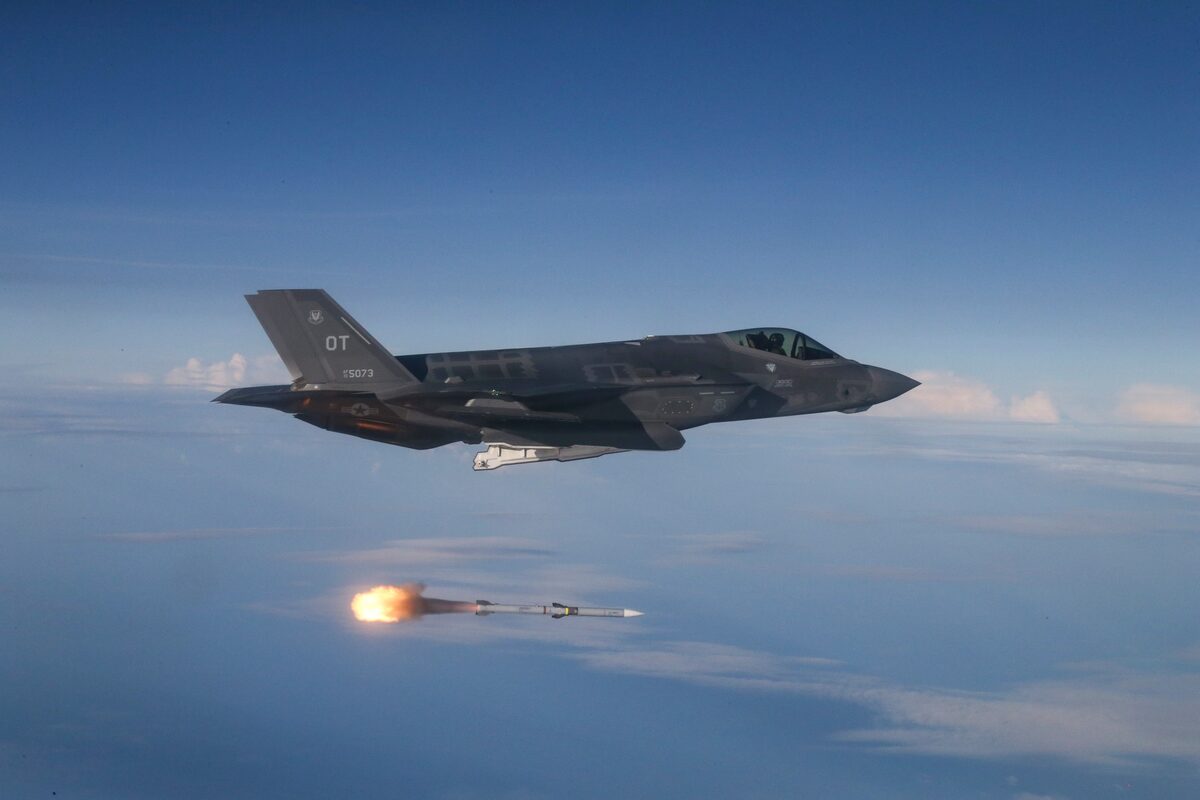
The Air Force has locked Raytheon into a record AMRAAM production run whose funded start comes largely from foreign governments. In a Department of War contract announcement mirrored by GlobalSecurity, the department disclosed a not-to-exceed $20,699,334,581 multiyear contract for the Advanced Medium-Range Air-to-Air Missile that covers foreign military sales to 16 countries.
Raytheon Co. of Tucson, Arizona, was awarded the fixed-price incentive firm and firm-fixed-price undefinitized contract action on Sept. 25, 2026. The department announced it Sept. 28. The Air Force Life Cycle Management Center at Robins Air Force Base, Georgia, is the contracting activity under contract number FA8556-26-C-B001. Work will be performed in Tucson and is expected to be complete by June 30, 2033.
What Does the $20.7 Billion AMRAAM Contract Actually Buy?
The announcement says the contract "provides for the procurement of AMRAAM All Up Rounds, Guidance Sections, Direct Charge, and FMS Offsets." All Up Rounds are complete missiles. Guidance sections are the seekers and electronics that steer them, and they also work as spares. The announcement does not give a missile count or a unit price. Defence Blog noted the same gap, reporting that the contract does not say how many missiles it will buy.
Raytheon frames the award as a five-year multiyear contract with two option years, valued at up to $20.7 billion, under the Department of War's Arsenal of Freedom. RTX's press release says it follows the agreement between Raytheon and the department announced earlier this year, which supports annual production of at least 1,900 AMRAAM missiles. Defence Blog dates that framework agreement to Feb. 4, 2026.
Raytheon President Phil Jasper said in the RTX release: "AMRAAM remains the world's most trusted, combat-proven air dominance weapon for the United States and our allies, delivering beyond-visual-range lethality with advanced guidance and electronic protection in contested environments."
Which 16 Foreign Customers Are Behind the Order?
The announcement lists the foreign military sales customers: Australia, Belgium, Canada, Czech Republic, Denmark, Finland, Germany, Italy, Japan, Kuwait, Netherlands, Norway, Poland, Sweden, Taiwan and the United Kingdom.
The money committed at award tracks that foreign focus. The department obligated $85,715 in fiscal 2026 Air Force weapons procurement funds and $154,266,225 in foreign military sales funds at the time of award. Foreign funds are therefore the overwhelming share of the cash that has actually moved. Defence Blog notes that the rest will be released as the contract is finalized and future budgets are approved.
RTX's release, by contrast, says Raytheon is scaling production to meet "surging demand from the U.S. Air Force, Navy and our international partners." The announcement names the 16 customers and the FMS funds, and it does not say how much of the ceiling belongs to U.S. orders. The public record reviewed does not split the $20.7 billion between the customers.
Why a Sole-Source Undefinitized Action?
The announcement is blunt on competition: "This contract was a sole-source acquisition." Raytheon did not compete for the award. The announcement gives no justification. It does not say why the department treated this as sole source, and the sources reviewed contain no explanation.
The contract is also an undefinitized contract action. Defence Blog explains that such an action lets work begin before the government and the company agree on final prices and terms, up to a set ceiling, which here is $20.7 billion. The figure is therefore a cap, not a negotiated price. The final value depends on how many missiles the customers order and on what price is eventually agreed.
Multiyear structure matters for the supply chain. Defence Blog describes the logic: multiyear contracts let the Pentagon buy several years of weapons at once, which gives manufacturers the confidence to invest in factories and suppliers and usually lowers the price per missile. RTX says it has invested heavily in recent years to ramp AMRAAM and other munitions, nearly doubling production in 2025 compared with 2024. It says it works with hundreds of small and mid-sized suppliers nationwide and is now exploring international co-production.
How Big Is the AMRAAM Franchise?
RTX says the missile, now in its fifth generation, operates on 14 platforms and is fielded by 44 countries, with more than 7,000 successful live fires in test and combat. It also serves as the primary interceptor for the NASAMS air defense system, according to the RTX release. That dual role, fighter-launched and ground-launched, helps explain the breadth of the foreign customer list. Defence Blog says Norway co-developed NASAMS with Raytheon; the announcement itself does not tie any customer to a particular platform.
What It Means for Contractors
The award shows how the department is structuring munitions demand. Production is being locked in through a single-source prime, with foreign customers carrying the funded start. Contractors should read several signals from it.
- Sub-tier suppliers: RTX says it works with hundreds of small and mid-sized suppliers. A period of performance running to June 30, 2033, and a production floor of at least 1,900 missiles a year under the framework agreement give lower-tier firms a longer demand signal than annual buys do. Firms that make seekers, propulsion components, electronics and test equipment should ask Raytheon procurement how the multiyear terms will flow to subcontracts.
- No open competition at the prime level: The prime award was sole source, so there was no competition to bid at that tier. Any opening sits in Raytheon's supply chain and in the international co-production RTX says it is exploring.
- Funding is not yet firm: Only $85,715 in U.S. funds and about $154 million in FMS funds were obligated against a $20.7 billion ceiling. Suppliers should treat the ceiling as potential, not booked, work until orders are placed and the contract is definitized.
- FMS-driven schedules: With 16 named customers, delivery timing will depend on foreign funding and export approvals as well as U.S. appropriations. The announcement does not say which customers receive missiles first.
- Watch definitization: The final price and terms remain to be negotiated. That negotiation will determine how much cost pressure moves down to suppliers.
For competitors and adjacent munitions suppliers, the practical point is scale: a $20.7 billion ceiling, one prime and a multiyear horizon through 2033. Companies pursuing air-to-air or air-defense work may reasonably expect the department to keep using multiyear structures where it wants industrial capacity built ahead of orders.
