
The Marine Corps has committed to a single supplier for the launchers behind its main long-range anti-ship weapon, and it has done so for the next eight years. Norway's Kongsberg Defence & Aerospace can now receive up to $404.4 million in orders for Naval Strike Missile launcher units and weapon control systems, according to Defence Blog's account of the Pentagon announcement. The Department of War announced the award Sept. 25, and Kongsberg announced the framework Sept. 28.
The contract is firm-fixed-price and covers full-rate production and support of the Naval Strike Missile Launcher Unit, its Weapon Control System and related support equipment. Those items make up the shooter side of the Navy-Marine Expeditionary Ship Interdiction System, known as NMESIS.
What Does the $404.4 Million Ceiling Actually Commit the Marine Corps To?
Less than the headline suggests. Defence Blog reports that no money was obligated at award. The Marine Corps will fund the work through individual orders as it places them, so the final amount spent depends on how much the service buys.
Naval News frames the deal the same way. "The value is not a firm order total; instead, the Marine Corps will place individual call-offs under the framework, with Kongsberg expected to announce significant order intake as those orders are made," the Naval News Staff wrote in its report on the agreement.
Defence Industry Europe reached the same reading of Kongsberg's announcement. The potential $404 million value does not mean the full amount has been ordered, and the size of Kongsberg's confirmed business will depend on subsequent call-offs. Kongsberg said it would announce significant orders as the Marine Corps places them.
The announcement did not say how many launchers or control systems the Marine Corps plans to order. A ceiling of $404.4 million tells a reader the maximum the vehicle can carry, not the quantity behind it.
Why Was the NMESIS Launcher Deal Awarded Without Competition?
The Marine Corps did not compete the award. "The Marine Corps did not compete the award, citing a federal rule that allows sole-source contracts when only one company can meet the requirement," wrote Colton Jones of Defence Blog.
The Marine Corps Portfolio Acquisition Executive at Quantico, Virginia, is managing the contract. The public announcement did not detail the justification beyond that exception.
Kongsberg's position as the missile's maker explains part of the logic. Defence Blog reports that Raytheon is Kongsberg's U.S. production partner and that the U.S. Navy also carries the missile on its warships. Naval News adds that the Naval Strike Missile is the centerpiece of the Navy's Over-the-Horizon Weapon System and is being integrated aboard Littoral Combat Ships and Constellation-class frigates. The launcher and weapon control equipment are built around that missile.
Where the Work Gets Done Through Sept. 24, 2034
Kongsberg will perform about 85% of the work in Kongsberg, Norway, and 15% in Johnstown, Pennsylvania, through Sept. 24, 2034. The split puts most of the work overseas, with a smaller U.S. share in Pennsylvania.
That geography is worth watching as call-offs arrive. Firm-fixed-price orders under an eight-year framework fix the price of each order in advance, which places cost risk on the contractor rather than the government. Because the framework itself carries no obligated funds, the government's exposure stays at zero until it issues an order.
How NMESIS Fits Into Marine Littoral Regiment Plans
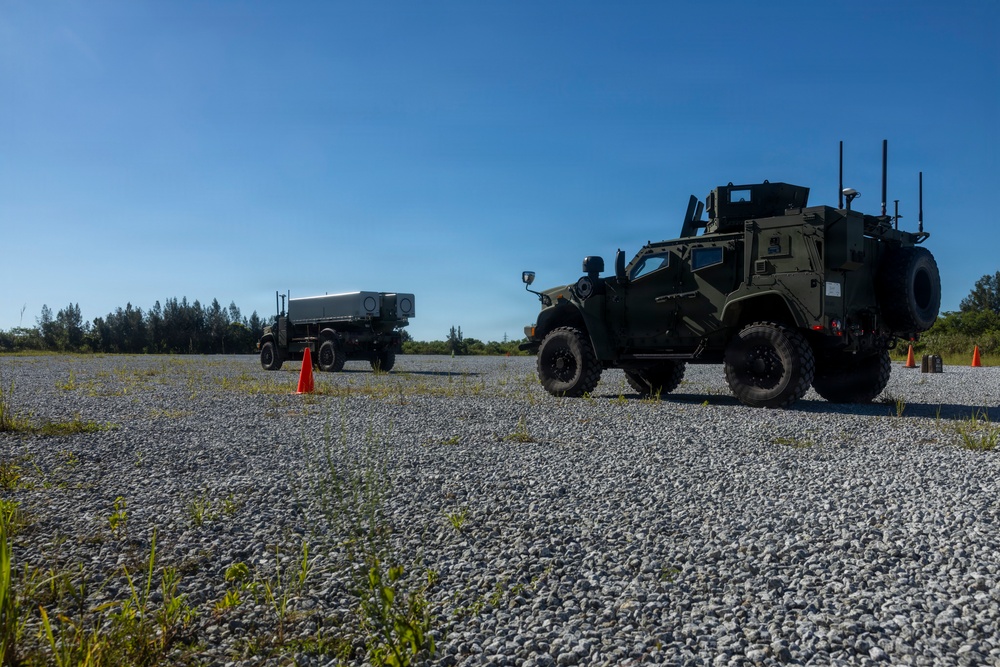
Each NMESIS launcher carries two Naval Strike Missiles on an unmanned, remotely driven version of the Joint Light Tactical Vehicle built by Oshkosh Defense, called ROGUE-Fires. With no crew cab, the vehicle can hide among coastal terrain and move between firing positions while its operators stay out of the target area, Defence Blog reports. Naval News notes that the weapon-control element is operated from a separate command-and-control vehicle.
The 3rd Marine Littoral Regiment received the first NMESIS launchers in November 2024. Marines took the system to the Philippines for Balikatan 2025, flying launchers across northern Luzon and the Batanes Islands, and to Okinawa, Japan, that summer for its first training there. During Balikatan 2026, they moved NMESIS by C-130J to the island of Itbayat and landed it by ship on Calayan, both in the Luzon Strait north of the Philippine main islands.
The Marine Corps has made NMESIS its main long-range anti-ship weapon and dropped plans for a ground-launched Tomahawk, according to Defence Blog. Its fiscal 2027 budget request includes 32 NMESIS launchers and 103 Naval Strike Missiles. Those request numbers are the clearest public signal of near-term demand, though the framework itself does not tie orders to them.
Naval News argues the agreement reaches past missile buys. "By covering launchers, weapon-control equipment and sustainment, the new arrangement goes beyond missile procurement," it wrote, adding that it "creates a long-term vehicle for the Marine Corps to expand the infrastructure needed to field, maintain and regenerate dispersed firing units." Marine Littoral Regiments are expected to operate from temporary and austere locations rather than fixed coastal-defence sites, which raises the value of sustainment support in the contract.
How Does This Differ From Other NMESIS and Kongsberg Awards?
Several separate awards touch the same ecosystem, and they should not be conflated. In July, Kongsberg received a $50.3 million modification for launcher missile modules for the program, per Defence Blog. In May, Oshkosh received a delivery order for more ROGUE-Fires vehicles, due through September 2028.
What It Means for Contractors
For competitors, the sole-source designation closes the launcher and weapon control lane on NMESIS for the life of the framework. Firms hoping to bid on that equipment have no open competition to enter. The opportunity sits instead in adjacent work: vehicles, integration, sustainment and support equipment that the Marine Corps may buy through other vehicles, as the Oshkosh ROGUE-Fires order shows.
For subcontractors and suppliers, the 15% Johnstown, Pennsylvania share is the U.S. entry point. The size of that share in dollar terms will depend entirely on call-offs, because no funds were obligated at award. Suppliers should treat the $404.4 million as a ceiling and watch for Kongsberg's announcements of significant orders, which the company has said it will make as the Marine Corps places them.
For teaming partners, the eight-year window through Sept. 24, 2034 gives a stable planning horizon. Sustainment and support equipment are named in the scope, so firms that provide spares, training, test gear or logistics support to Kongsberg's U.S. operations may find demand there, though the sources do not say how much of that work will be subcontracted. The fiscal 2027 request for 32 launchers and 103 missiles offers a rough sense of near-term volume, though only issued orders will confirm it.
For program watchers, the key indicators are the first call-off, its quantity, and whether the number of launchers is ever disclosed. Until orders appear, the award is a ceiling and a commitment to one supplier, not a spending total.
Sources
- Kongsberg Signs $404 Million Framework Agreement for USMC NSM Equipment (Naval News)
- U.S. Marine Corps buys more anti-ship missile launchers (Defence Blog)
- Kongsberg secures U.S. Marine Corps Naval Strike Missile launcher agreement with potential value of $404 million through 2034 (Defence Industry Europe)
