
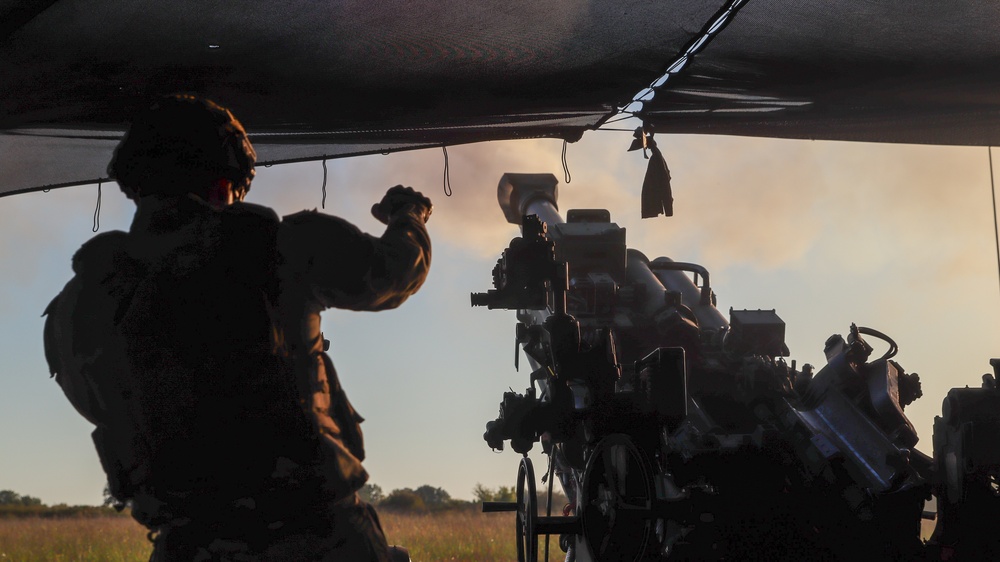
The Army has committed to buying artillery fuzes from a single small manufacturer for the next five years, betting the sustained fire rate of its 105mm and 155mm howitzer batteries on one Pennsylvania supplier staying in business. The Department of War's Aug. 31 contracts announcement confirms Action Manufacturing Co. of Bristol, Pennsylvania, won a $712,480,000 firm-fixed-price indefinite-delivery/indefinite-quantity contract to manufacture, inspect, test, package and deliver M739A1 point-detonating/delay fuzes through August 2031.
Army Contracting Command in Newark, New Jersey, issued the award, designated contract number W15QKN-26-D-A084, after soliciting bids over the internet. Only one company answered.
Why a Single Bid Landed a $712 Million Contract
The contract notice is blunt about how competitive the process was. "Action Manufacturing Co.,* Bristol, Pennsylvania, was awarded a $712,480,000 firm-fixed-price, indefinite-delivery/indefinite-quantity contract to manufacture, inspect, test, package and deliver M739A1 point detonating/delay fuzes," the Department of War wrote in its document text, adding: "Bids were solicited via the internet with one received."
A single-bid outcome on a contract worth nearly three-quarters of a billion dollars is unusual even by defense-industrial standards, and it points to how narrow the supplier base for artillery fuze production has become. Army Recognition, a defense-industry trade outlet that separately covered the award, described Action Manufacturing as an established domestic manufacturing source for the fuze, already identified in Army documentation as a production partner rather than a wholly new entrant. The asterisk the Army itself attached to the company's name in the notice is a standard flag the service uses to denote a small business, a reminder that the sole bidder on this three-quarter-billion-dollar program is a small, specialized manufacturer rather than a defense prime.
That concentration is not new to the M739A1 line, but locking in a six-figure-day production rate through 2031 makes clear the Army sees no near-term path to diversifying the supplier pool. An IDIQ vehicle lets the service place task orders against the ceiling as needed rather than committing the full sum up front, but it also means Action Manufacturing now holds effectively uncontested pricing leverage over a component that a shortage anywhere in its production line has no ready domestic backup for.
What the M739A1 Fuze Does — and Why It's a Chokepoint
The M739A1 is a point-detonating/delay fuze, meaning it can be set to trigger on impact for immediate fragmentation effects or delayed to let a projectile penetrate a target before detonating. It arms 105mm and 155mm projectiles fired from the Army's M119 towed howitzer, the M777 towed howitzer and the M109A6 Paladin self-propelled howitzer. Army Recognition's reporting on the award described the fuze this way: "The M739A1 provides point-detonating and delay functions for artillery rounds fired by systems including the M119, M777 and M109A6 Paladin."
The strategic significance of the award is less about the fuze's engineering than about where it sits in the supply chain. Projectile bodies and propellant have both received extensive public attention and investment as the services work to scale 155mm shell output. Fuzes have drawn far less scrutiny, yet Army Recognition's coverage of the award makes the underlying supply-chain logic explicit: artillery ammunition production depends on an interconnected chain of projectile bodies, explosive fill, propelling charges, primers and fuzes, and inadequate output of any single one of those components can restrict how many complete rounds reach training, stockpiles or the field — regardless of how much capacity exists elsewhere in the chain. A completed artillery round is useless without a working fuze on the nose, and if Action Manufacturing's line runs into trouble, its production effectively caps how many M739A1-fuzed rounds the Army can build no matter how much shell and propellant capacity comes online elsewhere.
A Five-Year Runway Instead of Annual Orders
The August 2031 completion date signals the Army wants five years of predictable fuze deliveries locked in rather than negotiating a new contract annually while it works on ammunition production scale-up elsewhere. IDIQ structures are common for munitions components precisely because they let the government issue delivery orders against a ceiling as budget and operational tempo dictate, while giving the contractor enough revenue visibility to invest in tooling, staffing and — in theory — capacity expansion.
Whether Action Manufacturing uses the five-year runway to expand output, or simply to run its existing line at a steady, well-compensated pace, will determine whether this award actually loosens the fuze bottleneck or just formalizes it. Nothing in the Department of War's notice indicates the contract includes capacity-expansion milestones or facility investment requirements — it reads as a standard production IDIQ, not a Defense Production Act-style capacity buildout.
That distinction matters for anyone tracking the broader artillery ammunition push. The push to scale 155mm shell output has drawn the bulk of the public attention and investment dollars tied to expanding artillery production, with shell-body and propellant contracts absorbing most of that focus. An IDIQ that simply keeps an existing fuze line running at its current pace, without new tooling or a second qualified source, does not by itself move the ceiling on finished-round output. It buys stability, not necessarily growth — and the two are easy to conflate when a headline dollar figure this large lands on the same day as other munitions news.
What It Means for Contractors
For companies watching the munitions sector, the takeaway is that single-source dependencies inside artillery supply chains are getting locked in with multiyear contracts rather than opened up to competition. A firm-fixed-price IDIQ awarded after a solicitation drew exactly one bid is not a market the Pentagon can easily reshape in the near term — Action Manufacturing now has five years of guaranteed work and, on the evidence of this solicitation, no domestic competitor that stepped up to challenge it on this specific fuze variant.
Smaller manufacturers eyeing the artillery-components space should note that the Army did solicit competitively before defaulting to a single award; the process was open, the market simply didn't respond with more than one bid. That gap represents both a warning about how thin the fuze-manufacturing base has become and a potential opening for a new entrant willing to pursue the qualification testing needed to bid against Action Manufacturing when this IDIQ's task orders eventually wind down. For now, Army Contracting Command in Newark remains the point of contact for anyone pursuing follow-on or parallel fuze work, and the $712.48 million ceiling gives outside observers a clear benchmark for what sole-source artillery fuze production currently costs the government.
