
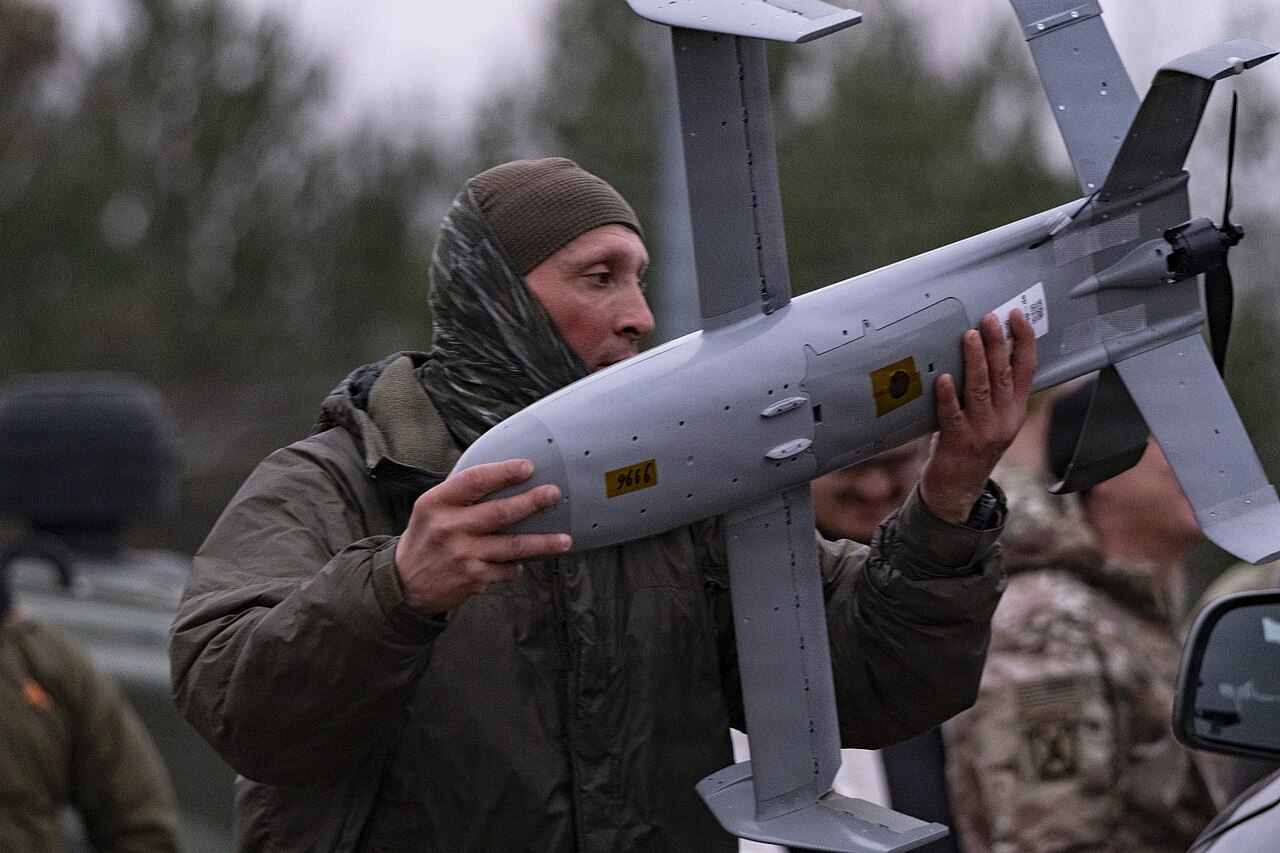
The Army now has a working example of a counter-drone buy that moved from a battlefield request to a formal program faster than its own rapid-acquisition target. Col. Christopher Hill, director of the Army's Global Tactical Edge Acquisition Directorate (G-TEAD), told an audience at the Association of the U.S. Army's annual convention that the service turned the Merops interceptor drone into a formal program in 142 days, TWZ reported on Oct. 14. G-TEAD's standard process aims to reach a program decision within 180 days.
For vendors selling into the Army's tactical edge, the timeline matters more than the drone itself. Hill described Merops as "an example of how we can move fast when we need to," and the directorate is using it to show how a capability can cross from urgent fielding to funded ownership without stalling.
How a 14-Day Demand Turned Into a Merops Program
According to TWZ, Merops came to the Army's attention after drone incursions involving two NATO partners pushed a senior commander to demand an urgent response. The system was not part of that commander's original acquisition plan, Hill said, but its record in Ukraine made it a strong candidate.
"He said, 'I want this capability in the hands of our partners within 14 days,'" Hill recalled, as quoted by TWZ. The Army missed that deadline by about a week. Hill said acquisition personnel and soldiers went into theater to evaluate the system and got it to NATO partners in roughly 21 or 22 days.
Merops is a small, low-cost counter-UAS system built to intercept long-range, one-way attack drones in flight. TWZ reports it was originally developed under the U.S.-backed Project Eagle initiative, with contributions from Swift Beat, and uses Surveyor drones as airborne interceptors that can operate autonomously or under remote control. Breaking Defense, in a June interview with Hill, identified the maker as American company Perennial Autonomy.
The effort then grew. Hill told TWZ the Army procured additional systems in partnership with the Joint Interagency Task Force, which procured 13,000 interceptors, and the mission expanded from supplying NATO partners to sending mobile Merops firing teams to a second theater, which TWZ says is presumably U.S. Central Command.
Why the Merops Clock Reads 142 Days in One Account and 148 in Another
The exact count depends on which interview you read. TWZ's October account, drawn from Hill's AUSA remarks, puts the figure at 142 days. Four months earlier, Hill gave Breaking Defense a slightly different number, hedged in the telling.
"From the time we got there into the time it showed up as a program, I want to say it was 148 days," Hill told Breaking Defense. "That is atypical. That is not what happens within acquisition."
Both figures come from Hill, and both land inside the 180-day window. Neither outlet explains the start and end points behind the count, so the six-day gap cannot be reconciled from the public record. TWZ's headline calls Merops a "program of record"; its body text describes a "formal program." Breaking Defense added one detail on the front end: Hill said "there was a contract written with the company the day we showed up in Europe."
Inside G-TEAD's 180-Day Transition Clock
The speed is the visible part. The structure behind it is what the Army wants to repeat. Hill told TWZ that G-TEAD brings in the organizations that will eventually own a capability from the start. Program acquisition executives (PAEs) join early, while the Army's test and evaluation community and soldiers give feedback as the system is assessed. The goal is to name a transition partner upfront instead of hunting for an owner after the first fielding.
That design targets the funding gap that strands many prototypes. "We will work to fill that valley of death gap between the time that we put capability into the hands of units and the time that the PM picks it up and actually [provides funding]," Hill said, according to TWZ. "There's a gap there. So we can do that intermediate scaling portion before it fully transitions."
Breaking Defense reported that G-TEAD has awarded other transaction agreements (OTAs) for two counter-drone systems, Merops and one made by Mountain Horse Solutions, and that the directorate targets technology at readiness level seven or above. Hill also cautioned TWZ that Ukrainian combat results do not automatically carry over to other environments, such as deserts versus the urban settings where Merops has operated. "The speed of getting it, then we can make the decision of how we employ it," he said.
What 13,000 Interceptors at About $15,000 Each Signals
Cost explains much of the Army's interest. TWZ reports that former Army Secretary Daniel Driscoll testified to Congress that the Army purchased 13,000 Merops interceptors within approximately eight days after the conflict with Iran began. Driscoll put the price at about $15,000 per interceptor, with the potential to fall below $10,000 as production scales.
TWZ notes that Merops won praise for its role against Iranian barrages of Shahed-136 one-way attack munitions in the Middle East. Against threats like those, a drone interceptor in the low five figures changes the cost-exchange math compared with conventional air defense missiles, and it saves the expensive interceptors for targets that need them.
TWZ also reports that Driscoll previously described an older Army process with 16 decision-making steps, each able to veto a proposal, which could leave the service waiting two to seven years to buy a capability. Merops is the Army's counterexample.
What It Means for Contractors
G-TEAD's model rewards companies with mature hardware, at technology readiness level seven or above, that can deploy evaluators and product into a theater on short notice. The contract-on-arrival pattern Hill described to Breaking Defense suggests vendors should have OTA-ready paperwork and pricing in hand before a request lands, not after.
The early role of PAEs and testers also changes who a vendor needs to brief. A company that wins a G-TEAD event is effectively pitching its eventual program office at the same time, so sustainment, production scaling and unit-cost reduction plans carry weight from the first meeting. The Merops figures Driscoll cited, including a per-unit price path from about $15,000 toward under $10,000, show the kind of cost curve the Army now expects to hear.
Firms outside counter-UAS should watch too. Breaking Defense reported that G-TEAD planned a ground autonomy OTA and that its competitive events, so far held in U.S. Army Europe and Africa's theater, would extend to the U.S. Army Pacific theater. If Merops holds up as a template, the 180-day clock could apply well beyond drones.
