
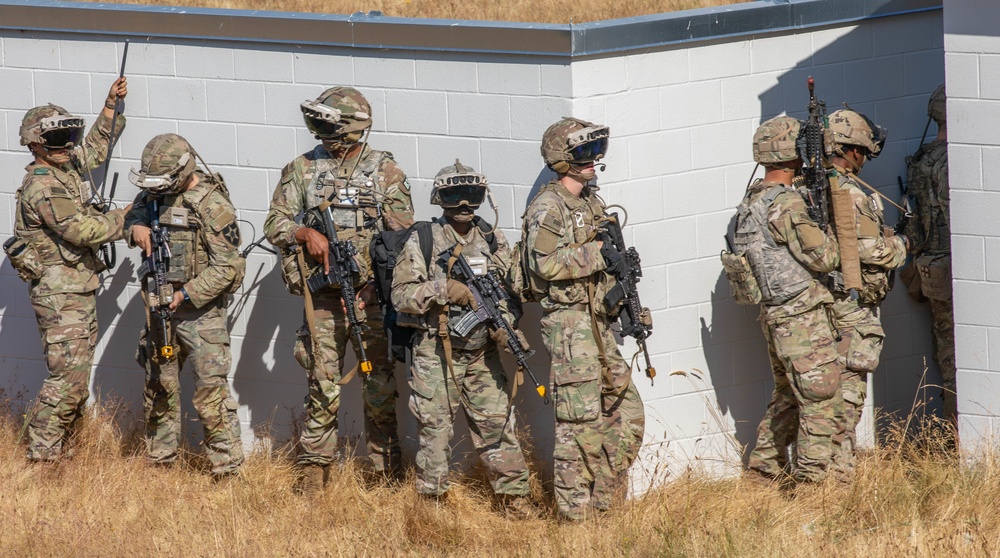
The Army will place nearly 10,000 sets of its Integrated Visual Augmentation System goggles into storage rather than issue them to soldiers, according to a July 8 report from the Government Accountability Office's annual weapons systems assessment. The finding closes out, at least for now, a $1.8 billion effort to put an augmented-reality heads-up display on every infantry soldier's head, and it hands the next phase of the mission to Anduril Industries under a differently structured program.
Background
The Army launched IVAS in 2018 as a partnership with Microsoft, betting that commercial augmented-reality hardware adapted for military use could give soldiers thermal sights, navigation overlays, and a shared common operating picture without requiring them to look down at a separate device. The pitch was ambitious: replace night-vision goggles, weapon sights, and paper maps with a single headset that fused sensor feeds into one display, all while soldiers moved, fired, and communicated in the field.
Three hardware versions followed over roughly seven years, and each one ran into the same wall. Version 1.0 entered operational testing and produced results the Army could not ignore. Soldiers wearing the goggles hit fewer targets and engaged them more slowly than soldiers using their existing equipment, and many reported physical side effects — disorientation, eye and neck strain, headaches, and motion sickness — after extended wear. Those are not minor comfort complaints in a combat context; they describe a system that degraded the very lethality and situational awareness it was built to improve.
Rather than pause to fix those problems, the program pushed Version 1.1 into production without additional operational testing, according to the GAO findings. That decision compounded the original design issues instead of resolving them, and it left the Army holding thousands of units it now cannot responsibly field.
Key Details
The GAO's July 8 assessment lays out the scope of the outcome in concrete terms. Close to 10,000 IVAS units — spanning both the 1.0 and 1.1 hardware versions — will go into storage rather than reach operational units. Task & Purpose reported that the performance testing behind that decision showed soldiers underperforming their own baseline equipment while wearing the headsets, a result serious enough to halt further fielding of the existing hardware. The Defense Post put the total program investment at $1.8 billion, spent across the original Microsoft-led development effort from 2018 through 2025.
The Army has not abandoned the underlying concept of a soldier-worn augmented display. It has instead restarted the effort under a new name and a new prime contractor. The successor program, Soldier Borne Mission Command, is now led by Anduril Industries, which replaced Microsoft as the lead contractor after the Army reprogrammed existing IVAS funding toward the new effort. Anduril was awarded an initial prototyping contract worth $159 million for SBMC, announced in September 2025.
Notably, the new program is not starting from zero. Roughly 400 IVAS Version 1.2 goggles remain in use specifically to inform the SBMC design, and the Army is carrying forward 260,000 hours of accumulated soldier feedback from the original IVAS effort into the new requirements process. That feedback — collected across years of field exercises, training rotations, and operational testing — represents the most tangible asset surviving the transition from IVAS to SBMC. The hardware itself is being shelved; the data about what went wrong with it is not.
The GAO's weapons systems assessment is an annual, congressionally mandated review of major defense acquisition programs, and it routinely surfaces cost growth, schedule slips, and performance shortfalls across the portfolio. IVAS stands out this year both for the size of the sunk investment and for the fact that all three hardware iterations were judged unready for fielding before the program pivoted to a new contractor entirely. Few programs in the current assessment combine a multibillion-dollar price tag with a documented performance regression relative to the legacy gear soldiers already carried, which is part of why GAO singled out IVAS for detailed treatment this cycle rather than folding it into a routine cost-and-schedule table.
What It Means for Contractors
The IVAS-to-SBMC transition is a live case study in how the Army now handles a troubled program rather than simply canceling it outright. Instead of terminating the effort after repeated negative test results, the service reprogrammed the existing budget line, swapped the prime contractor, and narrowed the near-term scope to prototyping rather than full-rate production. Contractors watching this pattern should note that a failed operational test no longer guarantees a program's end — it can instead trigger a contractor change while the underlying requirement and funding persist.
For companies working in soldier-worn electronics, augmented reality, and heads-up display systems, the SBMC award signals that the Army's appetite for the mission has not diminished, but its tolerance for hardware that degrades soldier performance has. Any vendor pursuing follow-on SBMC work, whether as a prime or subcontractor to Anduril, should expect the Army to weight physiological and performance data — eye strain, target engagement speed, hit rates — as heavily as technical specifications during source selection and testing gates. The 260,000 hours of soldier feedback being carried into SBMC effectively function as a pre-built test standard that any new hardware will be measured against.
The episode also illustrates the acquisition risk of hardware programs built on commercial platforms adapted for military use. IVAS leaned on a Microsoft-built commercial augmented-reality headset, and the mismatch between a commercial AR form factor and sustained combat-load wear appears to have driven much of the negative testing feedback. Contractors proposing commercial-derivative hardware for close-combat applications should budget for extended human-factors testing early, rather than treating operational test as a late-stage formality.
Finally, the reprogramming of IVAS funds into SBMC rather than a fresh budget line is a reminder that program office continuity does not equal contractor continuity. Firms that lost visibility into this account after Microsoft's role ended should note that the money, the program office relationships, and the underlying requirement all moved forward under Anduril — a transition worth tracking for teaming and subcontracting opportunities as SBMC prototyping matures toward a production decision.
