
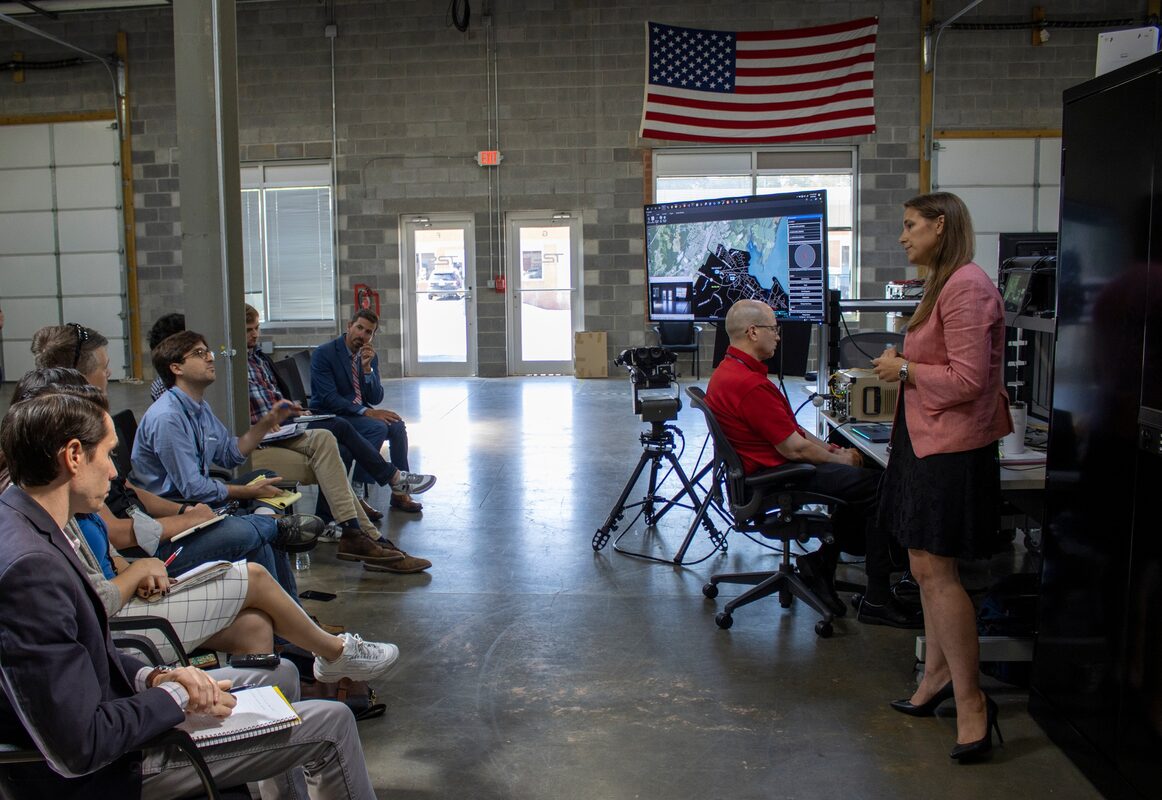
The Army is moving two small companies' electronic warfare sensors straight from prototype to production, using a new contracting pipeline built to outpace how fast adversaries update their jamming and signal-detection gear. Army Contracting Command–Aberdeen Proving Ground has awarded the first two production contracts under the Rapid Electromagnetic Warfare and Signals Intelligence Call for Solutions, sending nearly $196 million to Heaviside Industries and Research Innovations Inc. for sensors meant to reach soldiers at the tactical edge faster than a standard acquisition would allow.
Heaviside Industries Inc. won a $99 million firm-fixed-price indefinite-delivery/indefinite-quantity contract on Aug. 27, 2026, for its MOTH spectrum analyzer, a small-form-factor distributed sensor that detects and reports enemy signals in the field. Research Innovations Inc. followed on Sept. 3, 2026, with a $96.9 million firm-fixed-price IDIQ for its AI-driven Dragonfly sensors, which are integrated onto Menet Aero's Intrepid 1200 unmanned aircraft. Both contracts run over a five-year ordering period and were issued under solicitation number W9128Z-26-S-A002, managed by the Army's Project Manager for Electromagnetic Warfare and Collection. The awards were reported Sept. 11, 2026, and mark the first time the REWSI call for solutions has converted directly into production-level IDIQ vehicles rather than smaller prototype or demonstration agreements.
What the $99M MOTH and $96.9M Dragonfly Contracts Buy
The two awards fund different pieces of the same problem: giving soldiers a faster read on what's transmitting around them. Heaviside's MOTH is a small-form-factor spectrum analyzer designed for distributed placement, meaning individual units can be spread across a unit's formation to detect and report electromagnetic signals rather than relying on a single centralized sensor. RII's Dragonfly takes a different path, pairing artificial intelligence with signals-intelligence collection and mounting the sensor on Menet Aero's Intrepid 1200 drone, extending the reach of AI-assisted detection into the air.
Both fall under the Army's REWSI Call for Solutions, launched in April 2026 through the Army's Open Solicitation/Commercial Solutions Opening framework — a mechanism designed to let the service evaluate and award to non-traditional vendors faster than a conventional program of record. A Commercial Solutions Opening lets the government publish a broad problem statement rather than a detailed technical specification, then accept and evaluate competing commercial solutions on a rolling basis instead of a single fixed proposal deadline. That structure is what let PM EW&C move from opening the call in April to a signed production IDIQ for Heaviside by late August — a timeline measured in months rather than the multi-year cycle typical of a formal program of record. These are the first two contracts the call for solutions has produced since it opened.
Why the Army Built REWSI to Skip Traditional Procurement
The Army's own acquisition leadership has framed REWSI as a deliberate break from how it has historically bought electronic warfare gear. Col. Scott Shaffer, the project manager overseeing the EW portfolio, described the shift as "transitioning the enterprise from a reactive posture of developing proprietary systems to match emerging threats, to a proactive strategy of leveraging market velocity," according to DefenseScoop.
Joe Welch, the acquisition executive for the Army's command-and-control portfolio, put the underlying problem in blunter terms: "The pace of technology evolution is faster than the pace of traditional procurement processes," he said, per DefenseScoop. That gap is the reason the Army built REWSI as a call for solutions rather than a traditional program of record — a structure meant to let vendors with working hardware compete for production dollars without waiting years inside a formal requirements and milestone process.
Electronic warfare has become one of the areas where that gap matters most. Adversary jamming, spoofing and signals-collection capabilities have evolved quickly enough that a sensor designed against yesterday's threat can be outdated before it fields. REWSI's premise is that buying in five-year IDIQ increments from companies already fielding hardware — rather than writing a multi-year requirement first — keeps the Army closer to what industry can build right now.
The structure also spreads risk across the sensor types the Army is buying rather than betting the portfolio on one design. MOTH is a ground-oriented, distributed detection tool meant to sit with a formation; Dragonfly pairs AI-driven processing with an airborne platform to extend collection beyond line of sight. Funding both in the same round, through the same call for solutions, lets PM EW&C compare how each performs in the field before deciding how much further funding either sensor receives through follow-on task orders against the five-year IDIQ ceiling.
What It Means for Contractors
For companies working electronic warfare and signals intelligence, the REWSI awards are a signal that the Army intends to keep using call-for-solutions mechanisms to reach production dollars, not just prototype funding. Heaviside Industries and Research Innovations Inc. are not the primes that have historically dominated Army EW programs, and their wins show that a months-long path from call to production IDIQ is now a real, repeatable option for vendors who can demonstrate working sensors rather than paper designs.
The five-year ordering periods on both contracts also matter for planning purposes: an IDIQ award is a ceiling and a vehicle, not a guaranteed revenue stream, so the practical value to Heaviside and RII will depend on how many task orders PM EW&C issues against them over that window. Other vendors watching REWSI should note that the call remains open under the same Open Solicitation/Commercial Solutions Opening framework, meaning additional production awards are plausible as the Army continues evaluating submissions. Companies building distributed sensors, AI-assisted signal processing, or payloads compatible with small unmanned aircraft have a concrete data point now on what the Army is willing to fund at production scale — and how quickly it's willing to move once a call for solutions produces a credible submission.
The pairing of a ground-based distributed sensor with an air-mounted AI sensor in the same funding round also suggests PM EW&C is not committing to a single sensor architecture. Vendors offering EW capabilities across different platforms — dismounted, vehicle-mounted, or airborne — may find more than one lane into the program as it matures.
Sources
- Army awards $196M for sensors in first production contracts under EW-focused call for solutions | DefenseScoop
- Army Awards the First Two Production Contracts Using the REWSI Call for Solutions | Soldier Systems Daily
- Army Taps Heaviside, RII for $196M Electromagnetic Warfare, SIGINT Work | GovConWire
