
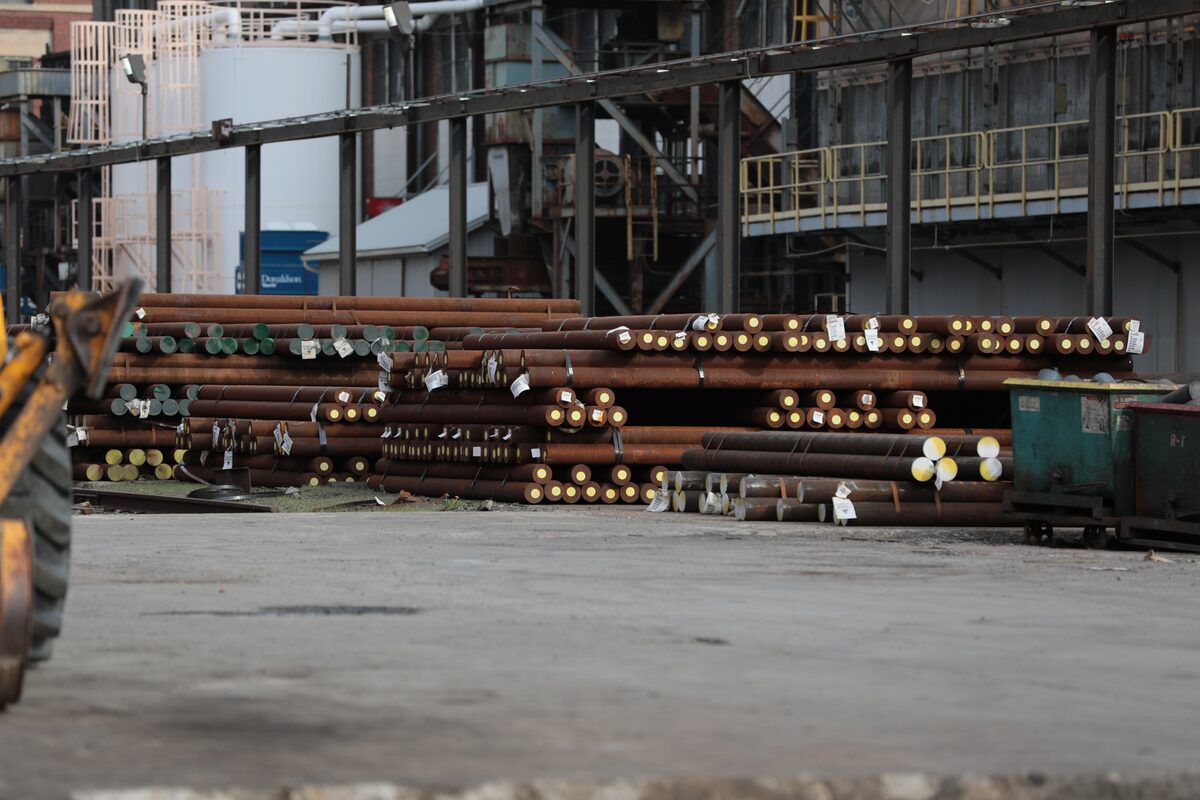
The Defense Logistics Agency has awarded Cleveland-Cliffs Steel Corp. a $400,000,000 sole-source indefinite-delivery, indefinite-quantity contract for grain-oriented electrical steel, according to the Department of War's July 1, 2026 daily contract announcement. The five-year deal locks in the Pentagon's only domestic large-scale supplier of a material critical to power grid and military electrical infrastructure.
Background
Grain-oriented electrical steel is a specialty product used in the cores of transformers and other electrical equipment. Its magnetic properties reduce energy loss, making it essential for both the commercial power grid and military electrical systems that the Army, Navy, Air Force, Marine Corps, and Space Force all rely on. For years, the United States has depended heavily on imports for this material, with foreign producers, particularly in Asia and Europe, supplying much of the grain-oriented steel used domestically.
Cleveland-Cliffs, based in West Chester, Ohio, operates the only facility in the country producing grain-oriented electrical steel at the scale needed to supply large defense and infrastructure customers. That singular domestic capability is the basis for the Defense Logistics Agency's decision to bypass competitive bidding. The award was justified under 10 U.S.C. 3204(a)(3)(A) and FAR 6.103-3(b)(1), the statutory and regulatory provisions that permit a sole-source award when only one responsible source exists and no other supplies will satisfy agency requirements.
The contract arrives as the Department of War has increasingly flagged single points of failure in supply chains for materials tied to national security, from rare earth elements to specialty metals. Grain-oriented electrical steel has drawn similar scrutiny because transformer manufacturing, both for grid resilience and military installations, cannot proceed without a steady supply of the material.
Transformer procurement has become a national security topic well beyond the Pentagon in recent years, as utilities and grid operators have also struggled to secure enough grain-oriented electrical steel to keep pace with replacement and expansion needs. A defense-specific supply agreement of this size effectively reserves a portion of Cleveland-Cliffs' output for military end uses, separate from the broader civilian grid market where the same steel is in demand. That distinction matters for a Department of War that has repeatedly emphasized reducing dependence on any material where a disruption abroad could ripple into equipment readiness at home.
Key Details
The contract calls for delivery of approximately 53,000 tons of grain-oriented electrical steel over the life of the agreement. It is structured as an indefinite-delivery, indefinite-quantity vehicle with a firm five-year period of performance and no option periods, running through an estimated completion date of September 8, 2030.
The steel will supply electrical equipment and transformer components used across all five military branches, according to the award notice. The Defense Logistics Agency, which manages the Department of War's supply chain for a wide range of consumable and durable items, will administer deliveries under the IDIQ structure, meaning actual quantities and delivery schedules will be determined through individual orders placed against the ceiling value of $400,000,000.
Because the award was sole-sourced rather than competitively bid, there was no competing offer process; the justification rests entirely on Cleveland-Cliffs' unique position as the only domestic producer capable of meeting the volume and specification requirements at this scale. The Department of War's contract notice frames the award around securing a reliable domestic source for a material that has historically been vulnerable to foreign supply chain disruption.
The five-year, no-option structure of the IDIQ is itself notable. Rather than a base period with renewal options that would require periodic re-justification, the Defense Logistics Agency committed to the full term up front, through September 8, 2030. That approach gives Cleveland-Cliffs a fixed planning horizon for the roughly 53,000 tons of steel called for under the agreement, and it gives the Department of War a locked-in domestic source without the administrative overhead of revisiting the sole-source determination each year.
What It Means for Contractors
The Cleveland-Cliffs award is a reminder that sole-source justifications under 10 U.S.C. 3204(a)(3)(A) remain a live pathway for agencies facing genuine single-supplier constraints, and it signals that the Department of War is willing to commit substantial, multi-year dollar volume to lock in a domestic source rather than risk continued reliance on imported materials. Contractors in specialty metals, alloys, and other niche manufacturing sectors where the United States has limited domestic capacity should take note: demonstrating unique domestic production capability, backed by scale and consistent quality, can be a stronger differentiator than price competition when an agency is focused on supply chain security.
For companies further down the supply chain, particularly those building transformers, generators, or other electrical equipment for military installations, the deal offers a measure of predictability. A five-year commitment to a domestic steel source reduces the risk of the kind of price spikes or delivery disruptions that can come with dependence on overseas suppliers, particularly during periods of trade tension or shipping disruption.
The award also illustrates a broader pattern worth watching: agencies increasingly treating industrial base fragility, not just unit price, as a justification for sole-source contracting. Firms that can document their status as the only qualified or scaled domestic producer of a defense-critical material have a template here for how to present that case. Conversely, competitors or potential new entrants hoping to challenge single-source arrangements in adjacent material categories should recognize that agencies view five-year, no-option commitments like this one as a means of insulating critical inputs from near-term market volatility, which raises the bar for demonstrating an alternative source is viable at comparable scale.
Contractors that supply the Defense Logistics Agency or other components with specialty materials should also watch how this award is administered over its five-year term. Because it is structured as an IDIQ with no stated ceiling breakdown by year, the pace and size of individual task orders will determine how quickly the $400,000,000 ceiling is reached and whether follow-on sole-source vehicles are likely as the September 2030 completion date approaches.
