
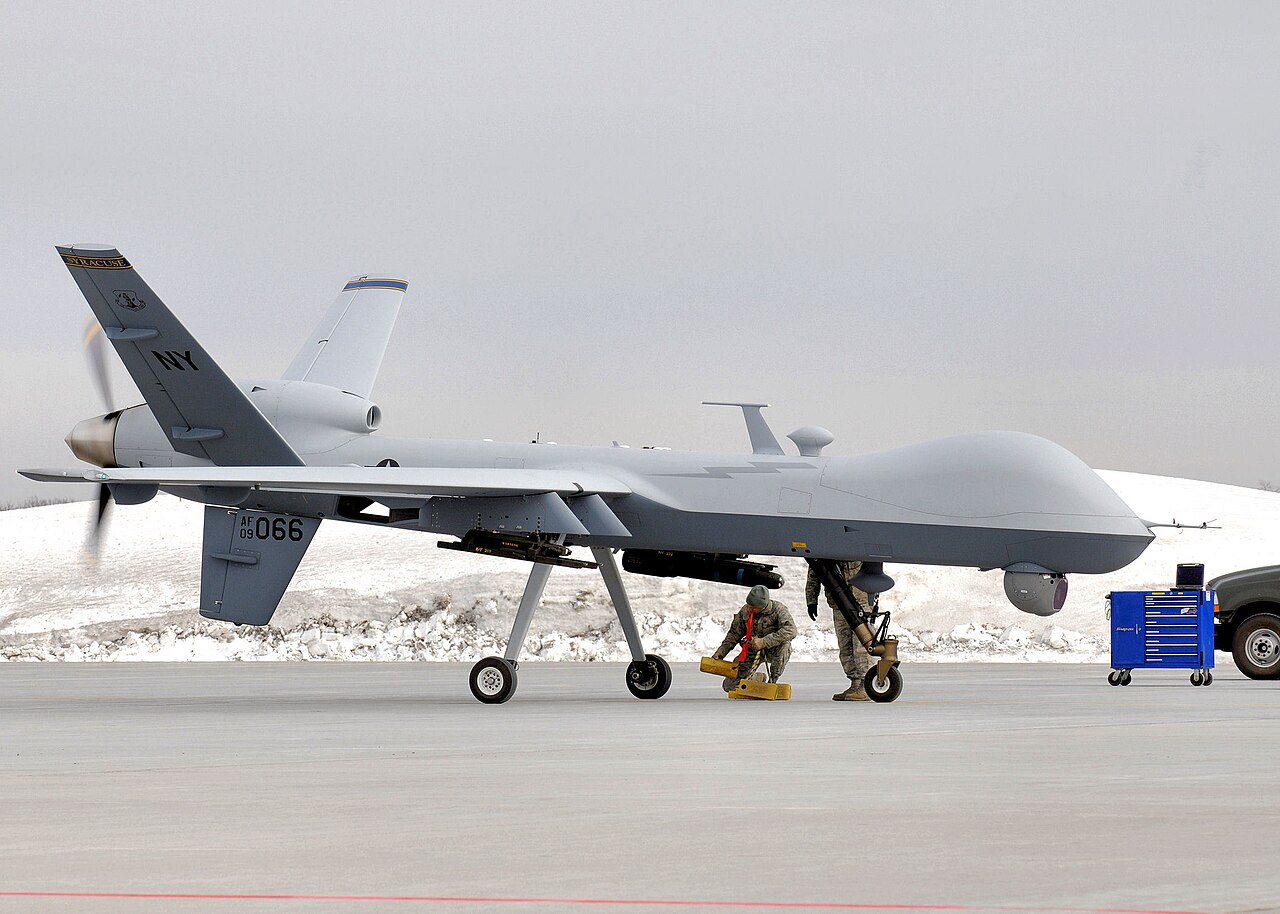
The Coast Guard is buying long-range drones of its own instead of relying only on the aircraft it flies alongside Customs and Border Protection. The service placed a $247.8 million order with General Atomics for four MQ-9B long-range unmanned aircraft systems, along with ground control stations and supporting equipment. The Coast Guard placed the order on Sept. 25, 2026, through a U.S. Customs and Border Protection contract.
The buy moves the Coast Guard from flying alongside CBP on a joint program to ordering long-range aircraft under its own funding, and it comes as the service works through the largest capital investment in its history.
What the $247.8M Order Buys
The order covers four aircraft, the ground control stations that fly them and the equipment needed to support them, according to the Coast Guard announcement as published by Seapower. The service did not break the $247.8 million into per-aircraft or per-station costs in the text it released.
The Coast Guard's announcement refers to the aircraft only as MQ-9B long-range unmanned aircraft systems and does not name a variant, and neither Seapower nor Defence-Industry.eu does either.
The service listed a broad set of missions for the new drones. According to the announcement, they will help the Coast Guard monitor offshore waters, protect borders and critical infrastructure, support search and rescue, combat drug trafficking and counter illegal and unregulated fishing. The aircraft will also improve the service's ability to collect and share intelligence and to conduct surveillance and support reconnaissance missions far at sea.
Anthony Antognoli, the Coast Guard's assistant commandant and program executive officer for robotics and autonomous systems, framed the purchase around reach. "The MQ-9B long-range unmanned aircraft systems will expand our reach and strengthen our ability to protect the nation," he said.
He tied the aircraft directly to decision speed. "This investment will give Coast Guard crews a longer-range view of our maritime domain, helping them detect threats earlier, make better-informed decisions and act faster across our missions," Antognoli said.
Why the Coast Guard Pointed to $306M in Drug Seizures
The service built its case for the purchase on results from the CBP fleet. In fiscal year 2026, CBP MQ-9A aircraft operating as part of Joint Interagency Task Force South directly contributed to the seizure of approximately 60,700 pounds of illegal drugs valued at $306 million and the apprehension of around 20 smugglers, according to the Coast Guard.
Those figures come from the older MQ-9A, not the MQ-9B the Coast Guard just ordered. The Coast Guard and CBP operate the MQ-9A Guardian, also known as Predator B, through a joint program office in Texas, according to Defence-Industry.eu. Coast Guard flight crews fly the maritime-variant aircraft alongside CBP on maritime missions.
How a 2008 CBP Pilot Became a Coast Guard Buy
The joint program began in 2008 as a pilot study, Defence-Industry.eu reported. It tested whether long-range unmanned aircraft could give ground agents on the U.S. Southwest border long-endurance intelligence, surveillance and reconnaissance. The program has since expanded into the maritime environment, providing that coverage in the Gulf of Mexico. The Coast Guard has said the joint flights improve its understanding of potential long-range options and support the development of its requirements.
The Coast Guard introduced its unmanned aircraft strategy in 2023. Under that strategy, the service is evaluating a wide range of systems to augment its aircraft fleets and extend the surveillance range of its surface assets, drawing on development work by other uniformed services and federal agencies. Defence-Industry.eu reported that the service is looking for cost-effective systems that meet both cutter-based and land-based requirements.
The reporting describes three tiers of unmanned aircraft. Short-range systems are used across all 11 of the service's statutory missions, with more than 600 remote pilots trained, over 330 systems fielded and more than 80 units qualified. Medium-range systems are part of the national security cutter fleet's force package, and the Coast Guard is moving toward expanding that capability to other surface assets. For long-range systems, the Coast Guard has validated a mission need aimed at significantly enhancing ocean surveillance in support of its operations. The MQ-9B order is the long-range purchase announced against that validated need.
Where the Money Comes From: Reconciliation and FY2026 Appropriations
The MQ-9B acquisition is funded through fiscal year 2025 budget reconciliation and fiscal year 2026 appropriations. Reconciliation provided nearly $25 billion, which the service calls "the largest capital investment in the service’s history." The Coast Guard said it has ordered approximately $16.3 billion in new assets and capabilities from that pot.
The service presented the drone order as evidence that the money is moving quickly. The announcement described a "rapid return on investment" and said it "demonstrates the Coast Guard’s commitment to modernizing acquisitions, integrating next-generation technology, restoring readiness and revitalizing infrastructure to deliver national mission outcomes."
The order went through a CBP contract rather than a Coast Guard-only vehicle. The announcement does not explain why the service chose that route, but it fits the pattern of the two agencies already running a joint program office for the MQ-9A.
What It Means for Contractors
General Atomics is the direct beneficiary of the order. CBP already operates MQ-9A aircraft, and the Coast Guard now has an MQ-9B purchase underway. Each additional owner of a platform tends to create follow-on demand for sustainment, spares, sensor integration, training and ground-station support, though the sources do not say which of those the order includes beyond ground control stations and "supporting equipment."
The contract route matters to the rest of the market. The Coast Guard bought through a CBP contract, which suggests DHS components can order from one another's vehicles. Firms that want to sell unmanned systems or related services to the Coast Guard should track which interagency vehicles the service can order from, not just its own solicitations.
The reconciliation funding is still flowing. With nearly $25 billion provided and about $16.3 billion ordered so far, by the service's own count, roughly $8.7 billion of the reconciliation money had not yet been ordered at the time of the announcement. The 2023 unmanned strategy's stated interest in cost-effective cutter-based and land-based systems, and its plan to extend medium-range systems beyond the national security cutters, point to where further unmanned work could land.
Data, maritime sensor and intelligence-sharing firms should also take note. The Coast Guard explicitly listed collecting and sharing intelligence among the aircraft's jobs, which will require processing, exploitation and dissemination capacity on the ground.
