
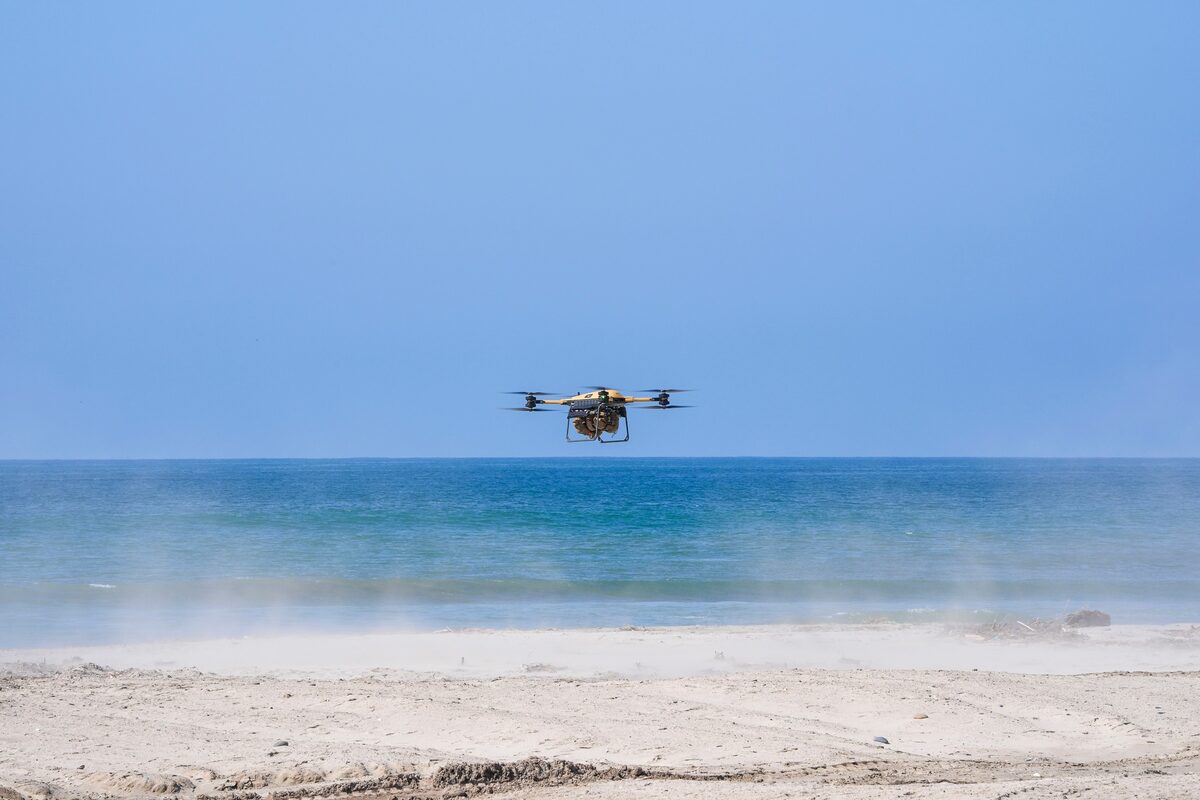
More than 120 teams from over 20 countries will converge on Dayton, Ohio, in early August to compete in DARPA's Lift Challenge, a head-to-head vertical-lift drone competition built around a single audacious target: aircraft that can carry payloads roughly four times their own weight, a ratio today's helicopters cannot approach.
Background
Helicopters and most vertical-takeoff-and-landing aircraft top out near a 1:1 payload-to-weight ratio, meaning a helicopter of a given weight can typically lift only about its own weight in cargo before performance and fuel margins collapse. DARPA's Lift Challenge sets out to break that ceiling by roughly a factor of four, targeting drones that can haul payloads equal to about four times their own empty weight. The agency frames the effort as core to the Pentagon's "Drone Dominance" initiative, which pushes the Department of War toward cheaper, more numerous unmanned systems across every domain. Program manager Phillip "Donna" Smith described the stakes bluntly: "Today's battlefields are dominated by small drones, but because they don't scale well, they're limited to tiny payloads. Breaking this weight barrier will revolutionize military missions, allowing us to supply our warfighters anywhere on Earth at a fraction of the cost." That framing puts logistics, not strike or surveillance, at the center of the competition — a bet that the next major leap in unmanned aviation will come from cargo-hauling efficiency rather than sensors or weapons.
The competition is structured as a prize challenge rather than a traditional acquisition program, a format DARPA has used before to pull in participants who would never bid on a standard defense contract. That design choice shows up directly in the roster: alongside established aerospace players, the field includes small businesses, independent entrepreneurs, and student teams building and flying their own heavy-lift concepts. DARPA will host the trials at the National Museum of the U.S. Air Force in Dayton, running Aug. 2-9, 2026, with public finals scheduled for Aug. 6-9.
Key Details
DARPA selected 124 teams to participate, according to DefenseScoop's reporting on the agency's preparations, with DARPA's own announcement describing the field as "over 120 teams" drawn from more than 20 countries. That breadth is notable for a Pentagon-run competition: rather than limiting entry to cleared U.S. contractors, the Lift Challenge opened its doors to an international pool of competitors, a structure closer to an X Prize than a traditional defense solicitation.
Each competing team will fly its aircraft over a five-nautical-mile circuit course at the Dayton site, giving judges a standardized way to compare payload capacity, efficiency, and handling across wildly different airframe designs. DARPA is backing the event with $6.5 million in total prize money, split across categories for the highest payload-to-weight ratios achieved and for the most novel engineering approaches to the lift problem. That dual-track prize structure signals DARPA wants both a pure performance winner and a signal on which unconventional approaches to propulsion, power, control, aerodynamics, and systems integration merit further government investment.
The public finals during Aug. 6-9 open the event to spectators at the Air Force museum, giving the competition a visibility that DARPA's typical closed-door technology demonstrations rarely receive. Staging the finals at a museum built around the history of military aviation also puts a heavy-lift drone race in direct visual conversation with a century of manned aircraft development, reinforcing the program's stated ambition to mark a genuine break from helicopter-era lift limits rather than an incremental gain.
DARPA's messaging ties the challenge explicitly to cost. Smith has said the cost per pound, per mile transported for vertical-lift platforms is currently too high, and that drastically decreasing that cost-per-pound-per-mile metric is central to the challenge's goal — a metric that matters most for resupply missions to austere or contested locations where fixed-wing airlift and ground convoys are slow, vulnerable, or unavailable. A drone fleet capable of a 4:1 lift ratio would let planners move more cargo per aircraft and per flight hour than current helicopter-based logistics allow — the kind of efficiency gain that shows up directly in sustainment budgets rather than in a single weapon system's performance specs.
What It Means for Contractors
The Lift Challenge is a rare case of DARPA running a prize competition open to entrants who never touch a normal solicitation process. Small businesses, individual engineers, and university teams are competing on the same course as larger firms, and the $6.5 million prize pool rewards demonstrated flight performance rather than a proposal narrative. For companies working in unmanned aviation, propulsion, or lightweight structures, the event functions as a public proving ground: a strong showing on the Dayton course is a credential that can be cited in follow-on pitches to program offices well beyond DARPA, particularly given the direct line the agency draws to the Department of War's Drone Dominance initiative and to logistics modernization more broadly.
The international makeup of the field — teams from more than 20 countries — also signals that DARPA is treating heavy-lift drone technology as a competitive space where the U.S. government wants early visibility into work happening outside American industry, not just inside it. Firms that place well, or whose novel-design entries catch DARPA's attention even without winning the top payload-ratio prize, are positioned for follow-on interest as the Pentagon looks to translate contest results into program funding. Companies in the logistics, resupply, and unmanned cargo space should watch the Aug. 6-9 public finals closely: results and design approaches that stand out on that course are the most likely starting point for whatever acquisition activity DARPA or Department of War logistics offices pursue next in heavy-lift unmanned aviation.
For contractors not directly entered in the competition, the event still matters as a market signal. A dedicated $6.5 million prize purse, a named program manager, and explicit linkage to Drone Dominance funding priorities all indicate the Pentagon sees heavy-lift cargo drones as a near-term investment category rather than a speculative research area. Firms building batteries, lightweight composites, autonomy software, or propulsion systems that could plug into a 4:1-ratio airframe have a concrete data point to reference when framing capability pitches to program offices tracking this space over the next several budget cycles.
