
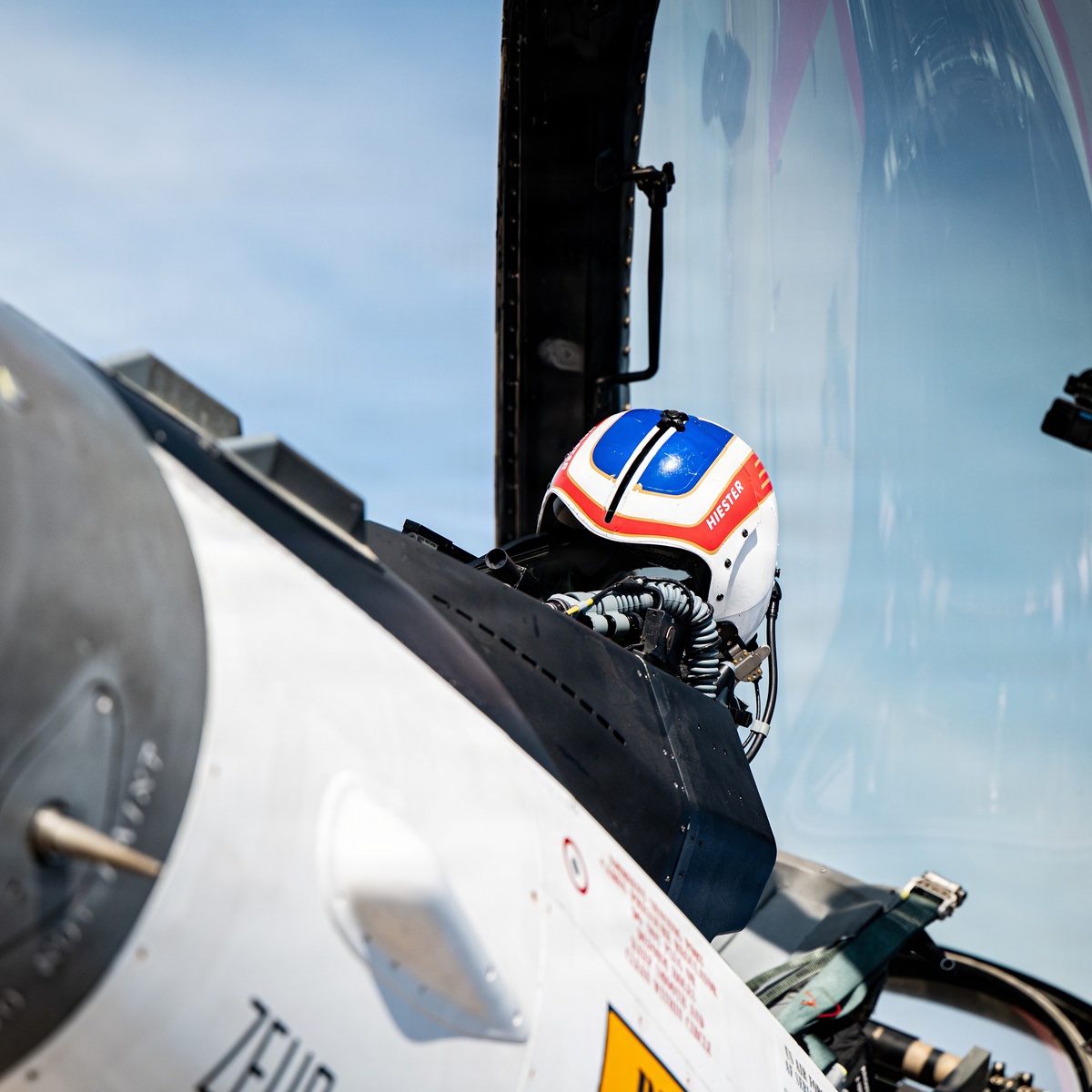
The Defense Logistics Agency has put an estimated $332.6 million behind keeping the helmet-mounted cueing systems worn by U.S. teen-series fighter pilots supplied and repaired through the middle of the next decade. In the Department of War contracts announcement dated July 24, 2026, DLA Weapon Support awarded Rockwell Collins ESA Vision Systems LLC of Fort Worth, Texas, a fixed-price, indefinite-delivery requirements contract to furnish Joint Helmet Mounted Cueing System spares and repairs for the F-15, F-16 and F-18 fleets. The estimated $332,623,964 vehicle, contract SPRWA1-26-D-0001, runs through July 23, 2032 — a six-year base with one six-month option period — giving the government roughly six years of access to consumable parts and depot-level overhaul for one of the fighter force's most widely fielded pieces of hardware.
Background
The Joint Helmet Mounted Cueing System lets a fighter pilot aim sensors and weapons simply by looking at a target. A display projected onto the helmet visor shows flight and targeting symbology, and the system tracks where the pilot is looking so that missile seekers, radar and targeting pods can be slewed off-boresight toward a threat the pilot has visually acquired. That off-boresight capability, paired with high-off-boresight air-to-air missiles, reshaped close-in air combat and made helmet cueing standard equipment across the Air Force and Navy teen-series fighter force.
JHMCS is not a new program, and that is precisely why this award matters. The hardware has been in squadron service for years, which means the sustainment problem has shifted from buying new systems to keeping a large installed base working. Visors crack, tracker components drift, cables fatigue and electronic modules fail. Each of those failures generates demand either for a consumable replacement part or for a depot-level repair, and a fleet spread across three aircraft types generates that demand continuously. The Defense Logistics Agency exists to meet exactly this kind of long-tail material need, and DLA Weapon Support at Warner Robins, Georgia, manages sustainment for a broad portfolio of aviation weapon systems.
Rockwell Collins ESA Vision Systems LLC, the Fort Worth awardee, is the industrial home for the cueing-system product line. Placing a single, long-duration sustainment vehicle with the manufacturer that owns the design data and repair processes is a familiar pattern for mature avionics: the original equipment source typically holds the technical baseline, the tooling and the trained repair workforce, which makes it the lowest-risk path to keeping fielded systems mission-capable.
Key Details
The award carries an estimated value of $332,623,964 and is structured as a fixed-price, indefinite-delivery requirements contract, meaning the figure estimates expected demand against which the government places delivery and repair orders as parts fail, rather than a lump sum paid up front. The contracting activity is the Defense Logistics Agency, with the vehicle managed out of DLA Weapon Support in Warner Robins, Georgia. It is a six-year base contract with one six-month option period, carrying a July 23, 2032, performance completion date.
The scope, as written in the Department of War announcement, covers Joint Helmet Mounted Cueing System consumable and depot-level reparable spares and repairs for F-15, F-16 and F-18 aircraft. Those are two distinct sustainment streams. Consumables are parts replaced and not returned, pulled from a supply bin and installed. Depot-level reparables are the higher-value assemblies that flow back to a repair facility, get restored to serviceable condition and re-enter the supply system. Bundling both under one requirements contract gives DLA a single accountable source for the full material lifecycle of the cueing system across all three platforms.
The announcement lists the Air Force and Navy as the primary using customers, alongside Foreign Military Sales to a roster of allied and partner air forces: Greece, Morocco, Singapore, Chile, Denmark, Norway, Thailand, Oman, Taiwan, Portugal, Canada, Switzerland and Australia. Work will be performed in Texas, Oregon and Israel, and the effort is funded through a mix of fiscal 2026 through 2032 defense working capital funds, military service appropriations and FMS funds. The award was made on a sole-source basis to Rockwell Collins ESA Vision Systems under the authority at 10 U.S. Code 3204(c)(2), as stated in Federal Acquisition Regulation 6.302-1.
The contract number, SPRWA1-26-D-0001, marks it as a delivery-order contract issued under that DLA Weapon Support solicitation series, and points to a steady drumbeat of task orders rather than a one-time buy. No individual order values were disclosed; those will be set as requirements materialize over the term. Contractors tracking the vehicle can follow the order flow against contract SPRWA1-26-D-0001 on the federal award database at USASpending.gov.
What It Means for Contractors
For companies that live in the aviation sustainment market, this award is a reminder that the money in a mature fighter fleet is in keeping it flying, not in building it. A third of a billion dollars flowing to a single helmet-cueing product line, years after the systems were first fielded, illustrates how deep and durable spares-and-repair demand runs once hardware is entrenched across multiple airframes. The teen-series fighters are slated to remain in service well into the 2030s, and every year of extended service life converts directly into sustainment obligations that the government must fund and source.
The requirements-contract structure is the operative detail. A vehicle of this size does not guarantee a fixed payout; it commits the government to source its actual JHMCS needs from this contractor and estimates what that will cost over the term. Revenue depends on the flow of delivery and repair orders, which depends on flying hours, failure rates and depot throughput. Contractors should read a large estimated value as a signal of expected demand, not booked backlog, and plan capacity and working capital against a variable order stream.
The award also underscores the original-equipment advantage in depot-level repair. Because the manufacturer holds the design authority, the repair procedures and the trained technicians, incumbency is difficult to dislodge on sustainment work tied to proprietary avionics. Firms hoping to compete typically enter through the supply chain rather than the prime slot, feeding components, subassemblies and specialized repair services up to the OEM. For subcontractors and parts suppliers, a six-year prime vehicle at the OEM level is a stable demand signal to position against, provided they can meet the qualification, traceability and quality requirements military avionics parts carry.
Finally, the choice of DLA as the buying command matters. DLA-managed sustainment runs on high-volume, transaction-driven ordering with rigorous cataloging and stocking rules. Suppliers that understand its demand-planning cadence, its emphasis on readiness-based sparing and its documentation standards are better placed to capture the orders that flow beneath a vehicle like this over the next six years.
