
A single Ohio steel mill just became the U.S. military's sole approved source for the alloy that makes 155mm artillery shells fragment lethally, locked in for the next five years without another company ever getting a chance to underbid it. The Defense Logistics Agency announced Sept. 25 that it awarded Metallus Inc. of Canton, Ohio, a firm-fixed-price contract worth up to $995 million for High Fragmentation 1 steel, the specialized alloy that forms the body of one of the Army's main artillery rounds.
The deal runs through Sept. 24, 2031, carries no option periods, and was handed to Metallus without a competition. DLA's Contracting Services Office in Columbus, Ohio, made the award under justification 10 U.S. Code 3204(a)(3)(A) and Federal Acquisition Regulation 6.103-3(b)(1) — the authority agencies use when keeping a single manufacturer in production is judged essential to industrial mobilization or a national emergency. The contract is funded across fiscal 2025 through 2029 accounts, and the Army, Marine Corps, Navy, Air Force and Space Force are all listed as using services.
Why the Pentagon Skipped a Competition for $995 Million in Steel
Sole-source awards of this size are rare, and the justification code DLA cited points to a specific rationale: rather than open HF-1 production to bidders, the government is paying to guarantee that Metallus, the producer DLA chose to rely on exclusively, keeps running at full tilt. Defence Blog described the mechanism plainly, reporting that "the agency awarded it without competition under a federal rule that allows sole-source deals to keep a producer available for industrial mobilization or a national emergency." The contract announcement itself is terse but exact: "Metallus Inc., Canton, Ohio, has been awarded a maximum $995,000,000 firm-fixed-price contract for High Fragmentation 1 Steel."
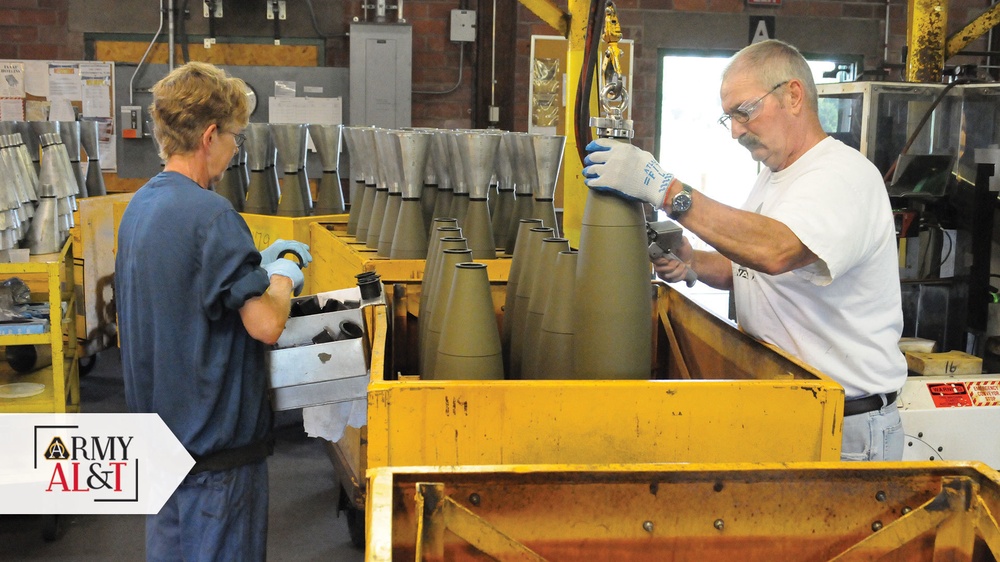
That framing matters because HF-1 isn't a commodity alloy. It is engineered to fracture into lethal fragments on detonation, and it is the material that becomes the body of the M795 high-explosive round — a roughly 47-kilogram shell packed with 10.8 kilograms of TNT or IMX-101 — as well as the M1128 extended-range round. Both are staples of the Army's 155mm howitzer arsenal, the ammunition that has been consumed in enormous volumes by artillery-heavy conflicts abroad and that the Pentagon has spent two years racing to replenish.
How a Canton, Ohio Mill Feeds the Army's Biggest Artillery Round
Metallus, known until a rebrand as TimkenSteel, has made HF-1 for the U.S. military continuously since 1993. It typically doesn't sell finished shells; instead it supplies steel billets as a subcontractor to companies such as General Dynamics Ordnance and Tactical Systems, which forge those billets into the shell bodies that eventually get filled with explosive and shipped to units. That two-step arrangement means Metallus rarely appears in headlines about artillery shortages even though its mill sits at the very start of the chain — a bottleneck upstream of the forging presses, the explosive-loading plants and the units that eventually fire the rounds. The new DLA contract effectively locks that upstream link in place for five more years, insulating it from the kind of competitive disruption that could slow output during a sustained push to replenish artillery-shell stocks.
What Two Years of Furnace Investment Bought the Army
The $995 million award caps roughly two years of direct Army investment in expanding Metallus's capacity. In February 2024, the Army signed an agreement worth up to $99 million, funded through Ukraine supplemental appropriations, that raised the plant's HF-1 output from 1,500 tons a month to 6,720 tons a month. On Aug. 26, 2026, the Army and Metallus went further, commissioning a new bloom reheat furnace and roller furnace at the Canton site. The Army says that equipment will support production of more than 120,000 155mm shell bodies a month once running at full capacity.
That furnace project is one piece of a roughly $6 billion push to rebuild the domestic ammunition industrial base, an effort that has opened 16 new ammunition production facilities across the country in two years. The sole-source steel contract announced this week effectively guarantees a customer for all that new Ohio capacity, giving Metallus a fixed five-year revenue floor to match the capital it and the Army have already sunk into the plant. It also removes a risk that has dogged past industrial-base buildouts: a company expands a production line on the promise of future orders, then finds demand doesn't materialize once funding shifts. By pairing the furnace commissioning with a five-year, near-billion-dollar purchase commitment on the same production, DLA is betting the new capacity actually gets used rather than mothballed.
What It Means for Contractors
For companies elsewhere in the artillery supply chain, the message is that DLA is prioritizing continuity of a single qualified source over opening the HF-1 market to new entrants — at least through 2031. A firm hoping to break into shell-steel production will not find a competitive solicitation to bid on; the government has decided the risk of interrupting Metallus's ramp-up outweighs any savings a competition might produce. Downstream forgers and loaders, including General Dynamics Ordnance and Tactical Systems, gain a predictable, government-backed steel supply locked in on fixed pricing rather than one exposed to market swings or a single supplier's financial troubles.
The award also signals where the next wave of capacity-building money is likely to go: not toward diversifying suppliers, but toward expanding the ones DLA already trusts. Contractors positioning for artillery-related work should expect similar sole-source extensions at other single-vendor chokepoints in the 155mm supply chain — propellant, primers, forging capacity — as the Pentagon continues treating existing qualified producers as the fastest path to more shells, rather than betting on new entrants to build that capability from scratch. For a company already holding a qualified position in a munitions supply chain, this award is a template: the government will pay a premium, and skip competition entirely, to keep a proven producer at full output during a sustained replenishment push.
