
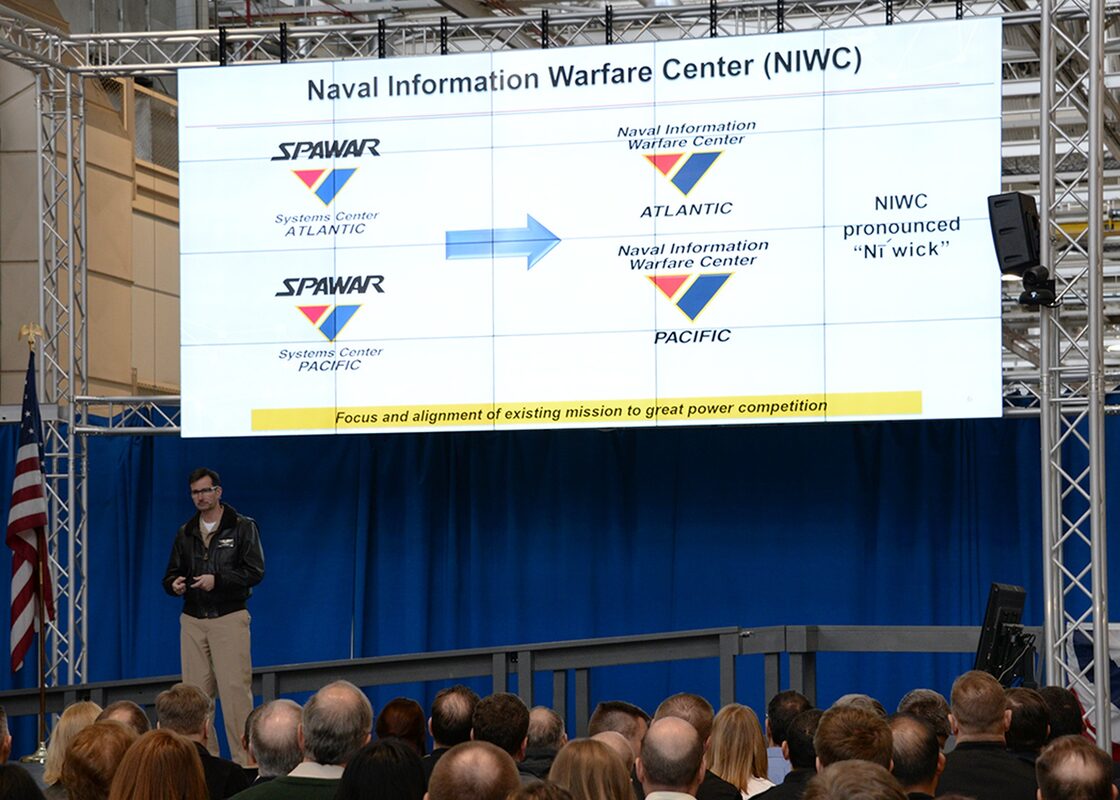
A former Navy civilian official who let the contractors bidding on his own program write the government's procurement paperwork is going to federal prison for six years, while the companies and individuals who paid him remain part of the same San Diego case record. James Soriano, 65, a former official at the Naval Information Warfare Center was sentenced Sept. 9, 2026, to 72 months after pleading guilty to a bribery scheme that steered hundreds of millions of dollars in Navy contracts toward companies that kept him in steak dinners, championship tickets, and a running stream of cash funneled through a family friend's paycheck.
Soriano worked out of NAVWAR — formerly known as SPAWAR — in San Diego, where prosecutors say he used his official position to help contractors secure and maintain work and to advocate for their selection on Navy information-warfare programs. According to his plea agreement, the bribery ran across three separate contractor relationships with overlapping but distinct timelines: bribes from Cambridge International Systems Inc. Vice President Russell Thurston beginning around June 2014, bribes from an unnamed contractor with offices in San Diego and Stafford, Virginia, beginning around May 2015, and bribes from Intellipeak Solutions Inc. president and CEO Philip Flores beginning around March 2016, all continuing until at least October 2019 — a run of more than five years. Soriano pleaded guilty to conspiracy to commit bribery under 18 U.S.C. § 371 and to filing false tax returns under 26 U.S.C. § 7206(1), in cases numbered 23-cr-2282-TWR-1 and 24-cr-341-TWR-1 in the Southern District of California.
How Soriano Let Contractors Write Their Own Competition
The scheme's mechanics, as laid out in Soriano's plea agreement, went well beyond a public official taking gifts on the side. Soriano took official action to aid his benefactors by allowing the very companies competing for NAVWAR work to draft the government's own procurement documents in both competitive and non-competitive procurements, submitting those documents as part of the process, and advocating for the contractors' selection.
In return, Soriano collected a running tab of favors: dinners at Ruth's Chris Steak House, Island Prime, and Fogo de Chão; tickets to the 2018 MLB All-Star Game, the 2018 World Series, and the 2019 Super Bowl; jobs arranged for his wife and other family and friends; private country-club golf outings; and roughly $2,000 a month in cash that his family friend Liberty Gutierrez paid him out of her own salary at one of the contractor companies. Soriano willfully failed to report that cash on his federal tax returns, which became the basis for the tax-fraud count.
"Corruption in federal procurement undermines fair competition and cheats law-abiding businesses," U.S. Attorney Adam Gordon said, according to the Justice Department's announcement of the sentence. NCIS Acting Special Agent-in-Charge Brian Merkal, whose agency investigated the case, added: "This sentencing reinforces our unwavering commitment to holding public officials accountable."
Along with the prison term, U.S. District Judge Todd W. Robinson ordered Soriano to forfeit $209,527.51 and pay $18,722.40 in restitution to the IRS for the tax fraud count. The case was prosecuted by Assistant U.S. Attorney Patrick C. Swan.
The Other Names in Soriano's Plea Agreement
Soriano's plea agreement doesn't describe him as acting alone. It names a NAVWAR coworker, Dawnell Parker, as someone who — alongside Soriano — received bribes from Philip Flores, the Intellipeak president and CEO. It also names Russell Thurston, Cambridge International Systems' vice president, as the source of a separate stream of bribes: the earliest of the three relationships, beginning nearly two years before the last of them, Intellipeak's, got underway in March 2016. The plea agreement doesn't state what legal exposure, if any, Parker, Flores, or Thurston face as a result of being named in Soriano's case.
That detail matters for how contractors should read this case. It wasn't a single rogue employee dealing with a single company — it was a pattern that ran through multiple contractor relationships over more than five years, with a coworker also implicated in taking gifts from the same contractor executive. Investigating agencies on the case included the Defense Criminal Investigative Service, the Naval Criminal Investigative Service, the Small Business Administration's Office of Inspector General, IRS Criminal Investigation, and the Department of Health and Human Services' Office of Inspector General — a roster that shows how widely a single procurement-corruption case can pull in federal investigators once it's opened.
What It Means for Contractors
For companies chasing Navy information-warfare work, the case is a pointed warning about how easily a compliance failure on the government side can become criminal exposure on the contractor side. Intellipeak Solutions, Cambridge International Systems, and the unnamed third firm named in the DOJ release didn't just benefit from a compromised official — according to the plea agreement, their executives were active participants who handed him sports tickets, steakhouse dinners, and cash routed through a family friend's paycheck in exchange for a hand in writing the procurement documents that were supposed to govern the competition. Any contractor whose business development strategy leans on a friendly relationship with the government personnel who shape a program's requirements should read the specifics of what got prosecuted here: drafting language for the government's own solicitation, funneling cash payments through a third party's employment, and failing to report that income are not gray-area lapses — they're the fact pattern of a federal bribery and tax-fraud conviction.
The case also underscores that federal tax-reporting obligations aren't a paperwork afterthought for compliance teams to treat as boilerplate. Prosecutors built part of their case around Soriano's failure to report the cash payments from Gutierrez on his own tax returns — a reminder that money moved through a third party's job or salary doesn't stop being reportable income for the person who ultimately receives it. Contractors who provide meals, tickets, jobs, or other benefits to government personnel should assume those benefits will eventually surface in an investigation, whether or not the recipient reports them honestly. And with three companies and three named individuals — Flores, Thurston, and Soriano's coworker Parker — already appearing in one sentencing announcement, firms with any exposure to NAVWAR contracting personnel have reason to review, now, whether their own past dealings could draw scrutiny as the case continues. The Justice Department's pattern here — building a case around the executives who gave bribes as well as the official who took them — means "we didn't ask him to break the rules" is not a defense that has held up in this case, and it should factor into how any contractor's compliance office trains staff who interact directly with government program personnel on active Navy contracts.
