
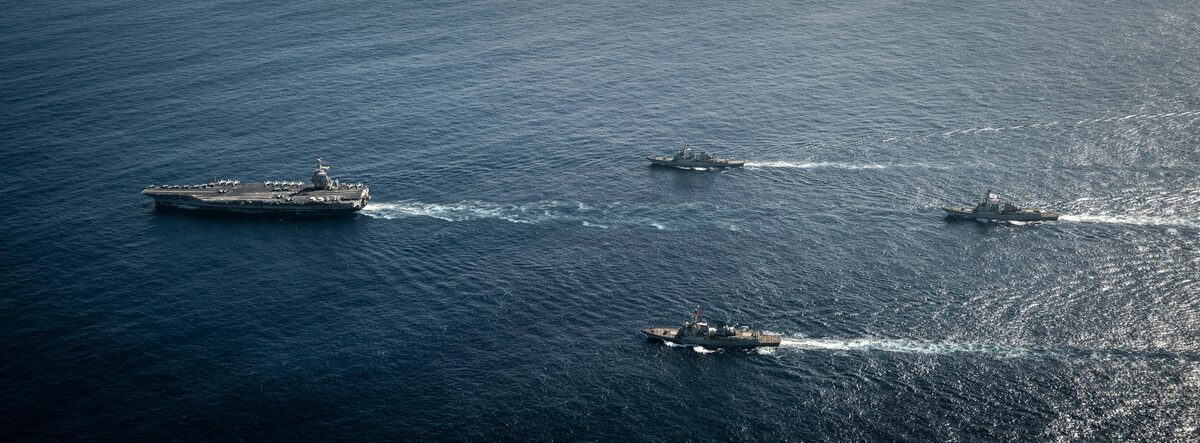
The Navy just started paying to build a carrier named for a president whose administration many sailors who will crew it weren't yet alive to remember — and the bill for the first parts alone runs $336 million. Huntington Ingalls Industries has been awarded a $336,112,000 cost-only undefinitized contract action to buy long-lead-time material for the future USS William J. Clinton (CVN 82), according to the Department of War's Sept. 4, 2026 contracts announcement. It is the earliest hard money committed to a ship that will not enter service for roughly another decade.
The contract, N00024-26-C-2182, was placed by Naval Sea Systems Command and covers work performed at Huntington Ingalls' Newport News, Virginia shipyard, with an expected completion date of March 2039 — well over a decade beyond this award, illustrating how far advance-procurement contracts on a Ford-class carrier can run past the initial funding action. FY2026 shipbuilding and conversion (Navy) funds were obligated at the time of award. The Pentagon's own language is precise about what the money buys: "Huntington Ingalls Industries Inc., Newport News, Virginia, is awarded a $336,112,000 cost only undefinitized contract action for advance procurement of long lead time materials to support construction of the future USS William J. Clinton (CVN 82)," the Department of War's contracts office stated in the Sept. 4 release.
Why the Navy Is Buying Materials Years Before Construction
An undefinitized contract action lets the Navy start spending on components — reactor parts, specialty steel, propulsion hardware, and other items with years-long manufacturing lead times — before the full scope and final price of the follow-on construction contract are negotiated. For a Ford-class carrier, that lead time matters enormously: forgings, nuclear components, and shipboard systems have to be ordered long before keel-laying so the yard isn't waiting on a supplier when steel-cutting begins. The award was sole-source under 10 U.S. Code 3204(a)(1), which permits a contract without full and open competition when there is "only one responsible source" — in this case Newport News Shipbuilding, the only U.S. yard that builds nuclear-powered aircraft carriers.
CVN 82 is a Gerald R. Ford-class carrier, the same production line that has already delivered USS Gerald R. Ford and that will produce the future USS George W. Bush (CVN 83), named the same day as CVN 82. Advance procurement contracts like this one typically arrive years ahead of the main detail-design-and-construction award, spreading the total cost of a Ford-class hull across a longer funding horizon and giving Congress and the Navy budget flexibility as the program moves forward. Splitting the cost this way also lets Congress track and appropriate carrier funding incrementally across multiple fiscal years rather than absorbing the full construction price in a single budget cycle — a routine approach for financing capital-intensive, multi-year shipbuilding programs.
A Name Chosen Before Either President Left the Political Stage
CVN 82's name is unusual among Navy ships: it was announced while President Clinton was still a living, active public figure, not decades after his presidency ended. Then-Secretary of the Navy Carlos Del Toro named the future carriers CVN 82 and CVN 83 for Bill Clinton and George W. Bush on Jan. 3, 2025, during a private ceremony at the White House. The announcement marked new territory: "This will be the first Navy vessel named for either president," the Navy's press release stated at the time.
Del Toro framed the choice around the two men's records in the White House rather than politics. "President Clinton and President Bush led the United States through some of the most challenging moments in U.S. history," he said in the Jan. 3, 2025 Navy.mil release. "Their legacies will endure through these aircraft carriers, which serve as formidable platforms dedicated to safeguarding our national security and strengthening our resolve to protect this Nation against any who would threaten our freedoms and way of life." The Navy's own release frames the names as consistent with its longstanding practice of naming aircraft carriers after presidents; what made this announcement unusual was different — both men were still alive when the names were announced, breaking with the Navy's traditional preference for naming warships after people who are deceased.
Chelsea Clinton will serve as the future carrier's sponsor, and President Clinton himself responded to the honor in a statement included in the Navy's release: "It's never far from my mind that the precious freedoms Americans enjoy are safeguarded by our armed forces, anchored by a strong, modern, and agile Navy. I'm honored that future servicemembers carrying on that proud tradition will serve on a carrier bearing my name."
What the $336 Million Buys Before Steel Is Cut
Long-lead-time procurement for a Ford-class carrier covers components that cannot be bought off the shelf: reactor plant components, main propulsion shafting, arresting-gear and catapult hardware, and specialty castings and forgings that only a handful of suppliers in the country can produce. Locking in orders for these items years in advance protects the eventual construction schedule from the kind of supply-chain bottlenecks that have slowed large shipbuilding programs across the fleet.
By obligating FY2026 shipbuilding funds now, the Navy keeps CVN 82's broader construction program moving on schedule — though as with prior Ford-class ships, the ship's eventual keel-laying, launch and commissioning dates carry construction risk that will only be tested once the detail-design-and-construction contract is finalized and the full build gets underway at Newport News.
What It Means for Contractors
The award reinforces that Newport News Shipbuilding remains the sole domestic source for nuclear-powered carrier construction, and it signals that the Navy intends to keep CVN 82 moving on a predictable funding cadence rather than let the program stall for lack of early money. For the supplier base underneath Huntington Ingalls — the forgers, reactor-component makers, and specialty-metal fabricators who receive subcontracts once advance-procurement funds start flowing — this is the signal to begin locking in their own production slots. Companies positioned in the Ford-class supply chain, particularly those supplying long-lead reactor and propulsion components, should expect solicitations tied to this funding line in the coming months, and should watch for the follow-on detail-design-and-construction contract that will eventually definitize the full scope and price of CVN 82's build.
