
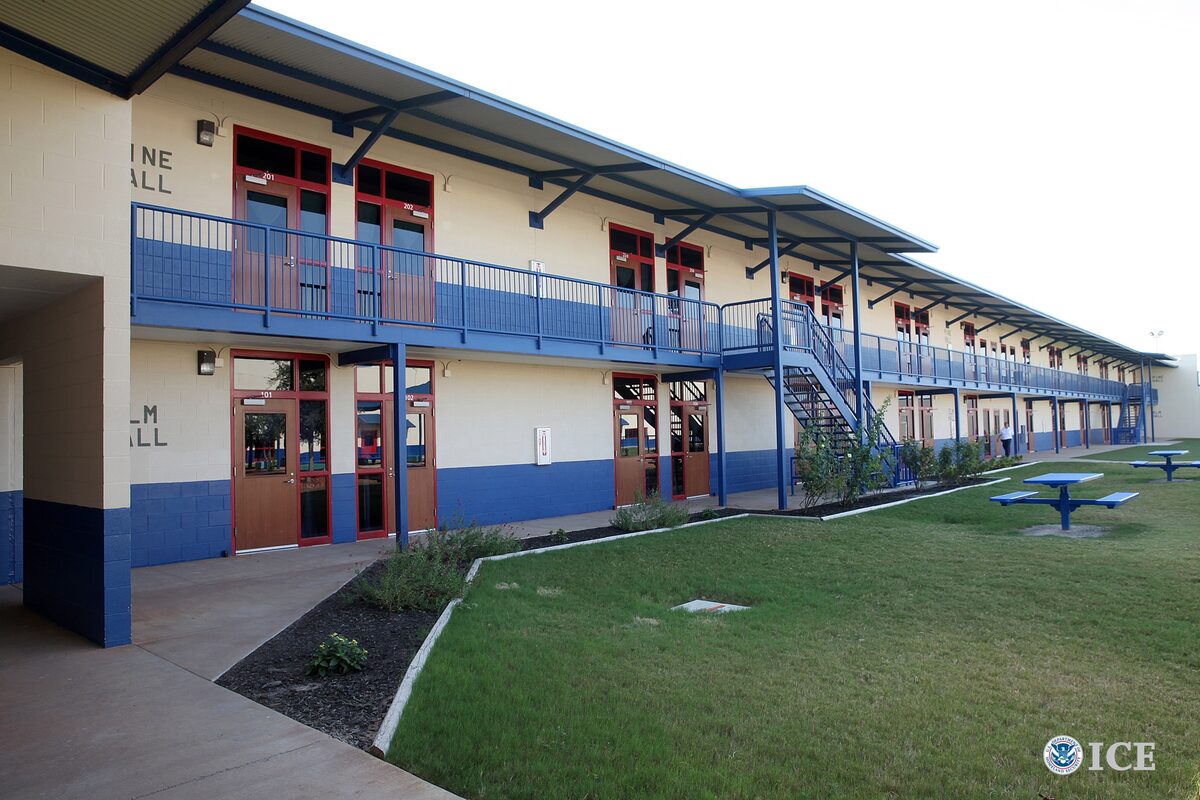
Immigration and Customs Enforcement is keeping the same company in charge of its largest immigration detention center for another year, without giving any other firm a chance to bid for the work. A federal contract notice disclosed in late July showed that ICE extended Amentum Services' contract to run Camp East Montana, the 5,000-bed detention site at Fort Bliss in El Paso, Texas, on a sole-source basis. The 12-month extension is worth more than $776 million and could keep Amentum running the facility through September 2027.
The extension follows a chaotic first year for the facility. ICE originally awarded the prime contract, worth $1.26 billion, to Acquisition Logistics, a small veteran-owned business registered to a single-family home in Virginia. ICE later terminated that contract, and Amentum — which had been working as a subcontractor — took over as prime contractor managing the facility in April 2026. No competition preceded that switch either.
What GAO Found: $19 Million in Unused Services and No Penalty Mechanism
The contract's early performance is documented in GAO-26-108886, a federal audit of spending at Camp East Montana. The report found that the web of contractors operating the facility spent up to roughly $19 million on unused services over a seven-month period, including paying for meals before the first detainees had even arrived at the site. The audit also identified a structural problem with the original contract: it was written without a Quality Assurance Surveillance Plan, the mechanism federal contracts typically use to track contractor performance and impose financial penalties for violations. Without one, the government had no built-in way to claw back money for services it paid for but never received. GAO's review covered only that original contract; it does not say whether the extension awarded to Amentum fixed the gap.
Nayna Gupta, an immigration attorney and policy director at the American Immigration Council, said the absence of that oversight structure is not an accident of one troubled contract but a pattern across ICE's detention system. "If private contractors want to whittle down on medical services in a facility, want to shortchange sanitation in a facility in order to pocket more of the money that came to them in the contract, there are very few folks at the federal level in Congress really watching how they move because there were never any meaningful requirements for those contracts in the first place," Gupta said.
Why Amentum Took Over Without a Competition
ICE has not cited an emergency justification for skipping competition on the Camp East Montana extension the way agencies sometimes do for urgent, time-limited needs. Instead, ICE has pointed to the facility's proprietary infrastructure and detainee population as grounds for a sole-source award, and a Department of Homeland Security spokesperson framed the decision as a matter of continuity, telling the Texas Observer that Amentum's track record on-site made it the obvious choice to keep running the facility. "Amentum has been a close partner with ICE in managing Camp East Montana, and was best suited to take over as the prime government contractor for this facility," the DHS spokesperson said, adding that the new contract adds on-site staff and what the agency described as a precise quality assurance surveillance plan — a claim GAO's audit does not independently verify.
That explanation sits uneasily next to GAO's findings on the facility's early spending problems and against Amentum's separate legal exposure. The company is currently defending a False Claims Act whistleblower suit, Josephs v. Amentum Services Inc., filed in 2023, which alleges Amentum used a practice known as "contract stacking" to inflate costs it billed to a federal program supporting Afghan refugees in 2021. A federal judge ruled earlier in 2026 that Amentum remains a defendant in the case rather than dismissing it, meaning the allegations will continue playing out in court at the same time Amentum runs one of the government's largest detention contracts. Charles Tiefer, a former member of the federal Commission on Wartime Contracting in Iraq and Afghanistan, described the underlying tactic bluntly: "Contract stacking is one of the unfortunate ways that government contractors pump up what the government pays."
A History of Fraud Allegations Follows the Contract
Amentum's exposure to fraud litigation predates the Camp East Montana deal. DynCorp, which Amentum had already acquired, paid $21 million in 2025 to settle a separate False Claims Act suit alleging it inflated the costs of training Iraqi police officers before the acquisition closed. DynCorp was already an Amentum subsidiary by the time that settlement was paid, meaning the liability attaches to the same corporate entity ICE has now handed a three-quarter-billion-dollar, no-bid extension.
Together, the GAO findings, the pending Afghan refugee program suit, and the DynCorp settlement form a track record spanning three separate federal programs where entities now under the Amentum umbrella have faced allegations of overbilling the government. None of that history appears to have factored into ICE's decision to extend the Camp East Montana contract without competition. The extension was disclosed through a federal contract notice in late July, well after the fact for anyone trying to track it in real time, and it drew no public solicitation, no competing proposals, and no published justification-and-approval document explaining why competition was impractical.
What It Means for Contractors
For companies competing in the detention and facilities-management space, the Camp East Montana sequence sends a mixed signal. On one hand, a company with an open FCA suit, a prior settlement tied to an acquired subsidiary, and a GAO finding of nearly $19 million in unused-service spending racked up while Amentum was already the facility's subcontractor can still land a nine-figure sole-source extension — evidence that active litigation and audit findings are not, by themselves, disqualifying in ICE's source-selection calculus. On the other hand, the underlying cause of the original contract's problems — a missing Quality Assurance Surveillance Plan — is now a matter of public record in a GAO report, which raises the bar for what oversight mechanisms competitors and incumbents alike will be expected to build into future ICE detention contracts. Firms bidding on similar facility-management work should expect closer scrutiny of QASP terms, financial penalty clauses, and subcontractor oversight going forward, particularly as detention capacity continues to expand under current enforcement priorities. Contractors already holding ICE facility contracts should also expect that GAO scrutiny of detention spending, once focused narrowly on Camp East Montana, is unlikely to stay contained to a single site.
