
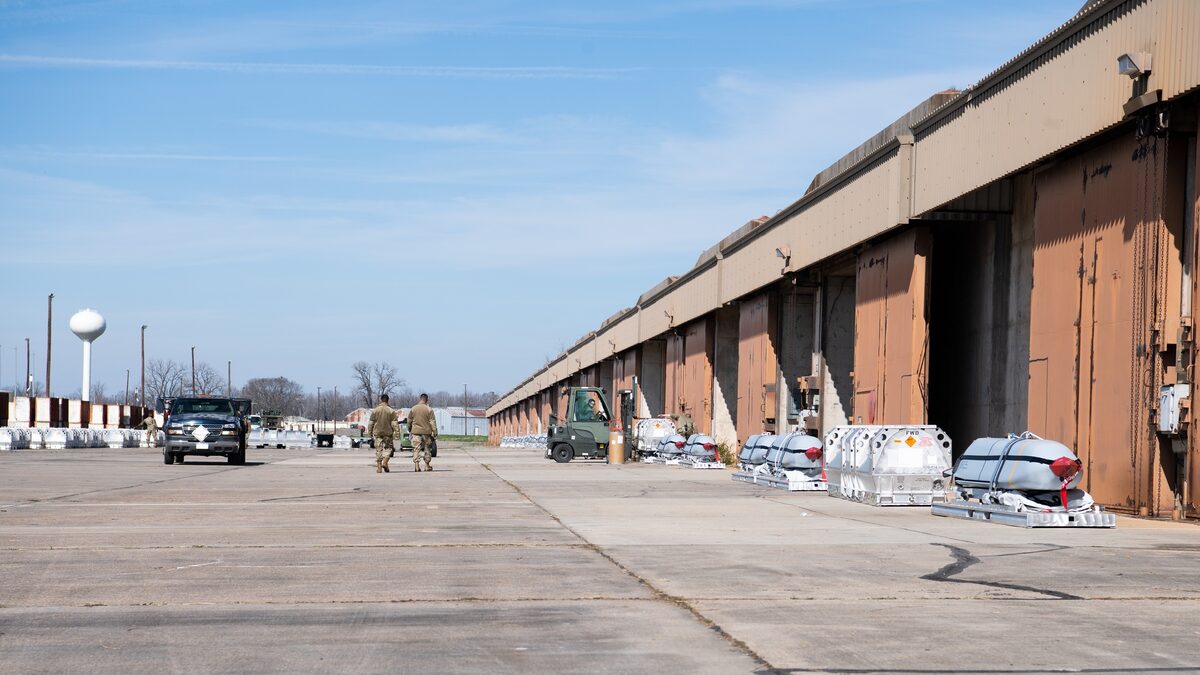
One of the Pentagon's largest standing orders for long-range strike missiles just cleared a threshold it has never crossed before, and the ripple effects will hit every subcontractor feeding Lockheed Martin's JASSM/LRASM missile line. On Sept. 9, 2026, the Air Force added $825.98 million to Lockheed Martin's bulk Joint Air-to-Surface Standoff Missile and Long Range Anti-Ship Missile production contract, pushing the deal's cumulative value past $10 billion for the first time.
The modification covers what the Department of War calls "Large Lot" procurement of JASSM and LRASM rounds, part of the Air Force's ongoing bulk production contract with Lockheed Martin. According to Army Recognition's review of the Pentagon's contract announcement, the modification raised the contract's cumulative value from $9.65 billion to $10.48 billion — the moment one weapons program crossed a threshold that only a handful of Pentagon deals ever reach.
What the $826 Million Modification Actually Buys
JASSM is the Air Force's primary air-launched cruise missile, built to hit fixed and relocatable targets from outside the range of most enemy air defenses. LRASM is its ship-killing cousin, derived from the same airframe and built to find and destroy surface combatants in contested waters. Both missiles are built on the same production line and draw from the same supplier base for propulsion, electronics, and final-assembly capacity — a detail that matters more as the Pentagon pushes for bigger lots.
The funding behind the $825.98 million increase is not a single pot of money. It blends Air Force missile procurement dollars from fiscal years 2024 through 2026, Navy weapons procurement funds, fiscal 2026 research, development, test and evaluation money, operations and maintenance funds, and $11.07 million in Foreign Military Sales funding from allied buyers. Poland, the Netherlands, Japan and Finland have all bought into earlier phases of the same Large Lot contract, according to Army Recognition. The work is expected to continue through July 2030, and the Air Force Life Cycle Management Center at Eglin Air Force Base, Florida, is the contracting activity managing the deal.
Why the Buy Is Growing So Fast
The size of the JASSM/LRASM contract has been climbing for years, but the jump from $9.65 billion to $10.48 billion in a single modification reflects a broader shift in how the Pentagon is planning for a potential fight in the Pacific. Army Recognition reported that the expansion comes as the United States seeks to increase the depth of its long-range munition inventories for high-intensity operations, particularly in the Indo-Pacific, with planned quantities across the program's follow-on lots growing from 16,710 to 23,095 weapons. That is a jump of 6,385 missiles added to the production schedule — enough that even a single production line cannot easily absorb the increase without trade-offs. Because JASSM and LRASM share tooling, test equipment and skilled labor, adding units of one missile inevitably competes for capacity with the other. Army Recognition's analysis captured the stakes plainly: "Production capacity is therefore becoming part of the deterrence equation."
The Factory-Capacity Squeeze Behind the Headline Number
For years, the limiting factor in long-range missile inventories was money — Congress simply wasn't buying enough JASSMs and LRASMs to matter in an extended conflict. That constraint has eased considerably as budgets for both missile lines have grown year over year. What hasn't grown as fast is the physical capacity to build them. Lockheed builds JASSM and LRASM on shared production lines, meaning every additional LRASM round ordered for the Navy's anti-ship mission effectively narrows the near-term output available for the Air Force's JASSM strike mission, and vice versa.
That dynamic explains why the contract's growth trajectory matters as much as its current dollar value. The Pentagon isn't just buying more missiles — it is placing a bet years in advance that Lockheed can scale its production fast enough to deliver 23,095 weapons across the contract's lot structure without one program cannibalizing the other's delivery schedule. The completion date on the new modification, July 2030, gives some sense of how far out that bet extends. Four years is a long runway for a single contract modification, and it signals that both the Air Force and Navy expect sustained, not episodic, demand for both missiles through the end of the decade.
A Pattern of Escalating Modifications
The contract's history shows a pattern of steadily larger modifications rather than one enormous initial award. The contract had already reached $9.65 billion before the September modification, meaning this single change added roughly 8.6 percent to the deal's total value in one action. That kind of incremental growth is typical for large-lot missile procurement, where the government locks in a base contract vehicle and then adds successive lots as budgets are appropriated and production ramps. It also means the $10.48 billion figure is unlikely to be the ceiling — if Indo-Pacific demand continues driving lot quantities upward, further modifications to the same contract are the most probable path for future JASSM and LRASM buys, rather than a new competitively bid vehicle.
What It Means for Contractors
The immediate winner is Lockheed Martin, which now holds a single contract vehicle worth more than $10.48 billion with roughly four more years of guaranteed production work under the current schedule. But the bigger opportunity sits one tier down. As lot quantities climb toward 23,095 weapons, Lockheed will need more capacity from its propulsion, electronics, and final-assembly suppliers to keep both missile lines fed without one starving the other. Companies that already hold subcontracts on JASSM or LRASM should expect purchase-order growth tied to the expanded lot sizes; firms outside the supply chain with relevant propulsion, electronics, or final-assembly capabilities have a rare opening to pitch capacity expansion directly to Lockheed as the prime works to avoid becoming the bottleneck in its own production system. The mixed funding profile — spanning three fiscal years of Air Force money, Navy weapons procurement, and FMS dollars — also signals that international partners buying JASSM or LRASM variants are now directly subsidizing capacity that benefits the U.S. services' own delivery schedules, a dynamic worth watching as more allied nations sign on to either missile.
